At the United Nations General Assembly on 22 October 2026, Germany’s ambassador Ricklef Beutin, speaking for Brazil, Germany, India and Japan, called for a consolidated Security Council reform model and negotiations on a draft text during the current session. His statement welcomed the African Group’s submission of its own model. The immediate political question is how African demands will shape the negotiating document: membership categories, voting powers and the allocation of seats will determine whose consent carries weight when the Council takes decisions. The G4 statement announced a negotiating position, with no new seats created by the speech. [1]
For the African Union, permanent representation remains a matter of institutional justice. On 11 May, Commission chairperson Mahmoud Ali Youssouf reaffirmed the demand for at least two permanent seats with the full privileges of that category, including the veto while it exists, and five non-permanent seats in an expanded Council. Five refers to the African total sought in the elected category. That formulation connects the present negotiations to a collective position maintained over two decades. Its political force comes from a demand to redistribute decision-making authority within an institution whose actions reach beyond its members. [2]
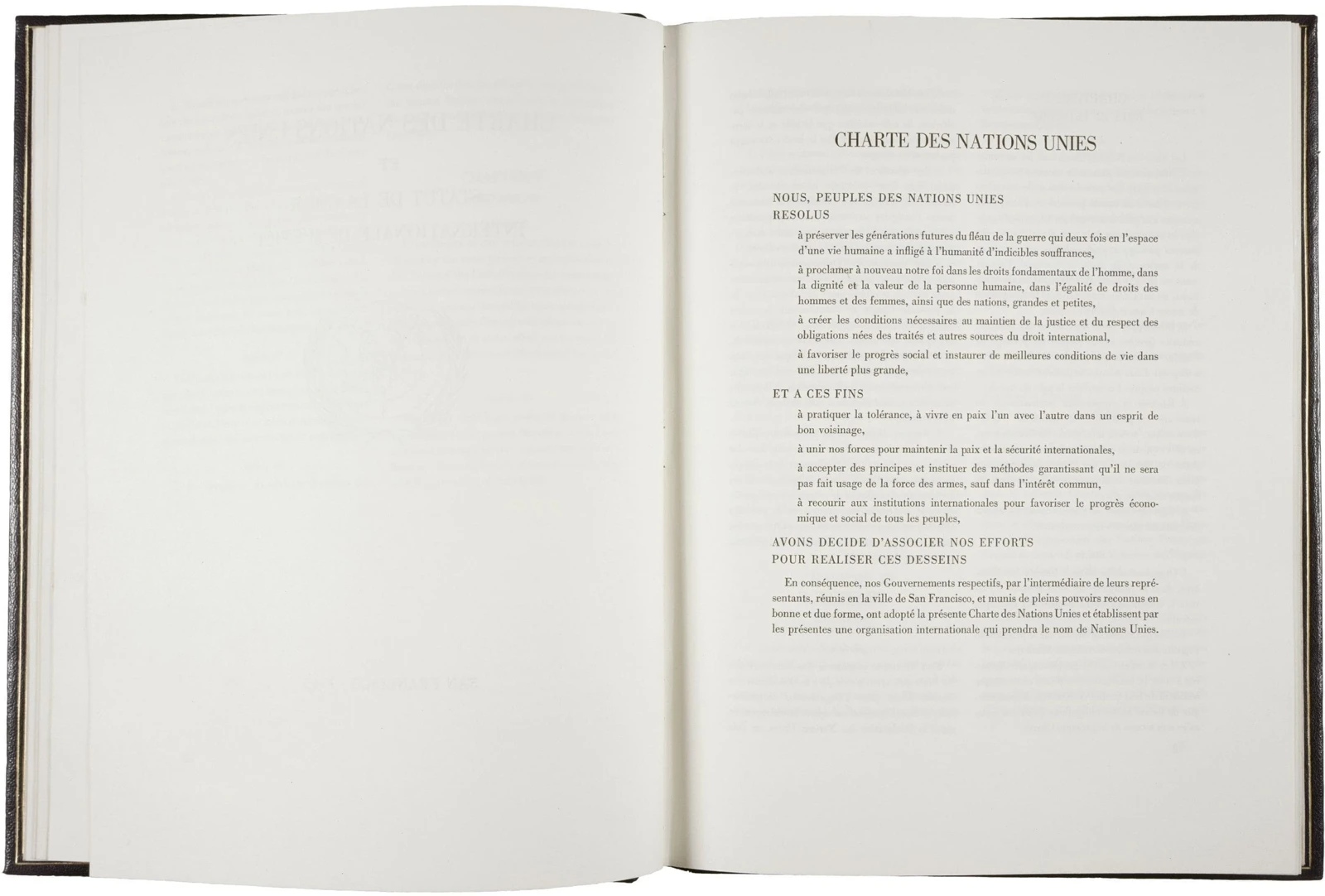
The stakes are embedded in the Charter. Article 24 gives the Council primary responsibility for international peace and security; Article 25 commits UN members to carry out its decisions. Article 23 establishes fifteen members, including ten elected for two-year terms. Article 27 gives permanent members a special position in substantive voting. These rules distribute institutional power over decisions that other states must implement. African representation therefore concerns participation in the production of international obligations, with consequences for the relationship between national sovereignty and collective security. [3]
There is a precedent for changing that distribution. General Assembly resolution 1991, adopted on 17 December 1963, explicitly linked the growth of UN membership to the need for more adequate geographical representation. It proposed increasing Council membership from eleven to fifteen and elected membership from six to ten. Its allocation gave African and Asian states five elected places jointly. The resolution’s language treated the existing composition as inequitable and unbalanced. Newly enlarged membership had become a reason to alter the institution’s structure through an amendment addressed to all member states for ratification. [4]
The same resolution changed the required affirmative vote from seven to nine as membership expanded. It left the permanent category intact. The resulting settlement increased access to elected office while preserving a separate source of privileged authority. This history helps explain the precision of the present African demand: an increase in elected seats and entry into permanent membership address different parts of the institutional arrangement. The 1963 text records a specific redistribution, with geographical representation written into the elected category and the architecture of permanent membership retained. [4]
The AU’s March 2005 Ezulwini Consensus placed that unfinished question within a longer history of exclusion. It stated that most of Africa had lacked representation when the UN was founded in 1945 and that Africa’s bargaining position had remained weak during the earlier reform. Those are the AU document’s historical assessments. Its response was to specify both permanent and elected representation, assigning the AU responsibility for selecting African representatives and determining criteria that considered representative character and capacity. The proposal thus connected external recognition to an internal African process for deciding who could occupy the seats. [5]
Ezulwini also contained a carefully stated position on the veto. It opposed the power in principle, while demanding equal privileges for all permanent members for as long as that power survived. The distinction explains why a proposal offering permanent status with different voting rights would raise a substantive issue for the African common position. The document pursued equality within the institution’s existing categories while expressing an objection to one of their defining privileges. Any settlement would have to address both commitments openly. [5]
At Sirte in July 2005, the AU Assembly reaffirmed the seat demands and stated that the African representatives selected by the Union would act in its name and on its behalf. That language makes representation a political relationship between the seat holder and a wider constituency. A government occupying a place would have national responsibilities alongside the collective mandate envisaged in the declaration. The practical significance lies in how that mandate is communicated, debated and maintained when African governments face different diplomatic choices. [6]
Sirte’s reform agenda also reached into the General Assembly, the Secretariat, economic governance and human rights institutions. In that setting, the Security Council demand formed part of a larger effort to influence how international authority is distributed. Reading the declaration in full gives permanent membership a wider context: the Union was seeking a stronger position across institutions that shape security, development and representation. The contemporary debate inherits that breadth even when negotiations concentrate on the number and classification of Council seats. [6]
The extraordinary AU Assembly decision of 31 October 2005 turned the common position into a continuing diplomatic instruction. It reaffirmed Ezulwini and Sirte, called for African unity and extended the follow-up work required to build support for the position at the UN. This institutional sequence matters. A declaration set out the objective; a subsequent decision sustained the process for pursuing it. The survival of the position into 2026 reflects a repeated collective commitment carried through AU bodies, with coalition-building among other UN members remaining part of the task. [7]
The AU’s Constitutive Act supplies a further standard for assessing the meaning of that collective commitment. Article 3 includes defending common African positions, promoting democratic institutions and popular participation, and protecting human and peoples’ rights. Article 4 recognises sovereign equality alongside participation by African peoples, gender equality and respect for human rights. These provisions place the pursuit of a stronger continental voice within a framework that also concerns the exercise of authority towards people. An African mandate derives its public significance from the interests and rights it is expected to advance. [8]
A seat’s regional identity cannot by itself explain how that mandate will work. The ISS PSC Report’s June 2026 discussion of African foreign-policy coordination emphasises that the AU operates through states retaining their own foreign-policy authority. Shared institutions can coordinate positions while national interests continue to shape decisions. Applied to Security Council reform, this identifies a practical political issue: collective representation depends on sustained consultation among governments, with a means of maintaining coherence when the interests under discussion diverge. [10]
The same ISS discussion points to coordination between the AU Peace and Security Council and African members of the UN Council through the Oran Process. Its recommendations concern the organisation of African input into decisions, including consultation and ownership of work on African matters. This brings attention to the continuing work surrounding a seat: preparing positions, influencing drafts and carrying decisions back into regional deliberation. Such coordination is an institutional capacity that would remain relevant under an enlarged Council. The report’s proposals are contributions to that debate, with implementation requiring political agreement. [10]
African scholarship also opens a wider argument about the design of power. In an ISS African Futures study updated in August 2026, Jakkie Cilliers proposes ending permanent membership and the veto, creating a category of global powers defined through population, economic weight and UN budget contributions, and giving that category weighted votes. Other members would serve elected three-year terms, with decisions requiring a two-thirds voting majority. This is a published reform proposal. Its relevance is the explicit connection it draws between the criteria for membership and the authority attached to a vote. [9]
Cilliers’s model makes the choice of criteria visible. Population, economic size and financial contributions would each become part of the route to institutional influence. Allowing qualifying coalitions of states introduces a possible collective route into the proposed category. Weighted voting would still distribute influence unevenly, even after abolition of the veto. The study therefore presents a different settlement between representation, material capacity and decision-making. That design can be examined alongside the AU’s demand for equal privileges in permanent membership without treating either proposal as an enacted institutional reform. [9]
The G4’s September ministerial statement shows how the African demand intersects with another organised reform coalition. The four foreign ministers supported expansion in permanent and non-permanent categories and welcomed the African Group’s model. They also criticised the intergovernmental process and called for negotiations on a text. Their position creates common ground around African permanent representation, while the African Union retains its own requirements. Assessing a coalition requires attention to the specific provisions its members support: agreement on enlargement leaves further decisions about powers, selection and the final shape of membership. [11]
The September statement also envisaged developing a consolidated model with other reform-oriented groups and engaging the wider UN membership. That is a route through diplomatic negotiation in which African institutions have a formulated position to advance. The immediate significance of the October debate is that this work could enter a document whose wording makes commitments and disagreements explicit. A negotiating text would give governments specific provisions to accept, amend or reject. Political support would then be assessed against the institutional rules proposed, with the African common position remaining a distinct point of reference. [11]
On 22 October the G4 said that 119 member states had expressed support for expansion in both categories; that figure is the coalition’s own count. Beutin also rejected a proposal for fixed regional seats as a bridge to agreement. These statements show that the design of representation remains contested. An agreed negotiating document or an amended rule would establish how far African demands had advanced. Support expressed in a debate remains one stage in that process. [1]
The legal route retains a powerful condition. Under Article 108, a Charter amendment requires adoption by two-thirds of General Assembly members and ratification by two-thirds of UN members, including every permanent Council member. The existing permanent powers therefore retain a decisive role in bringing a new settlement into force. The earlier Council enlargement entered into force on 31 August 1965, after the December 1963 decision. The distinction between negotiation, adoption and ratification is central to assessing any future announcement of progress. [3]
The AU’s Constitutive Act connects common African positions to participation and rights. Those commitments give representation a public test: how representatives exercise their powers, maintain a wider mandate and account for decisions. A stronger continental voice carries responsibilities towards the people whose interests provide its political justification. The current reform debate places the allocation of international authority within reach of that question of accountability. [8]
- [1]Permanent Mission of Germany to the United Nations. G4 statement at the General Assembly debate on Security Council reform, 22 October 202622 October 2026
- [2]African Union Commission. AUC Chairperson reaffirmed Africa’s united & principled position on UN Security Council reform11 May 2026
- [3]United Nations. Charter of the United Nations: current text and amendments26 June 1945; amendments noted in text; consulted 23 October 2026
- [4]United Nations General Assembly; text hosted by UNHCR Refworld. Question of equitable representation on the Security Council and the Economic and Social Council, resolution 1991 (XVIII)17 December 1963
- [5]African Union; original document reproduced by InTheNet. The Common African Position on the Proposed Reform of the United Nations: The Ezulwini Consensus, Ext/EX.CL/2 (VII)7–8 March 2005
- [6]African Union Assembly. Sirte Declaration on the Reform of the United Nations, Assembly/AU/Decl.2 (V)4–5 July 2005
- [7]African Union Assembly; original decision hosted by SARPN. Decision on the Reform of the United Nations, Ext/Assembly/AU/Dec.1 (V)31 October 2005
- [8]African Union. Constitutive Act of the African Union11 July 2000
- [9]Institute for Security Studies, African Futures; Jakkie Cilliers. UN Security Council ReformUpdated 13 August 2026
- [10]Institute for Security Studies, PSC Report. Can a foreign policy framework enhance a common position in Africa?26 June 2026
- [11]German Federal Foreign Office; G4 foreign ministers. G4 Joint Ministerial Statement on the Reform of the UN Security Council22 September 2026
Did this publication help you understand the topic?
0 voluntary responses. Browser-based participation; responses are not a representative survey.
We welcome suggestions, contributions and recommendations.
Editorial standards ↗