Barbados’s Prime Minister Mia Mottley and her British counterpart Andy Burnham discussed the next steps towards a structured dialogue with communities affected by the transatlantic slave trade when they met in Antigua on 2 November 2026. The British government’s readout, published on 3 November, also records discussion of climate change and reform of international debt arrangements. For Caribbean societies, the connection between these subjects is political: whether a conversation about historical responsibility can alter the terms on which governments obtain resources and communities exercise power over their futures. The readout announces further discussion, rather than an agreed reparations settlement. [1]
CARICOM has already set out the disagreement that such talks must confront. On 31 October, CARICOM chair Philip J. Pierre welcomed Britain’s openness to an apology while insisting that reparations remain within the discussion. He distinguished responsibility carried by states and institutions from personal guilt assigned to people living today. This distinction changes the object of negotiation. The issue becomes the obligations of enduring public institutions, rather than whether an individual citizen personally committed an historical crime. It also challenges a dialogue whose permissible remedies are settled before Caribbean representatives enter it. [2]
The British political boundary remains consequential. ITV reported on 2 November that Burnham had expressed willingness to listen to calls for an apology while ruling out reparations. Asked in Antigua whether his approach complicated matters for King Charles, he described it as an attempt to listen and bring Commonwealth members together. An invitation to speak therefore coexists with a stated limit on the outcome. The distinction matters for Caribbean participants: recognition can be politically significant without resolving the dispute over resources. Neither an expression of regret nor willingness to discuss an apology establishes that compensation has been accepted. [3]
The setting brings that dispute into a wider contest over development. The Commonwealth Secretariat identifies the 1–4 November meeting in St John’s, Antigua and Barbuda, with partnerships, investment, climate resilience, trade and equality. Those priorities concern decisions about how prosperity is generated and distributed. Placing historical repair within them asks whether development cooperation is a discretionary offer from wealthier partners or involves responsibilities arising from the past. That is an interpretive question running through the competing positions, rather than an agreed Commonwealth conclusion. A shared summit platform does not erase the different interests that governments bring to it. [4]
The history of British emancipation supplies a concrete reason why the language of compensation is so charged. UCL’s Legacies of British Slave-ownership project explains that Parliament allocated £20 million to former slave owners as part of the abolition settlement. Researchers used the Slave Compensation Commission records as the foundation of a database identifying ownership and tracing economic and social connections. The archive makes a distributional decision visible: public money protected the claims of owners over people previously treated as property. It offers a documented institutional history against which to read today’s debate about which losses deserve recognition and whose claims public finance serves. [5]
These records also complicate the idea that slavery’s beneficiaries belonged to a distant world disconnected from Britain. UCL’s account describes Catherine Hall’s project tracing the life trajectories of approximately 3,000 slave owners in Britain. This does not establish a present liability for every person or institution with a historical connection. It does establish that ownership and its proceeds can be investigated through identifiable relationships, rather than left as an abstract national memory. That distinction allows a discussion of responsibility to become more precise while keeping different claims, beneficiaries and forms of redress open to examination. [14]
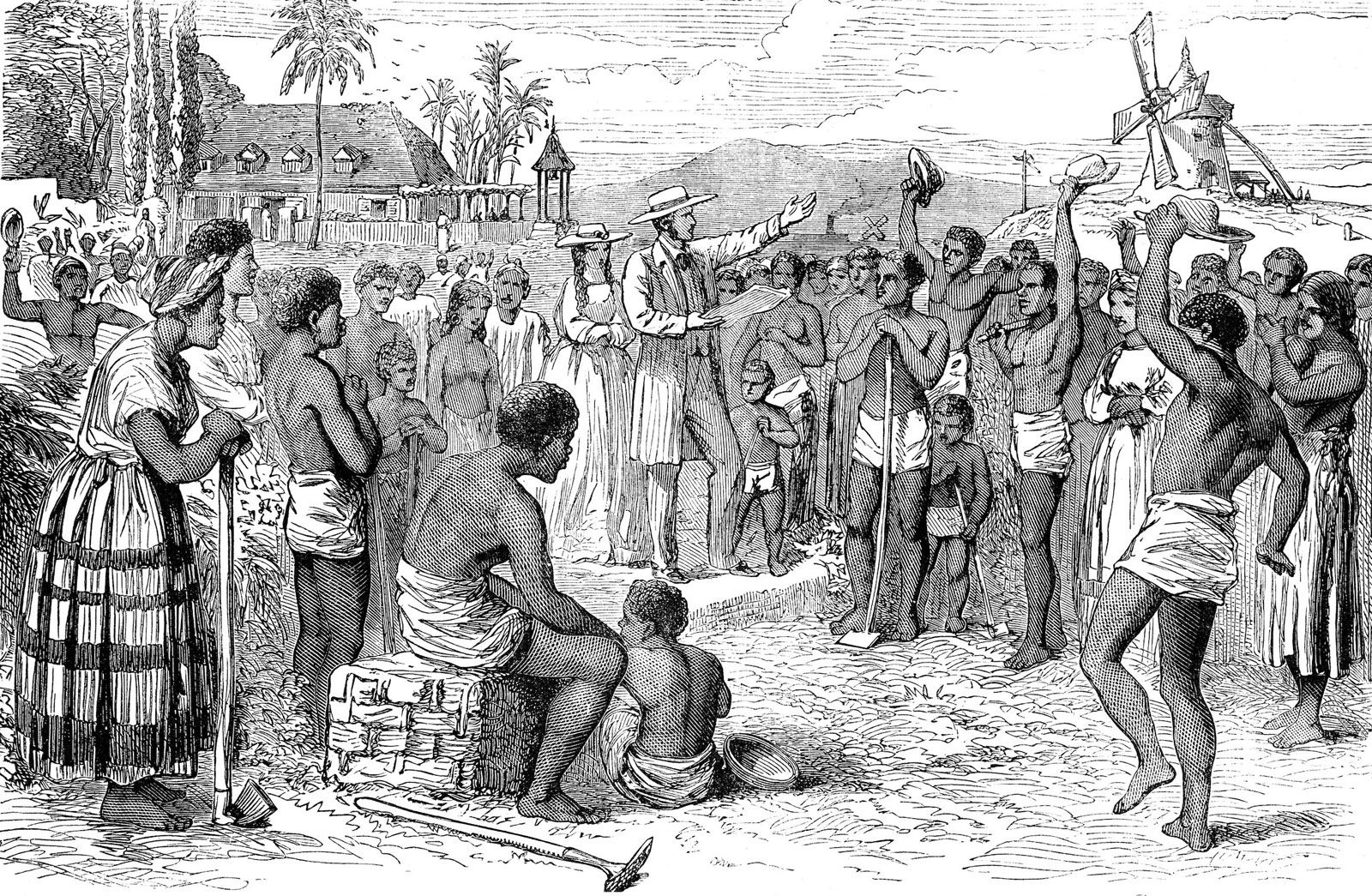
The historical illustration accompanying this essay shows another way emancipation acquired a public meaning. Catalogued as a scene of a West Indian plantation receiving news of abolition, it comes from a Cassell’s History of England edition dated approximately 1873–1875. Its artist and exact creation date are unknown. A central figure holds a document before a gathering of Black figures, several raising their arms. Read as a later representation, the composition concentrates attention on the announcement of freedom. It cannot supply an eyewitness account of 1833 or tell us how particular people understood emancipation. It documents how freedom was subsequently pictured. [6]
Set beside compensation records, the illustration exposes a difference between announcing freedom and distributing the means to exercise it. The document and its reception dominate the image, while the compensation archive records state expenditure. Neither captures emancipation’s whole experience. Reading them together shifts attention from a celebratory moment to the institutions that shaped what followed. The result is a more demanding understanding of historical recognition: a public account of freedom should also explain whose economic interests the settlement protected. That question gives the archive a direct bearing on the argument now taking place in Antigua. [6][14]
Caribbean historian Hilary Beckles has developed a different narrative of change, centred on Black political action. In his 2019 published essay for the ACLU, he presented the reparations movement as connected to earlier struggles against enslavement, exclusion after emancipation and racial discrimination. This is his historical and political interpretation, not a timetable proving that justice will inevitably arrive. Its contribution is to place descendants among the makers of change. Contemporary demands then appear as another exercise of political agency, rather than a request to be remembered by institutions that retain exclusive control over recognition and remedy. [7]
The chronology also matters for understanding CARICOM’s authority to negotiate. Its 10 July 2026 account records approval of a revised Ten-Point Plan by heads of government at their 5–8 July meeting. The proposals reaching the Commonwealth gathering therefore have an identifiable regional decision behind them. They are more than an improvised response to a British announcement. Approval establishes CARICOM’s political endorsement of an agenda; it does not bind the governments from whom redress is sought. The difference between adopting demands and securing a settlement is central to assessing what the present diplomatic opening has actually changed. [8]
The manifesto itself presents reparatory justice as a programme connecting recognition with development and self-determination. Its ten points encompass an apology, Indigenous development, cultural restitution, education, health, gendered harm, technological capacity and financial redress. The prologue calls it an evolving framework rather than a fixed negotiating settlement. Its final substantive chapter places debt cancellation alongside monetary compensation and decolonisation; its technology discussion seeks greater control over knowledge and productive capacity. These are demands made by CARICOM, whose detail would have to be negotiated. They show why an apology alone cannot encompass the region’s stated programme. [9]
This programme now also has a transcontinental institutional route. The African Union’s 17 June account records a joint meeting of its reparations experts, legal experts and the CARICOM Reparations Commission. Participants agreed to establish coordination through regular bureau meetings and an annual plenary, with secretariat work on communication and joint activities. Such arrangements can help African and Caribbean actors develop positions together rather than negotiate separately with more powerful counterparts. Their existence is evidence of organisation, not proof that every proposed activity has occurred. Nor does a common mechanism make the histories or priorities of its different participating societies interchangeable. [10]
Political agency also extends beyond the officials who negotiate. The University of the West Indies announced a Global Reparations Caravan programme at its Five Islands Campus for 2–3 November, combining public learning, cultural expression and civic engagement. Its announcement envisaged participation by students, academics, activists, policymakers and the wider public. That is an intended route for discussion outside diplomatic meeting rooms; the announcement does not establish attendance or a completed outcome. Its significance is the role assigned to public knowledge in the movement. People affected by a proposed settlement need ways to examine and influence it, as well as hear that leaders have met. [11]
The Commonwealth People’s Forum offers another institutional space for that question. Its published 2–4 November programme centres people-focused governance, economic inclusion and freedom of expression. A scheduled health-financing discussion asks how governments can strengthen provision without shifting disproportionate costs onto households, and how communities can influence priorities. These are programme commitments, not findings from a completed consultation. Nevertheless, they make participation concrete: whose services receive support, who pays, and who has a voice in the decision. A reparatory programme can be judged against those questions without pretending that a forum grants citizens control over intergovernmental negotiations. [12]
The Secretariat’s account of the concurrent small-states ministerial meeting shows why financing cannot remain a secondary concern. Ministers called for wider access to sustainable finance and stronger economic and climate resilience. Secretary-General Shirley Botchwey identified affordable, predictable and adequate finance as a major obstacle for small states. This account records priorities and proposals, rather than money delivered to households. It also reveals an arena where Caribbean states seek influence over international rules. The political question is whether partnership gives them greater room to fund their own priorities, or leaves essential choices dependent on the terms set by outside financiers. [13]
Pierre’s statement makes a specific intervention in that arena: he argues that income classifications can exclude vulnerable Caribbean countries from concessional relief and that vulnerability must count. He also insists that debt relief cannot substitute for reparatory justice. These are related but distinct claims. One concerns how a financing system assesses present needs; the other concerns the basis on which redress is owed. Combining them without agreement would allow a development offer to answer a different question from the one Caribbean representatives are asking. Keeping the distinction visible is necessary to understand both the opportunity and the limits of the current talks. [2]
The 2 November meeting opens a consequential process; it does not settle its outcome. Historical compensation and CARICOM’s adopted demands make the test more exacting: whether recognition gives affected societies influence over both the agenda and material redress. An announcement of a new relationship leaves that distribution of power unresolved. [1][8]
- [1]Prime Minister’s Office, United Kingdom. PM meeting with Prime Minister Mottley of Barbados: 2 November 20263 November 2026; meeting 2 November 2026
- [2]CARICOM; Philip J. Pierre. Statement from the Chair of the Caribbean Community: Reparatory Justice31 October 2026
- [3]ITV News. PM denies claims offer of slavery apology talks made things difficult for King2 November 2026
- [4]Commonwealth Secretariat. Commonwealth Heads of Government Meeting 2026Undated; accessed 3 November 2026; summit 1–4 November 2026
- [5]UCL Centre for the Study of the Legacies of British Slavery. Legacies of British Slave-OwnershipUndated; accessed 3 November 2026; research projects 2009–2015
- [6]Cassell’s History of England, volume VII; Wikimedia Commons record. Illustration of a West Indian plantation receiving news of emancipationCirca 1873–1875 edition; exact creation date and artist unknown
- [7]Hilary Beckles; American Civil Liberties Union. A Global Mass Movement for the 21st Century7 June 2019
- [8]CARICOM. CARICOM Endorses Revised Ten-Point Reparations Manifesto10 July 2026; approval at 5–8 July meeting
- [9]Caribbean Community Secretariat. The CARICOM Ten Point Plan for Reparatory Justice: A Manifesto for the Coming Enlightenment2026; prologue, contents and printed pages 38–42 consulted
- [10]African Union Commission. African Union and CARICOM Reparations Mechanisms Hold First Joint Meeting Operationalizing a Joint Mechanism on Reparative Justice17 June 2026
- [11]The University of the West Indies; UWITv. UWI to Host Global Reparations Caravan During CHOGM 202630 October 2026; announced programme 2–3 November
- [12]Commonwealth Foundation. The People’s Forum 2026: programmeUndated; accessed 3 November 2026; programme 2–4 November
- [13]Commonwealth Secretariat. Commonwealth ministers call for stronger partnerships and scaled-up investments for resilient small statesUndated CHOGM 2026 report; accessed 3 November 2026
- [14]UCL Research and Innovation. Engaging with the legacies of British slave-ownershipUndated page; December 2014 URL; accessed 3 November 2026
Did this publication help you understand the topic?
0 voluntary responses. Browser-based participation; responses are not a representative survey.
We welcome suggestions, contributions and recommendations.
Editorial standards ↗