On 3 November 2026, Ghana’s culture minister, Abla Dzifa Gomashie, opened regional meetings in Accra that included the ECOWAS committee on the return of cultural property. The committee, chaired by Côte d’Ivoire’s Memel Epse Kassi Yooul Silvie, was working on how to implement a 2027–2031 action plan. ECOWAS’s account of the meeting describes work on procedures; it announces no transfer of any specific object. A case from Kumasi shows why those procedures matter. In 2024, objects associated with the Asante court came back to the same city under two different arrangements: British institutions lent regalia, while a museum in California returned seven pieces permanently. Both brought objects home, but they gave the receiving institution different powers over what could happen next. [1][2][3][4]
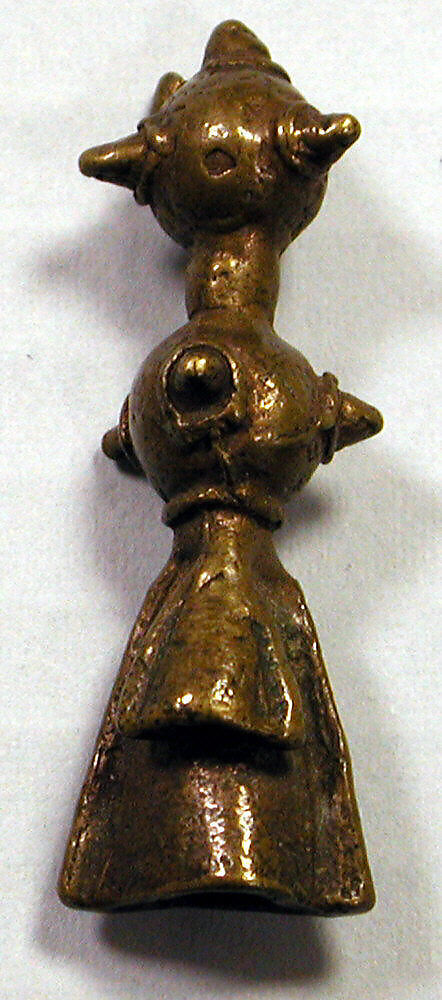
The brass weight pictured here helps explain the political world that made these objects significant. The Met dates it to the eighteenth or nineteenth century and attributes it to an Akan artist in Ghana. It is a tool for weighing gold dust, not a piece of the regalia returned to Kumasi. Akan merchants and rulers developed weights that made quantities comparable across transactions; some weights took the shapes of court objects, bringing the forms of political authority into ordinary exchange. The weight’s usefulness depended on people accepting a shared measure of value. The court regalia had other purposes. In the V&A’s account, cast gold badges identified offices connected with the Asantehene. Reading the weight alongside those badges shows why the category “gold objects” tells us too little about what was taken. Materials that look similar in a display case could do quite different work in trade, court life and public authority. [3][5][6]
The British attack on Kumasi in February 1874 made it possible to separate regalia from those uses. The V&A traces part of its collection from the military raid to an April sale in London. The South Kensington Museum, its predecessor, acquired thirteen pieces at that sale. The sale is part of the history of the objects, but it does not describe the circumstances in which they left the palace. A provenance record—the account of an object’s origin and movement through different hands—has to follow both stages. If it begins with the museum’s purchase, it makes a documented transaction visible while obscuring the military seizure that put the objects on the market. [3][7]
The London exhibition that followed also changed what audiences were invited to see. The museum selected work that could show British designers how Asante goldsmiths used casting and worked sheet gold. That attention preserved evidence of artistic skill, but it also made it possible to study an ornament detached from the ensemble to which it belonged. The V&A says that the original placement of many beaten gold ornaments is unrecorded. A display can therefore restore a history of removal without being able to reconstruct every earlier use. The gap is consequential for restitution: it makes the knowledge of court specialists, artisans and custodians relevant to identifying what a museum holds, rather than simply adding a local perspective after the object has already been classified. [3][8]
University of Ghana political scientist Charles Amo-Agyemang argues that restitution concerns ownership and the authority of dispossessed people to determine what their cultural material means and how it is used. His account connects the Asante claims to a longer history of demands for return; the 2024 agreement did not begin that history. His emphasis on control also clarifies a difference that the museums’ language of collaboration can leave in the background. Being able to exhibit an object in Kumasi can change who encounters it and whose interpretation the audience hears. Control over its long-term future depends on whether that ability rests on the terms of a loan or on a permanent return. The Asante case shows that both changes are possible and that they need not occur together. [3][7][8]
The loans themselves were the outcome of Asante initiative. In May 2023, Asantehene Otumfuo Osei Tutu II met the leadership of the British Museum and V&A in London. The institutions’ joint announcement identifies the Ghanaian historian Ivor Agyeman-Duah and the historian Malcolm McLeod as the Asantehene’s advisers in the subsequent negotiations. In January 2024 the partners announced separate loan agreements: seventeen objects from the V&A and fifteen from the British Museum for display at the Manhyia Palace Museum. An initial three-year term made the return possible within the arrangement then available. The V&A says its loan may be extended subject to approval; the announced term and a possibility of renewal are not proof that renewal has already occurred. [3][7]
There was a gain that a focus on title alone can miss. Manhyia could exhibit court regalia in Kumasi and place it within commemorations that the London announcement itself associated with the Asantehene’s jubilee, the Anglo-Asante war and the return from exile of Prempeh I. An object’s location changes who can see it without travelling abroad and which historical account accompanies it. Agyeman-Duah, speaking at Manhyia in February 2024, distinguished the British objects expected in April from the items already returned permanently by the Fowler Museum. His distinction allows both the practical value of securing a display and the limits of the arrangement to be described without treating one as evidence against the other. [3][4][7]
The V&A attributes its decision to lend rather than relinquish ownership to the narrow circumstances under which it can remove objects from its collection under the United Kingdom’s National Heritage Act 1983. That is the V&A’s account of its own powers; it is not a rule governing every British or overseas collection. The Fowler return is a useful comparison precisely because it happened through a different institution. It shows that a permanent return was possible for those seven objects, without establishing that the same legal route was open to either London museum. Conversely, the London museums’ ability to arrange access in Kumasi does not itself change the legislation or settle the larger claim to ownership. [3][4][7]
ECOWAS can help members negotiate across that variation. Its earlier restitution guide proposes a formal government-to-government request for colonial-era cultural property in foreign public collections. It asks the claimant to document removal, inventory the objects, set out the basis of the claim and explain how returned material will be cared for. It also proposes joint expert work and a national commission that collaborates with affected communities. Those proposals give ministries and collections a shared process through which to act. They do not supply a foreign museum with powers it lacks, and a procedure written for public collections should not be assumed to cover every object held by a university or private collector. [9]
There is a further division of authority on the requesting side. A government may be the actor that can send a diplomatic note; it need not be the institution that knows the history of the object or should determine its use. In the Kumasi case the palace initiated negotiations and the palace museum became the receiving institution. The regional guide’s inclusion of communities and heritage organisations matters because a formal request written at ministry level could otherwise omit the custodians whose knowledge gives it substance. It also matters after delivery. Decisions about public display, handling, ceremony and access to records can persist for decades after the return ceremony. A claim identifying a country of origin therefore answers a different question from an agreement specifying who will have those responsibilities within the country. [4][7][8][9]
For a resident visiting Manhyia, the distinction is concrete. The loan can bring a previously inaccessible piece into a museum where its political and ceremonial history can be taught. A permanent return gives the receiving side a different basis for planning beyond the term of an exhibition. These interests can coexist, but recording both under a single number of objects returned conceals the terms under which access was achieved. The same problem appears in provenance files: counting a nineteenth-century purchase without recording the seizure that preceded it gives a precise figure for the wrong part of the story. The most useful inventories connect the history of removal to the remedy sought for each object. [3][4][7][9]
Accra’s discussions can make restitution more practicable if the resulting procedures help claimants build those records and make the terms of each outcome clear. For the Asante case, the available documents already establish the difference between a loan arrangement and a permanent return; they do not show that Accra altered either arrangement. The next evidence that would change the account would be a published implementation measure, a documented change to the terms of a loan, or a new transfer naming the recipient and the authority it gains. For the people whose histories these objects carry, the central issue is the durable power to decide what happens to them after they come home. [1][3][4][8][9]
- [1]ECOWAS Commission. ECOWAS convened regional meetings on private copying remuneration and the repatriation of cultural property in Accra2026-11-04
- [2]Ghana Information Services Department. Tourism Minister Demands Fair Pay for Creatives, Pushes for Return of Africa’s Stolen Cultural Artefacts2026-11-04
- [3]Victoria and Albert Museum. A history of Asante gold at the V&AUndated; accessed 2026-11-04
- [4]Manhyia Palace. Stolen Asante Artefacts Set to Return from UK in April2024-02; describes 2024-02-08 handover
- [5]The Metropolitan Museum of Art. Gold Weight18th–19th century object; record accessed 2026-11-04
- [6]The Metropolitan Museum of Art. Sword, fly whisk, and amulet gold weights18th–19th century objects; record accessed 2026-11-04
- [7]Manhyia Palace Museum, V&A and British Museum. Asante regalia to be displayed in Ghana for the first time in 150 years through a significant cultural partnership2024-01-25
- [8]African Identities / University of Ghana repository. Charles Amo-Agyemang: Ghana’s demand for restitution of material artifacts: a decolonial reflection2024
- [9]ECOWAS Commission. Guide to Initiating Requests for the Return of Cultural Property to its Countries of OriginUndated guide; accessed 2026-11-04
Did this publication help you understand the topic?
0 voluntary responses. Browser-based participation; responses are not a representative survey.
We welcome suggestions, contributions and recommendations.
Editorial standards ↗