South Africa votes in municipal elections on 4 November 2026, with approved special voting scheduled for 2 and 3 November. The immediate contest concerns who will sit in councils, but its everyday stakes reach into households: water, sanitation, roads and the ability to obtain an answer when a service fails. In a 31 October public-information article, government communicator William Baloyi urged voters to judge delivery records and realistic plans. The election brings an older democratic question into the present: how can residents turn the authority to choose representatives into influence over the institutions that organise their lives? [1]
That question now intersects with a national reform programme. In an address dated 22 October and posted on 25 October, President Cyril Ramaphosa launched the revised White Paper on Local Government. He presented differentiated municipal responsibilities, stronger support and regulation, and changes to service provision as ways to address unequal capabilities. These are consequential policy directions, but a presidential launch does not establish that every proposed legal change has taken effect. The political choice facing incoming councils includes how they will respond to a reform agenda whose institutional arrangements and implementation still require further work. [2]
The constitutional starting point is unusually demanding. Chapter 7 locates municipal executive and legislative authority in councils and connects accountable government with sustainable services, development and community involvement. It also requires national and provincial government to strengthen municipal capacity. Local accountability therefore concerns a relationship among institutions, rather than simply the character of an individual councillor. A resident seeking reliable water encounters a council with powers, an administration with responsibilities, and other spheres of government with duties of support. Treating every difficulty as solely local can conceal part of that constitutional relationship. [3]
The Bill of Rights adds a different but connected standard. Section 27 recognises everyone's right of access to sufficient water and requires reasonable measures, within available resources, towards progressive realisation. Its language matters: a right creates a public obligation, while its realisation involves choices about resources and action over time. The democratic question is consequently larger than whether a pipe exists. It concerns how public institutions justify priorities and extend access. The distinction between the existence of an entitlement and the conditions through which people enjoy it is central to understanding the present municipal debate. [4]
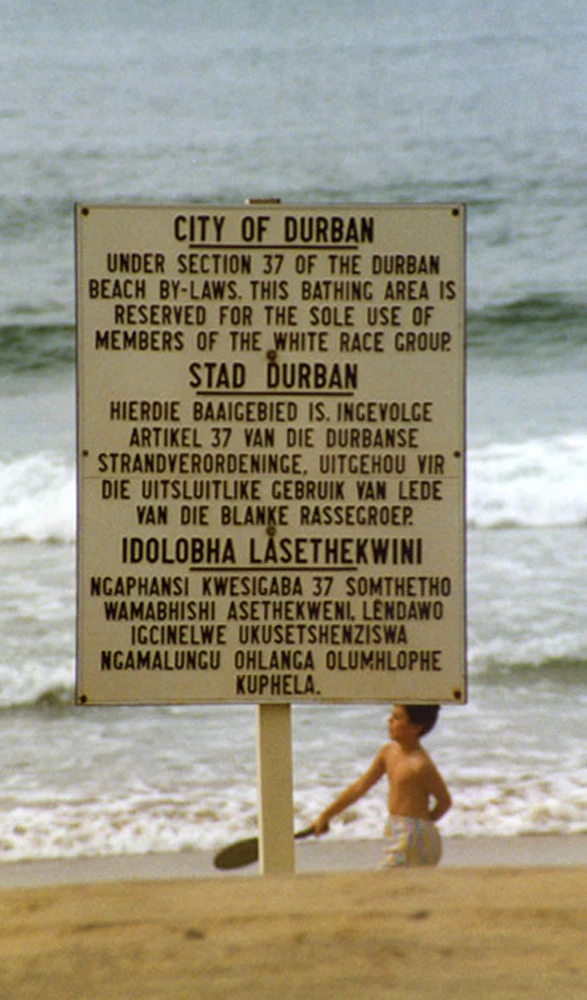
An archival photograph from Durban in 1989 makes the historical contrast visible. Guinnog's image records a beach sign reserving access for white people and invoking section 37 of municipal beach by-laws. The English, Afrikaans and isiZulu wording gave a discriminatory local rule a public, administrative form. This is evidence of how municipal authority once organised exclusion, rather than a photograph of today's election or water services. Its relevance is precise: local government helped define who could use a shared place. The democratic transformation changed the governing principle from authorised racial exclusion towards equal rights and public accountability. [5] The sign also shows that discriminatory power could be expressed through routine administrative language, rather than only through national political speeches. [5]
The 1998 White Paper on Local Government placed that transformation in a wider institutional history. Its account describes racial separation as predating apartheid's introduction in 1948, then explains how apartheid intensified residential segregation and separated township needs from commercially valuable tax bases. Municipal inequality was produced through decisions about territory, revenue and entitlement. This history challenges an explanation that begins with present-day administrative performance alone. Institutions inherited unequal capacities to raise resources and meet needs; the democratic settlement had to change those relationships as well as the identity of those holding office. [6]
The same White Paper proposed developmental local government, linking community participation, basic infrastructure and redistribution with municipal planning. It recognised residents in several roles: voters, people affected by policy, service users and partners in development. That combination is important for the election now approaching. Voting allocates representative authority, while planning and public finance influence how authority is exercised between elections. Reading the 1998 programme alongside the current contest reveals a continuity in democratic ambition. Participation was intended to shape the substance of local development, rather than end when a council had been constituted. [6]
Recent published research shows why the material side of that ambition remains politically urgent. Stephen Ndoma's September 2026 Afrobarometer dispatch reports that 60% of surveyed South Africans said their household had lacked enough clean water at least once during the preceding year; 22% reported this many times or always. These are household experiences reported in interviews, not measurements of water quality or a November 2026 outage count. Their significance is nevertheless direct. A constitutional entitlement may coexist with recurring insecurity, and that insecurity becomes part of the experience through which people evaluate public authority. [7]
The water dispatch draws on 1,600 adult citizens interviewed from 28 June to 19 July 2025 by the Institute for Justice and Reconciliation-led Afrobarometer team. Its national margin of error is plus or minus 2.5 percentage points at 95% confidence, with greater uncertainty for subgroups. Water shortages were reported by 77% of rural respondents and 53% of urban respondents. Those differences require attention to place, while the fieldwork date prevents the findings from being mistaken for an election-week poll. The evidence illuminates an unequal social setting in which the current political choices are being made. [7]
Rehan Visser's June 2026 Afrobarometer dispatch examines local representation using the same 2025 survey, rather than a separate independent sample. Only 17% said local councillors often or always listened to ordinary people; 48% said they never did. The finding raises a problem of responsiveness alongside the problem of provision. Residents may possess voting rights yet struggle to obtain a hearing about what matters to them. A council's democratic standing depends partly on whether people can bring lived problems into decisions, including the less visible administrative decisions that rarely become campaign headlines. [8]
The same dispatch reports that 27% approved of their councillor's performance, while 70% disapproved. These are evaluations by respondents, not audited verdicts on each municipality and not predictions of tomorrow's result. They should not be converted into allegations against unnamed office-holders or treated as proof that every institution works identically. Their value is in showing the distance between representative authority and public confidence. Read beside the water findings, they make a coherent political issue visible: institutions must provide services and maintain a relationship in which residents believe their experience can affect public decisions. [8]
The Municipal Systems Act gives participation an institutional location. Section 16 links it to integrated development planning, budgets, performance management and strategic service decisions. Section 42 requires community involvement in the development, implementation and review of performance systems, including indicators and targets. The provisions reviewed here are in the government's consolidated text updated through July 2024. They establish an existing foundation for public involvement; they are not new promises made for this election. Their significance is that participation can enter the processes through which a municipal commitment becomes a planned and assessed responsibility. [9]
The Act also treats affordability and financial sustainability together. Section 74 provides for equitable tariffs and access to basic services for poor households through mechanisms including special tariffs and subsidies. This complicates an argument that reduces municipal reform either to collecting more money or to eliminating charges without considering service costs. Distribution is built into the institutional problem: who contributes, who receives support and how the arrangement is made sustainable. An accountable service system must make those choices intelligible to the people affected, rather than leave them concealed inside a bill or a general claim of financial necessity. [9]
African civil-society research brings residents' political agency into this institutional picture. In the August 2020 report Claiming Water Rights in South Africa, Lisa Chamberlain, Kelebogile Khunou, Thato Masiangoako and Alana Potter examined four cases across different settlement types and provinces. Their work combined documentary research with interviews focused on activists and residents, rather than municipal respondents. That declared perspective helps explain what the report contributes: an account of the routes people used to claim rights. It should be read as situated research into mobilisation, not a representative survey of all municipalities or a current assessment of those cases. [10]
Across its cases, the report traces combinations of organising, engagement, litigation and self-supply. Its discussion of Harrismith's Water Heroes considers both the practical appeal of residents repairing infrastructure and questions about sustainability, expertise and the longer-term public role. The wider lesson is that agency does not disappear when institutions disappoint. Communities seek other ways to secure necessities. But celebrating their resourcefulness can also obscure the work and costs they absorb. For the present debate, participation becomes more substantial when it enables people to influence public provision, rather than simply shifting responsibility for provision onto them. [10]
The government's current reform proposals can be assessed against that distinction. Ramaphosa's October address links clearer responsibilities and differentiated capabilities with a proposed transition plan; it also says some changes require legislation, financing arrangements or possibly constitutional amendments. The address places maintenance and the handling of service revenues within the reform agenda. For residents, the consequential issue is how these institutional changes connect to control over services. A reorganisation may alter the location of responsibility without automatically making it easier for the affected community to obtain reasons, influence priorities or secure a response. [2]
The 4 November election opens another stage in this relationship. Baloyi's election-week article directs readers towards budgets, expenditure information and audit records as resources for judging performance. Read alongside the other evidence, the invitation means that democratic authority needs a continuing public record against which promises can be assessed. The issue after the votes are counted will be whether the people who depend on local services can see how decisions are made, contest their consequences and hold those responsible to their commitments. [1]
- [1]SAnews / Government Communication and Information System. William Baloyi, Ready to Vote: Preparing for the 2026 Local Government Elections2026-10-31
- [2]The Presidency, South Africa. Address by President Cyril Ramaphosa at the Official Launch of the Revised White Paper on Local GovernmentAddress 2026-10-22; posted 2026-10-25
- [3]Department of Justice and Constitutional Development, South Africa. Constitution of the Republic of South Africa, 1996, Chapter 7: Local Government1996; amended web text, accessed 2026-11-03
- [4]Department of Justice and Constitutional Development, South Africa. Constitution of the Republic of South Africa, 1996, Chapter 2: Bill of Rights1996; amended web text, accessed 2026-11-03
- [5]Guinnog / Wikimedia Commons. DurbanSign1989.jpg: municipal beach segregation sign, DurbanPhotograph 1989; exact day unknown; accessed 2026-11-03
- [6]Government of South Africa. The White Paper on Local Government1998-03-09; historical and developmental-local-government sections
- [7]Afrobarometer. Stephen Ndoma, Access to water and sanitation in South Africa: A tale of insufficiency and inequality, Dispatch 12362026-09-29; fieldwork 2025-06-28 to 2025-07-19
- [8]Afrobarometer. Rehan Visser, Ahead of municipal elections, South Africans vent frustration with local government, Dispatch 11922026-06-10; fieldwork 2025-06-28 to 2025-07-19
- [9]Department of Public Service and Administration, South Africa. Local Government: Municipal Systems Act 32 of 2000, consolidated text2000; text updated 2024-07-23; publisher checked 2025-05-02
- [10]Socio-Economic Rights Institute of South Africa. Lisa Chamberlain, Kelebogile Khunou, Thato Masiangoako and Alana Potter, Claiming Water Rights in South Africa2020-08; methods pp.11–12; synthesis pp.78–84; Harrismith pp.77–78
Did this publication help you understand the topic?
0 voluntary responses. Browser-based participation; responses are not a representative survey.
We welcome suggestions, contributions and recommendations.
Editorial standards ↗