At the close of the 28–29 October 2026 Russia–Africa Summit in Moscow, Évariste Ndayishimiye called for a partnership organised around priority projects, suitable financing and measurable results. Burundi’s presidency, reporting on 30 October, linked the summit co-chair’s demands to employment, education, energy and digital innovation. Those priorities place African public needs within the negotiations themselves. They also expose the political work that follows a summit: selecting projects, allocating resources and deciding who can assess performance. The central argument developed here is that African bargaining power gains lasting public value through the institutions that turn international choices into productive capacity and make those choices answerable to affected people. The summit’s own language of results supplies an immediate starting point for that assessment. [1]
The AU Commission’s new relationship with Russia has a defined institutional form. Commission Chairperson Mahmoud Ali Youssouf and Foreign Minister Sergey Lavrov signed an action plan on 28 October covering 19 areas for 2027–2029. The Commission explicitly describes it as a framework creating no rights or obligations under international law. Proposed activities include technical exchanges, digital systems and institutional capacity-building. Its significance lies in establishing channels through which cooperation can be pursued. Authority then passes through further decisions: ministries and other participating bodies must identify activities, agree responsibilities and organise resources. The framework makes those decisions possible without settling their eventual content. Reading it this way directs attention towards the institutions through which a continental diplomatic agenda becomes particular national and regional commitments. [2]
Tighisti Amare’s pre-summit assessment offers a useful interpretation of this political space. Writing on 27 October, she describes African engagement with Russia as diversified non-alignment: governments pursue relationships with several partners while seeking trade, security and greater international representation. In this reading, diplomatic diversification can widen the range of available choices. Its value depends on what governments can negotiate within those relationships and on the resources a partner can actually commit. Amare argues that Russia’s economic delivery remains constrained and uneven. Her assessment raises a question about capacity alongside political intent. The presence of several potential partners can create room for manoeuvre, but an offer becomes useful through the terms, capabilities and sustained institutional work attached to it. This is a framework for interpreting negotiations, not a finding that every African government pursues an identical strategy. [8]
The Commission’s plenary intervention gave that negotiating space an explicitly productive purpose. Youssouf called for local processing and industrialisation so that African populations retain more value from agricultural and mineral resources. He also sought more favourable access to capital markets and stronger African representation in international decision-making. Taken together, these demands address the distribution of value and the authority to shape the rules under which value is produced. Processing capacity, investment finance and access to technology influence where skilled work occurs and which institutions accumulate expertise. The Commission was therefore advancing a conception of partnership connected to the organisation of production. Its demands make African agency visible as an effort to change the position occupied within economic relationships, with the benefits for populations remaining the publicly stated purpose. [3]
That ambition has a longer African policy history. The Africa Mining Vision, adopted in February 2009, treats minerals as a basis for wider economic and social linkages. The AU’s explanation connects mining to local suppliers, knowledge-based services, fair resource rents, community benefits and environmental protection. This perspective makes the proposed relationship between extraction and development concrete. National negotiating capacity includes the ability to secure provisions that connect a project with domestic production and protect the people whose surroundings and livelihoods it changes. Regional industrial and trade policies also matter because the productive relationships can cross borders. Applied to the Moscow agenda, this earlier framework supplies African-defined criteria for evaluating resource partnerships. It directs attention to the economic connections built around a project and the share of value retained through them. [9]
Namibia’s stated priorities illustrate how a national government can give those criteria a particular focus. Before the summit, NBC reported that President Netumbo Nandi-Ndaitwah would pursue investment, mineral beneficiation, industrialisation and technology transfer, citing the presidency. The account linked these aims to jobs, diversification and skills, and identified the Namibia–Russia intergovernmental commission as an existing channel of engagement. Beneficiation concerns the processing through which a mineral acquires additional economic value. Its relevance to public life includes the types of employment and technical capability that can develop around production. Namibia’s agenda thus identifies both a desired economic change and an institution through which negotiations can continue. It remains a statement of priorities: the terms of particular investments and their implementation must be established through the decisions that follow. [5]
Ghana’s contribution brings infrastructure and financing into the same argument. GNA reported on 31 October that John Dramani Mahama had discussed a possible first nuclear power plant with Rosatom and invited investment in agricultural and mineral processing. He also proposed exploring local-currency settlement of legitimate trade. These proposals concern systems whose operation could shape economic relationships over long periods. A power project involves decisions about technology, financing and access to energy; a payment arrangement concerns the channels through which firms transact. At this stage, the record establishes discussions and proposals. Their developmental significance would emerge through the allocation of costs, operating responsibilities and benefits in any resulting arrangements. Ghana’s case shows a government placing specific economic opportunities before a partner while the most consequential terms remain open for negotiation. [6]
Tunisia’s intervention connects the productive agenda to social conditions and the exercise of public authority. Sarra Zaâfrani Zenzri called for conflict prevention, support for AU mediation and early-warning mechanisms, and attention to economic vulnerability and marginalisation. Her government’s account also records priorities in agricultural production, storage, water management and affordable energy. These concerns locate security within institutions that sustain livelihoods and respond to disruption. Their importance extends to how investment is selected: a project’s contribution depends on its relationship to the services, production systems and capacities people need. Zenzri’s argument therefore offers a public-wellbeing criterion within the partnership debate. It makes the prevention of crises and the strengthening of African institutions part of the purpose against which cooperation can be assessed. [4]
Education diplomacy gives the discussion another scale, linking presidential recognition to universities and professional communities. RUDN awarded Ndayishimiye an honorary doctorate on 28 October. In its account, Rector Oleg Yastrebov presented the honour as recognition of educational and international cooperation and described agricultural research and legal training connected to Burundi. The university’s presentation joined political recognition to examples of academic work. That connection deserves careful interpretation: the ceremony creates visibility for a relationship, while research and teaching require sustained institutions and professional opportunities. For students and graduates, the practical significance lies in access to training, the ability to develop expertise and the conditions for using it. The public purpose attached to the honour can therefore be followed through the educational relationships the university and president invoked. [12]
The institution’s use of Patrice Lumumba’s name places these relationships within a history of African independence and international solidarity. RUDN’s own history dates its use of the name to 1961–1992 and its restoration to March 2023. Its account of subsequent engagement in Kinshasa connects commemoration to academic exchanges and research cooperation. This is an institutional interpretation of its historical identity, expressed through a name associated with Congo’s independence. It helps explain the language of recognition surrounding the Burundi visit. Historical memory supplies a vocabulary through which partners can present their relationship as meaningful. The contemporary stakes concern the institutions and opportunities built through that relationship, and the capacity of African participants to shape their purposes. [13]
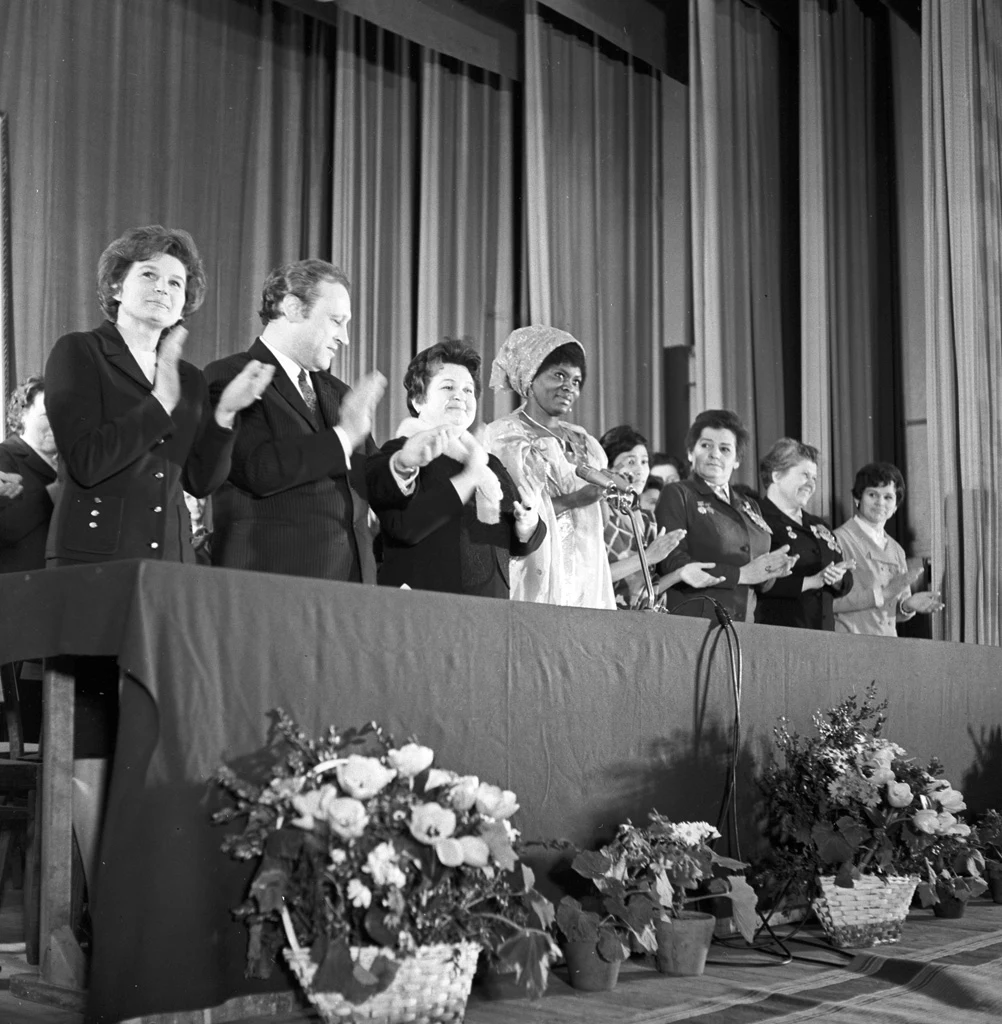
The historical photograph accompanying this review brings a student into view within that institutional history. Vitaliy Karpov photographed an International Women’s Day celebration at Patrice Lumumba University on 8 March 1972. The archive identifies the woman at the centre as Wilhelmina Scott Boyle, a third-year history and philology student from Sierra Leone, alongside Soviet public figures including Valentina Tereshkova. Their presence on a formal platform records the public presentation of educational internationalism through particular people. The photograph documents a university ceremony, not the private political views of those shown. As historical evidence, it locates African participation within an institution whose relationships were sustained through students as well as official visitors. [14]
Constantin Katsakioris’s archival history of the university explains why those relationships cannot be reduced to a Soviet initiative passively received abroad. African governments contested recruitment channels and the recognition of qualifications, while students pursued training and professional futures within changing political conditions. His study traces reforms that extended programmes and strengthened academic requirements in the early 1970s. It also distinguishes the university’s educational work from the wider cultural ambition to cultivate an international alliance. These negotiations mattered because a scholarship’s value depended on access to a credible qualification and opportunities to use it. Read against the present ceremony and announced educational cooperation, this history highlights a continuing institutional question: who shapes training, recognises expertise and creates the conditions for graduates to contribute? The historical cases explain the importance of those mechanisms; they do not establish their present operation. [15]
Russia’s published account of its meeting with Kenya makes one educational commitment more specific. In opening remarks reproduced by the Russian Foreign Ministry, Vladimir Putin said that 70 scholarships for civilian subjects had been allocated for Kenyan students for the following year. He discussed education alongside agricultural trade and fertiliser supplies. The statement establishes an announced allocation attributed to the Russian president. The pathway from an allocation to a student’s qualification involves selection, admission, support and completion. Those stages distribute opportunity among individuals and connect diplomatic commitments to institutions of training. Kenya’s example shows why the scale and terms of educational access belong within an assessment of international partnerships: they affect who gains skills and how relationships between societies are sustained beyond meetings between governments. [7]
Citizens’ views add evidence that diplomatic accounts cannot supply. Afrobarometer’s February 2026 report draws on 50,961 face-to-face interviews in 38 countries during 2024–2025, using nationally representative samples and equal country weights for multi-country averages. It reports country-level margins of error of approximately two to three percentage points. Positive assessments of Russian influence ranged from 88% in Mali to 13% in Botswana. Among respondents who had heard about the Russia–Ukraine war, 72% across the surveyed countries favoured neutrality. These are dated findings covering the sampled countries, not a poll of reactions to the October summit. They establish substantial variation in public attitudes and a widespread preference for retaining room to choose. They also prevent an easy equation between attendance by national leaders and a uniform popular position across the continent. [10]
African political frameworks provide a language for connecting that public voice to decision-making. Chapter 9 of the African Charter on Democracy, Elections and Governance addresses parliamentary capacity, civil-society participation, public administration and economic governance. Articles 27–33 include provisions on expression, women’s participation, public-finance transparency and the allocation of natural resources. These are commitments directed to states parties; the charter’s application must be assessed through ratification and national circumstances. As an African normative framework, it connects the exercise of government authority to participation and answerability. Read alongside the summit agenda, it supplies a basis for examining how decisions on finance, resources and institutions enter public political life. The terms of a partnership acquire democratic significance through the opportunities people have to influence decisions and scrutinise the authorities responsible for them. [11]
The Moscow commitments place productive capacity, education and public wellbeing within the declared purposes of cooperation. Their lasting value will depend on African institutions’ ability to negotiate workable terms and sustain the public participation through which those terms remain answerable to people. That is where greater international choice can become a material resource for African societies. [1][11]
- [1]Presidency of the Republic of Burundi. 3ᵉ Sommet Russie-Afrique : partenariat orienté vers des actions concrètes et des résultats tangibles2026-10-30; summit 2026-10-28–29.
- [2]African Union Commission. Signature of the AU Commission–Russian Federation Action Plan 2027–20292026-10-28.
- [3]African Union Commission. AUC Chairperson addressed the plenary session of the Third Russia–Africa Summit in Moscow2026-10-29.
- [4]Presidency of the Government, Tunisia. Sommet Russie-Afrique : La cheffe du gouvernement souligne le rôle essentiel de la paix et de la sécurité2026-10-29; listing dated 2026-10-30.
- [5]Namibian Broadcasting Corporation, Celma Ndhikwa. Nandi-Ndaitwah to boost Namibia–Russia economic tiesUndated pre-summit report; event 2026-10-28–29; accessed 2026-11-01
- [6]Ghana News Agency, Iddi Yire. President Mahama returns home from Russia–Africa Summit2026-10-31; summit 2026-10-28–29.
- [7]Ministry of Foreign Affairs of the Russian Federation. Putin’s opening remarks at meetings with African leaders, including William Ruto, Moscow, 29 October 20262026-10-29 statements; consulted 2026-11-01.
- [8]Chatham House, Tighisti Amare. Russia–Africa Summit: Moscow is engaging more with Africa, but its delivery is limited2026-10-27; pre-summit expert comment.
- [9]African Union. AMV – Africa Mining VisionUndated explanatory page; vision adopted February 2009; consulted 2026-11-01.
- [10]Afrobarometer, Aubrey Ghambi, Alfred Kwadzo Torsu and Carolyn Logan. Popular perceptions of Russia lag, even as its influence grows across Africa2026-02-27; Round 10 fieldwork 2024–2025.
- [11]African Union. African Charter on Democracy, Elections and Governance, Chapter 9, Articles 27–33Adopted 2007-01-30; entered into force 2012-02-15.
- [12]Patrice Lumumba Peoples’ Friendship University of Russia (RUDN). Президенту Бурунди присвоено звание почётного доктора РУДН2026-10-28.
- [13]RUDN University. Lumumba: A Name That UnitesUndated; events 1961–2025; accessed 2026-11-01
- [14]RIA Novosti archive / Vitaliy Karpov, via Wikimedia Commons. March 8 celebration at Patrice Lumumba University, image 7267161972-03-08; digitised 2012-03-02
- [15]Journal of Global History / Cambridge University Press, Constantin Katsakioris. The Lumumba University in Moscow: higher education for a Soviet–Third World alliance, 1960–912019-07-08; historical scope 1960–1991
Did this publication help you understand the topic?
0 voluntary responses. Browser-based participation; responses are not a representative survey.
We welcome suggestions, contributions and recommendations.
Editorial standards ↗