Uganda’s August 2026–March 2027 roadmap for ratifying IGAD’s free-movement protocol places a decision about mobility before national institutions. Agreed at consultations in Entebbe on 21–23 July 2026, the timetable covers regulatory assessment, a Cabinet memorandum, approval and formal ratification. It identifies the Ministry of Internal Affairs and other public bodies responsible for advancing the process. The roadmap gives a concrete institutional setting to a wider political question: how do people’s ambitions to study, work or build a household become choices they can exercise across borders? [6]
In a 23 October 2026 intervention for the Mo Ibrahim Foundation, Afrobarometer researcher Ama Korankyewa Nimako locates the decision within transitions that carry social meaning: leaving education, finding work, forming a household and becoming financially independent. Her intervention gives attention to the opportunities educated young people can see abroad and the obstacles they encounter at home. It also connects personal aspirations with regional integration. A person considering a job in another African country encounters the institutions through which that ambition must pass. Rules about borders and employment become part of the route from an educational qualification to an income, alongside the availability of work itself. [1]
The underlying Afrobarometer report makes differences across countries visible. In its 2024–25 surveys, 53 per cent of Gambian respondents and 51 per cent of Liberian respondents said they had considered emigrating ‘a lot’; the figure in Mauritania was 7 per cent. On a different question, support for free cross-border movement reached 63 per cent in Morocco and 30 per cent in Mauritania. These are distinct measures of personal aspirations and preferred public policy. Their variation places different social experiences behind a continental discussion of mobility. [2]
The report’s evidence comes from face-to-face interviews in 38 countries between January 2024 and September 2025. National results use representative samples, with stated margins of error of about two or three percentage points at 95 per cent confidence, depending on sample size. Multi-country averages give each country equal weight. These dates and definitions matter: consideration of leaving describes an expressed possibility during fieldwork. It is not a count of departures in October 2026. The findings make people’s expectations available for political discussion while preserving the difference between an aspiration and a journey. [2]
Hein de Haas’s aspirations–capabilities framework helps explain the institutions between the two. In his 2021 study, aspirations concern what people want from life and where they believe those goals can be realised. Capabilities concern their practical freedom to act, shaped by resources, information, networks and political restrictions. Education can change someone’s ambitions and knowledge of opportunities while money, legal documents or admission rules constrain the available routes. This makes mobility a relationship between people’s purposes and the conditions under which they can pursue them, including the possibility of remaining where they live. [3]
The framework also brings people who remain in place into the discussion. Someone may want to leave and lack the means; another may have the means and prefer to stay. De Haas describes these as different configurations of aspiration and capability. This provides a way to understand why a government’s migration policy affects people who never appear in a border-crossing count. The freedom involved includes access to a workable future at home, an attainable route elsewhere and the ability to make a decision within family and social obligations. [3]
African scholarship places these choices inside the politics of governing. CODESRIA’s July 2026 programme for its Democratic Governance Institute, organised with the University of Ghana’s Centre for Migration Studies, asks how mobility relates to democratic agency. Its research agenda treats movement as part of livelihoods, knowledge and belonging. It directs attention to the people whose work and relationships depend on mobility and to their place in decisions made about it. That approach makes the organisation of public authority central to a discussion often conducted through administrative categories such as origin, destination and transit. [5]
CODESRIA also identifies unequal access to participation within migration governance. Governments, community associations, migrant networks and international organisations occupy different positions in shaping rules. Its programme asks whose experiences become recognised knowledge and whose interests remain marginal. Read alongside current mobility decisions, this perspective gives representation a concrete meaning: workers, traders and families need ways to influence decisions that organise their movement and livelihoods. This African scholarly agenda connects representation with people’s ability to influence the rules organising their lives, alongside the administrative capacity to apply them. [5]
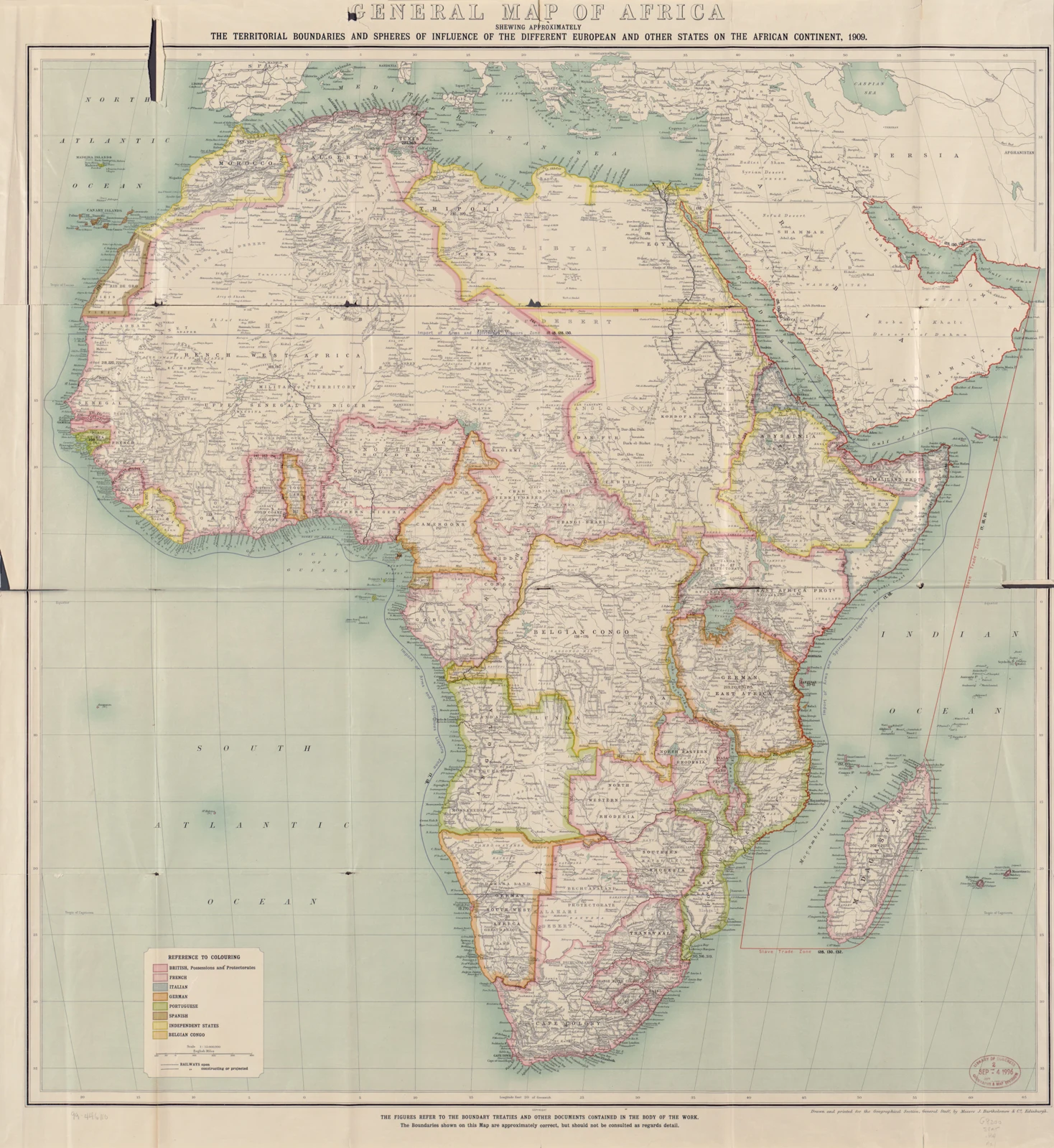
The historical map accompanying this essay records an earlier organisation of territorial authority. Published in 1909 in The map of Africa by treaty, it describes territorial boundaries and spheres of influence and colours much of the continent according to European powers’ possessions and protectorates. Its legend also recognises independent states. The map is evidence of a particular classification of political space at the time of publication. Its categories make claims of territorial control prominent, offering a historical document through which the political construction of boundaries can be examined. [8]
That visual organisation has a specific perspective. The map’s title and colour scheme foreground states and imperial jurisdictions; they do not record individual travellers’ rights, household movements or people’s consent to the boundaries represented. It is consequently useful as evidence of how territorial power was displayed. Its approximate lines and dated labels belong to 1909. A present discussion of migration can use this document to recognise the historical production of territorial categories while tracing the later laws and institutions through which Africans have reorganised movement and political membership. [8]
Flahaux and de Haas’s 2016 research examines part of that later history. Using migration-population data for 1960, 1980 and 2000, migration-flow records and historical visa requirements, they relate mobility to development and state formation. Their findings describe different regional trajectories and the diversification of overseas destinations. The study argues that national institutions can facilitate movement and restrict it through changing political priorities. This chronological perspective places border regulation within state–society relations: institutions classify people and activities, shaping the social and economic relationships that can cross a frontier. [4]
Their interpretation also gives African governments a role in shaping migration patterns. The formation of postcolonial states involved decisions about nationality, entry and the regulation of work, alongside external states’ admission rules. The authors connect these decisions with broader economic and political transformations. This places present-day mobility within a history of changing public authority. Colonial boundaries are part of that history, while subsequent governments’ choices also influence the opportunities available to migrants and their communities. Political responsibility can therefore be examined at multiple points along a route, including institutions in countries of origin and destination. [4]
Regional free movement is itself an African institutional project with a long chronology. The 1979 ECOWAS protocol established entry, residence and establishment as successive phases. Its first-phase provisions set out visa-free visits of up to 90 days for Community citizens carrying the required documents and entering through official points. Residence and establishment concern additional relationships between a person and the receiving state. The distinctions identify the different public decisions involved when a short visit becomes a plan to live, trade or work elsewhere in the region. [9]
The protocol’s provisions also address the powers retained by states, including admission under their laws and safeguards concerning expulsion. Regional membership creates a framework in which national administrations act; implementation gives that framework practical force at the border and beyond it. These 1979 provisions show the institutional work embedded in the term ‘free movement’. The current rights of a particular traveller depend on applicable later instruments and administrative rules as well. The historical protocol supplies the foundation for examining those relationships, without treating a regional commitment as automatic evidence of unrestricted movement today. [9]
Responsibility in that process is distributed across public institutions. The Ministry of Internal Affairs leads the roadmap with other departments, while migration, labour, legal and border-management officials participated in the consultations. IGAD and the ILO support the wider project with EU financing. This configuration identifies African officials’ decision-making responsibilities and an external partner’s supporting role. The July record describes preparation towards ratification and implementation; it does not establish that ratification has subsequently occurred. The practical significance of the process lies in how these institutions turn negotiated commitments into rules and services people can use. [6]
Mobility beyond Africa adds another set of authorities and interests. The ILO’s 1 October account records 16 recommendations agreed by African governments, employers and workers at a Nairobi meeting on 22–23 September. They prepared for an AU–GCC+ labour-migration dialogue involving Gulf states and destinations including Jordan and Lebanon. Proposed measures concern qualifications, social protection, fair recruitment and labour remedies. For a worker, these issues govern the relationship between a job offered before departure and the conditions encountered after arrival. They locate protection in employment arrangements as well as in permission to cross a border. [7]
The recommendations include contracts supplied before departure in a language workers understand, recognition of skills and routes to pursue employment claims after returning home. The ILO also records proposals for coordinated consular support and a crisis-response mechanism. These are proposed commitments within a consultative process, whose format is voluntary and non-binding. Their implementation would require decisions by the responsible governments and institutions. They nevertheless identify specific questions of power within labour mobility: who sets contractual terms, who recognises qualifications, and which institution remains answerable when a worker seeks a remedy. [7]
The African Charter on Human and Peoples’ Rights supplies a rights framework for these relationships. Adopted in 1981 and in force from 1986, Article 12 recognises movement and residence within a state subject to law, the right to leave a country and return to one’s own, and safeguards concerning asylum and expulsion. It prohibits mass expulsions directed at national, racial, ethnic or religious groups. These protections place obligations around state authority over movement. They have particular importance when political debate turns migrants into a collective category instead of considering individual rights and applicable legal procedures. [10]
The Charter also recognises equality before the law and equitable working conditions. These provisions connect the political organisation of movement to people’s standing in the societies where they live and work. A coherent account of African mobility can follow that connection through admission, residence, employment and access to remedies. The contemporary stakes concern the authority exercised at each stage and the rights people retain while pursuing a future. African self-determination in this field includes the capacity of institutions to make policy and the ability of people affected by it to enjoy protection and equal treatment. [10]
- [1]Mo Ibrahim Foundation / Ama Korankyewa Nimako. Should I stay or should I go? What Africa’s young people are telling us about migration23 October 2026
- [2]Afrobarometer. Beyond borders: Citizen perspectives on a shifting global order — African insights 20265 August 2026; fieldwork January 2024–September 2025
- [3]Hein de Haas / Comparative Migration Studies. A theory of migration: the aspirations-capabilities framework24 February 2021
- [4]Marie-Laurence Flahaux and Hein de Haas / Comparative Migration Studies. African migration: trends, patterns, drivers22 January 2016; historical datasets specified in text
- [5]CODESRIA. 2026 Democratic Governance Institute: “Migration Governance”: Rethinking Mobility and Democratic Agency in Africa28 July 2026; programme scheduled 28 September–9 October
- [6]Intergovernmental Authority on Development. Government of Uganda Develops Roadmap to Advance Ratification of the IGAD Protocol on Free Movement of Persons24 July 2026; consultation 21–23 July; roadmap August 2026–March 2027
- [7]International Labour Organization. African tripartite partners agree on a common labour migration approach1 October 2026; Nairobi meeting 22–23 September
- [8]Edward Hertslet, R. W. Brant and H. L. Sherwood / Library of Congress. The map of Africa by treaty — General map of Africa, 19091909; exact digitisation date unknown; accessed 25 October 2026
- [9]Economic Community of West African States. Protocol A/P.1/5/79 Relating to Free Movement of Persons, Residence and Establishment29 May 1979; official digital reprint accessed 25 October 2026
- [10]Organisation of African Unity / African Commission on Human and Peoples’ Rights. African Charter on Human and Peoples’ Rights, Articles 1–3, 12–15Adopted 27 June 1981; entered into force 21 October 1986
Did this publication help you understand the topic?
0 voluntary responses. Browser-based participation; responses are not a representative survey.
We welcome suggestions, contributions and recommendations.
Editorial standards ↗