On 13 November 2026 in Accra, African Union Commission chair Mahmoud Ali Youssouf asked member governments to consider spending a limited amount of Peace Fund capital each year to respond to crises, with a way to replenish it. He also proposed raising the ceiling on compulsory member contributions and extending use of the levy on eligible imports. Ghana’s foreign minister, Samuel Okudzeto Ablakwa, put a separate choice before the same meeting: governments could use the Kigali levy or raise the money through an equivalent domestic mechanism whose proceeds could be verified. The opening statements put concrete options before foreign and finance ministers. They do not establish that the Executive Council adopted any of them. [3] [4] [11] [12] [13]
The question reaches beyond how much the AU raises. A minister can endorse a mission in one meeting and return to a treasury that must find the money for it in another. A state can pay its annual AU bill while using a different source of domestic revenue from the one envisaged by the Union. And a dollar reported as part of the Peace Fund's capital is not a dollar that a mission can automatically spend. The documents from Kigali in 2016, Addis Ababa in February 2026 and the current Accra session show where these decisions sit and how easily the different figures can be confused. [1] [2] [3] [4] [5]
In July 2016 the AU Assembly met in Kigali, Rwanda. Its financing decision directed states to introduce a levy of 0.2 percent on eligible imports from 2017. National administrations were to place receipts in accounts at their own central banks for transmission according to each state's assessed AU contribution. The route from customs to the AU ran through national institutions. Kigali created a common financing rule but did not give the Commission a customs service of its own, and the decision itself recorded a reservation by Mauritius. [4]
The choice of an import levy put part of the funding question at the border. Eligibility matters: a levy on some imports is different from a charge on every shipment. Where states collect it, national rules determine which goods are covered and how customs authorities administer it. The legal obligation to remit the levy also tells us little about who bears its cost. A business might absorb it or pass some of it on in prices. The Kigali decision gives a rate and a collection mechanism, but it cannot establish that households in different countries paid the same share of their income towards the AU. [4] [6]
Amani Africa's May 2026 analysis, written from Addis Ababa, traces the slow uptake of the instrument. It reports that the AU counted 16 states implementing the levy in 2018, and that by 2025 the reported count had increased by one. This is evidence about the adoption of a collection route, not a count of every country that paid an assessed contribution. Combining the two would obscure the latitude treasuries retain and make it harder to ask which governments owe arrears, which collected the levy, and which met their obligations through other revenues. [4] [5] [6]
The figure in Ghana’s November address is 18 of 55 members implementing the levy, compared with the 17 reported for 2025 in Amani Africa’s review. The sources do not establish that they used identical reporting dates or criteria. The prepared address also gives distinct 2027 projections for the shares members would finance: nearly 99 percent of operating costs, about 4 percent of programme costs and about 12 percent for peace and security. Those are projections from the host government, not audited receipts. They describe different parts of the budget and should not be added or treated as a single measure of self-financing. [5] [6] [11]
The Executive Council's February 2026 decision offers a different measure. It recorded about US$167.9 million paid against US$200 million assessed for the 2025 regular budget, or 84 percent. Separately it recorded about US$349.3 million in member state contributions to the Peace Fund since 2017. One number is a payment against an assessment for a single budget year. The other accumulates payments towards a distinct fund over several years. Neither is a measure of all AU resources; nor does either identify the amount disbursed for a particular peace operation. [5]
The February decision set out principles of capacity to pay, solidarity and equitable sharing, and allowed more time for consultation. The Council then adopted the 2027–29 assessment scale on 29 July in Addis Ababa. Its annex lists Ghana in Tier 2 with 3.134 percent. The Council also recorded that Ethiopia and Kenya had voluntarily raised their annual contributions to the equivalent of Tier 1 levels for the new cycle. The adopted scale gives treasuries a reference for what they owe. The voluntary commitments illustrate how a government can choose to carry a larger share without waiting for the Union to devise a new formula. Neither kind of commitment is itself a receipt. [5] [16]
At the 13 November session in Accra, Ghana’s foreign minister, Samuel Okudzeto Ablakwa, said President John Dramani Mahama had asked his ministry to examine whether Ghana could move to Tier 1. The instruction is to study the option, rather than a decision to pay at the higher level. The Ghanaian government’s report gives no amount, start date or appropriation. The July schedule remains the reference for the assessment described here. If Ghana chooses to assume a larger share, a subsequent commitment and the budget and payment records would show what changed for its treasury and what reached the Union. [15] [16] [17]
The Peace Fund adds another layer. Kigali identified three uses: mediation and prevention, institutional capacity and peace support operations. It set an endowment trajectory from US$325 million in 2017 to US$400 million in 2020. In February 2026 the Assembly discussed a proposed path to US$1 billion, including new funding sources and a way to replenish the fund. In April the Fund's trustees reported that the Executive Council had endorsed the higher target. A target is a statement of the resources an institution seeks; even a funded endowment needs rules on how much can be used, for what and with whose approval. [3] [4] [7]
Youssouf’s proposal would bring a new spending decision into the life of the fund. If ministers agree to draw on capital for a crisis, the amount available for future needs will depend in part on when and how the money is replaced. The Commission’s account of his remarks gives no annual limit or timetable for replenishment. His proposed pact for 2027–2029 would pair more equitable member financing with spending discipline and measurable results within the Union. A contribution ceiling, a rule for drawing down capital and a rule for replenishing it would each settle a different part of that bargain. The last two would matter directly to the people relying on operations that need support across several budget years. [5] [7] [9] [13]
Amani Africa's analysis presses that distinction by comparing mobilisation for the Fund with the financing of operations. It points to a 2025 AU budget decision that placed a peace support operations line on international partner financing, even as the Union was building the Fund's capital. The two developments can coexist. Member governments can strengthen a common financial institution over time while specific operations still depend on funds negotiated elsewhere. A contribution announcement from a bank, an amount entered into a budget and cash reaching an operation also belong to different stages. The existence of one should never stand as proof of the others. [5] [6] [7]
The United Nations can share some of those costs through a separate procedure. Security Council resolution 2719, adopted in December 2023, provides for decisions on individual AU-led operations. Under its terms, UN assessed contributions may cover up to 75 percent of the annual budget of an eligible operation, with the balance to be jointly mobilised by the AU and the UN. The rule leaves the AU in command of an operation funded through this route while reserving decisions on authorisation and oversight to the Security Council. A ceiling of 75 percent is neither a guarantee that it will be reached nor an obligation for the AU Peace Fund alone to pay the rest. [8]
These two sources of authority can coexist without becoming interchangeable. A national treasury pays dues towards an institution whose members can collectively set priorities. UN assessed funding, by contrast, is linked to an operation with an expressly authorised mandate. The resolution provides for joint planning and review, as well as oversight of spending. Those requirements help make it possible to see who is responsible for a mission. They also mean that the AU and its members still need resources for tasks such as prevention and mediation before there is an operation to authorise, or in situations where no such operation is proposed. [3] [4] [8]
Somalia makes the stakes of these distinctions visible. In her 2026 Institute for Security Studies report, Emmaculate A. Liaga follows how successive AU-led missions relied on arrangements assembled from several sources. The report draws on published material, interviews and a workshop in Addis Ababa in November 2025. It describes how the earlier AMISOM mission had established arrangements for mobilising uniformed personnel while civilian staffing required a different kind of sustained financing. That history does not measure today's staffing or prove what an additional dollar would accomplish. It shows how decisions over which activities receive reliable money can matter as much as the total at the top of a budget. [9]
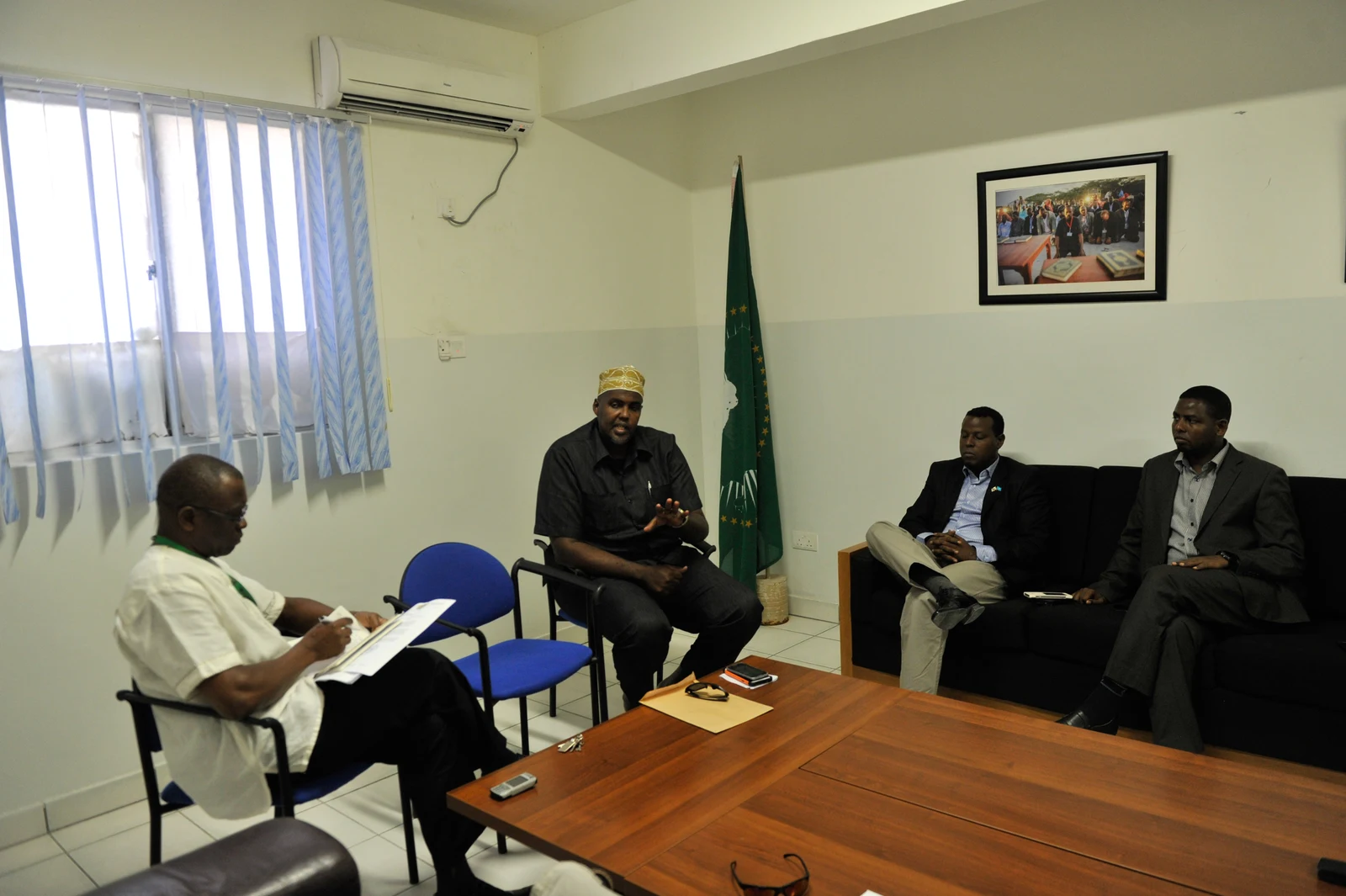
Liaga distinguishes consulting communities from giving them influence over protection priorities. A mission can gather information from people and still lack civilian staff able to follow up, or it can finance engagement for a short project without making it a continuing responsibility. Her report treats local groups as people with existing knowledge and their own approaches to safety, not simply as recipients of a mandate written elsewhere. For a resident who needs a way to raise a concern and hear what happened next, the question is whether money supports a durable channel for participation. The photograph documents a meeting of the AMISOM political office with Somali subnational officials and elders in Mogadishu in March 2016. It shows an encounter of the kind that civilian staff made possible. It cannot establish what influence those present had, or whether people outside the room had a comparable way to shape the mission's work. [9] [10]
The record from Mogadishu also helps explain why the domestic and continental funding debates belong together. The AU mission had to work with Somali institutions that did not all sit at the same level of government. Liaga's study suggests that effective civilian protection requires room for priorities to come from those institutions and from communities, as well as from mission headquarters. Funding that can sustain a civilian presence is one condition for that relationship, but it does not by itself make it equal. A mission still has to show what happened to the concerns raised with it and how those concerns influenced decisions. [9] [10]
Ghana proposed packaging its financing measures in an Accra Declaration. They include a single budget organised by programme, wider use of the import levy or a verifiable domestic equivalent, and a way to replenish the Peace Fund as it grows towards its US$1 billion target. The Commission’s fuller account says the closed session considered the financing representative’s report and the proposed partnership with African multilateral financial institutions, and heard presentations from Afreximbank and the African Development Bank. South Africa’s foreign ministry had framed its participation around the influence funding conditions can give external partners. The presentations confirm that the banks took part in the discussion; the account does not establish that ministers accepted financing terms or that either bank committed money. [7] [11] [12] [14] [15]
The Commission also reports that it was asked to prepare a roadmap for consideration at the 2027 AU summit, identifying who would be responsible, what they would do by when, and how progress would be reported. Those details matter because the levy, assessed contributions and Peace Fund spending are administered by different institutions. A roadmap could show where a delay occurred: in a member government’s collection and transfer of dues, in the Union’s allocation of money, or in the release of funds for work on the ground. The account still describes Ghana’s declaration as a proposal and gives no adopted text or new spending authority. [4] [5] [11] [15]
Accra therefore brings together questions that the last decade kept pulling apart. At Kigali, governments agreed a way to collect revenue. Later records show both payments and gaps, and research from African institutions explains why money on paper does not settle whose protection gets financed. The next record to look for is the proposed roadmap: whether it identifies who must report on contributions and drawdowns, and when those figures will be available. An adopted decision and subsequent payment records would allow readers to trace the money further, to the civilian work it is meant to sustain. [2] [4] [5] [6] [9] [15]
- [1]African Union Commission. AUC Chairperson has arrived in Accra, Ghana for the 27th Extraordinary Session of the Executive Council of the AU Dedicated to Financing the Union13 November 2026
- [2]African Union Commission. Towards a Financially Sustainable and Self-Reliant African Union: Advancing African Ownership, Accountability and Institutional Effectiveness9 November 2026
- [3]African Union Assembly. Decision on the Progress Report on the Institutional Reform of the African Union, Assembly/AU/Dec.967(XXXIX)14–15 February 2026
- [4]African Union Assembly. Decision on the Outcome of the Retreat on the Financing of the African Union, Assembly/AU/Dec.605(XXVII)18 July 2016
- [5]African Union Executive Council. Decision on the Joint Sitting on Scale of Assessment and Contributions and the Committee of Fifteen Ministers of Finance, EX.CL/Dec.1349(XLVIII)11–12 February 2026
- [6]
- [7]African Union Peace Fund. AU Peace Fund Board of Trustees Reviews Financial Status and Advances in Resource Mobilization Efforts2 April 2026 trustee meeting
- [8]United Nations Security Council. Security Council resolution 2719 (2023)21 December 2023
- [9]Institute for Security Studies. Emmaculate A. Liaga, Expanding the protection toolbox: community partnership in African-led peace operationsJune 2026; workshop November 2025
- [10]AMISOM Public Information via Wikimedia Commons. Omar Abdisalan, 2016 03 01 AMISOM Meets ISWA-11 March 2016
- [11]Ghana Ministry of Foreign Affairs / African Union. Welcome address by Samuel Okudzeto Ablakwa at the 27th Extraordinary Session on Financing the African Union13 November 2026; prepared remarks published by the AU
- [12]African Union Executive Council. Draft Agenda: 27th Extraordinary Session of the Executive Council, Ext/EX.CL/Draft/1(XXVII)12 November 2026 draft; session 13 November 2026
- [13]African Union Commission. AUC Chairperson called for a paradigm shift towards greater African ownership & self-reliance in financing the Union’s priorities13 November 2026; opening remarks readout
- [14]South African Department of International Relations and Cooperation. Minister Lamola leads South African delegation to critical AU financing session in Ghana13 November 2026
- [15]African Union Commission. 27th Extraordinary Session of the AU Executive Council Opens in Accra, Underscoring the Imperative of Financial Autonomy and Institutional Reform13 November 2026
- [16]African Union Executive Council; original decision archived by AfricanLII. EX.CL/Dec.1359(XLIX): Decision on the Scale of Assessment and Contributions and the Committee of Fifteen Ministers of Finance29 July 2026
- [17]Information Services Department, Ghana. Ghana considers moving to Tier 1 in AU assessed contributions – Foreign Affairs Minister13 November 2026
Did this publication help you understand the topic?
0 voluntary responses. Browser-based participation; responses are not a representative survey.
We welcome suggestions, contributions and recommendations.
Editorial standards ↗