The West African rice programme launched in Abuja on 11 November 2026 puts irrigation and climate resilience among its priorities. In Senegal’s Lower Casamance, the practical question is often what kind of water reaches a rice field, and when. Rain can help wash salt from a low field before planting; salty water held in the wrong conditions can leave the field harder to cultivate. Studies from Djiguinoum, Agnack and near Ziguinchor explain why the result depends on more than whether a dam or gate was built. They also show how growers choose rice varieties to fit the small differences between their fields. [1][3][4][5][6]
Rice growers in the Lower Casamance have long worked with a seasonal exchange of water. Didier Brunet, writing from research conducted around Djiguinoum, describes low fields near the mangroves that tidal water could cover in the dry season. That water kept some sediments from drying out and becoming more acidic. The rains then brought fresh water that could wash away salts before growers transplanted seedlings. For the rice, the same water could be helpful in one season and harmful in another. The practice depended on enough fresh water arriving in time to change conditions in the field. [3]
Rainfall records from Ziguinchor showed why that sequence became harder to rely on. In Brunet’s comparison, the mean annual total was 1,564 millimetres from 1921 to 1967 and 1,174 millimetres from 1968 to 1992. Those are figures for a station and two historical periods, not a forecast for this year. They help explain why a water-control structure designed around an earlier seasonal pattern would not necessarily work as hoped when rains diminished. The report describes how admitting salty water to prevent soil from drying at one site left shallow groundwater extremely salty and reduced the prospects for planting when the rains returned. [3]
In experiments during the 1989 and 1990 wet seasons at Djiguinoum, the researchers used a modified gate to release some of the first rainwater at low tide, once it had picked up salts. They then retained enough water for the rice plots. Measuring water levels upstream and downstream helped them estimate what passed through the gate; sampling the discharge showed that water leaving the valley carried dissolved salts and aluminium. That difference between moving water and measuring what it carried was essential. A large discharge alone could not show that the operation was reducing a stress on the crop. [3]
Within the experimental area the team also grew three varieties, including the local African rice Etouhal. The harvests differed with variety, cultivation method and season. Brunet found differences between varieties more consequential than planting arrangement in that comparison, while the distribution of rainfall in the shorter 1990 wet season also mattered. The resulting evidence holds at the scale of experimental plots and two seasons. It does not tell us whether the surrounding valley was fully restored, how every household would fare, or whether another valley would respond to the same operating rules. [3]
An investigation led by Hyacinthe Sambou of Université Cheikh Anta Diop examined a different small dam and a different question. At Agnack the team compared Landsat images from 1984, 1992, 2000 and 2010 with ground observations, soil analysis and survey evidence. It mapped how the extent of rice land changed over time rather than measuring the harvest of a few managed plots. The researchers reported less land under rice across the study period and found very acidic soils at the sampled sites. They concluded that the dam had fallen short of the expected rehabilitation. The images locate a change in land use; they do not by themselves prove that a dam caused it. [4]
The Djiguinoum and Agnack studies can therefore tell different stories without contradicting each other. The first asks what can happen when water is carefully measured and managed on and around a selected plot. The second asks whether a landscape around another structure sustained rice cultivation over decades. A successful test is evidence that a process can work in specified conditions. For a farmer deciding whether to plant in a particular field, the longer record adds a different question: whether those conditions can be maintained between seasons. [3][4]
Thioro Fall’s 2014–15 experiments near Ziguinchor show what can be learned by keeping the rice variety constant and changing the treatment. Fall grew the salt-tolerant WAR1 variety and compared flat planting with raised beds, alongside treatments using biochar, crushed oyster shell, or both. Electrical conductivity served as a measure related to the amount of dissolved salt; pH described acidity. Fall tracked the water table through the first season and found that it was both high and very salty for part of the growing period before the conductivity declined. The measurements captured changes that a single sample at planting or harvest could have missed. [5]
In Fall’s trials neither planting arrangement nor soil amendment produced a statistically detectable yield difference in 2014. The biochar treatment did yield more than the control in 2015. Read together, those results support taking the possibility seriously and checking how it varies by season. They do not support promising a gain wherever farmers apply the same material. Water, acidity and the crop can move differently from year to year; keeping track of those changes is what makes it possible to say whether a treatment helped in a particular trial. [5]
Crop choice is already something growers test in their own fields. Camille Ollier and colleagues interviewed about thirty growers, approximately half of them women, in villages in Lower Casamance in January and February 2020. Their interviews asked people to match named varieties to growing times and to the places where they did best. The authors recorded fifty-five names, including eight for varieties the people interviewed remembered but no longer grew or stored. That count describes the material collected through interviews; it is not a genetic inventory or a census of varieties in southern Senegal. [6]
The growers’ accounts put the differences within a valley back into view. The study describes rice that could mature in a short season, varieties suited to particular fields, and women experimenting with those choices year by year. Water depth and the position of a parcel mattered, but so did what households wanted from the rice and which seed they could obtain. A variety distributed through a programme can be useful; knowing its performance in a trial is only part of knowing which field and household it fits. That second question is one the people doing the planting are equipped to answer. [5][6]
For the women interviewed, keeping seed also kept choices open for future seasons. The study records cases in which a daughter or niece continued deciding what to grow when an older cultivator stopped. That is one way an assessment of seed can travel without a written trial report: someone learns which rice fits a wet parcel, when it stands ready to cut and how it stores. The authors’ interviews cannot establish that the same responsibilities apply in every village. They do establish why speaking only to whoever owns a plot or operates its gate could miss part of the technical knowledge needed to improve it. [6]
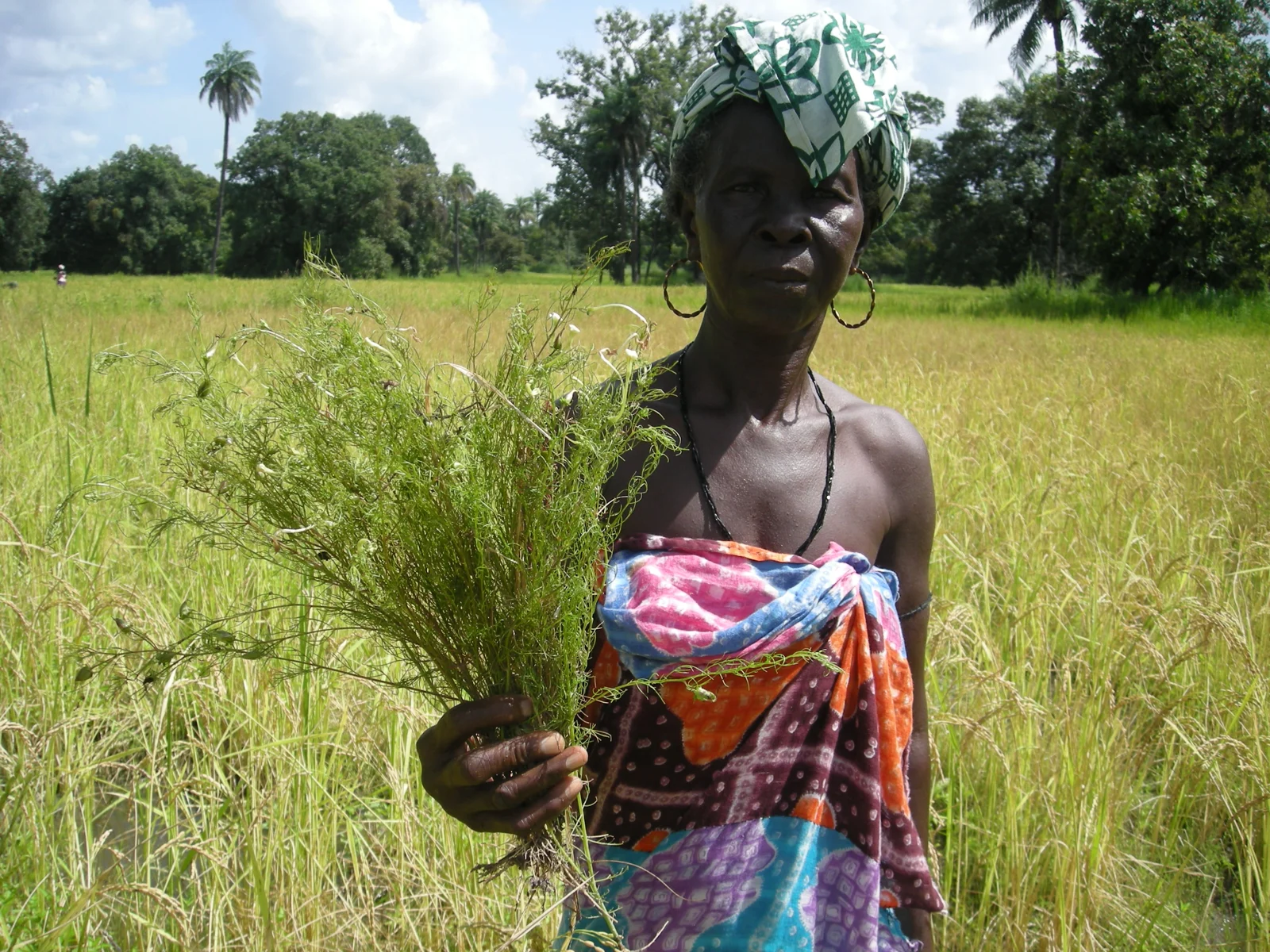
Salinity is also only one reason why a harvest can disappoint. In Jonne Rodenburg’s October 2008 photograph, a grower holds up Rhamphicarpa fistulosa in a Casamance rice field. It is a plant capable of growing on its own and of attaching to the roots of a host such as rice. The photograph shows a grower drawing attention to a weed in her crop; it cannot establish yield loss or tell us whether that field was saline. It illustrates why people who notice what is growing and researchers who can identify a plant contribute different evidence to the same practical problem. [7][8]
That distinction matters when a regional programme sets targets. ECOWAS says it will coordinate policies and technical support and develop monitoring linked to its rice observatory. AfricaRice describes a complementary programme concerned with agronomy, seeds and adapting to climate stress. Neither document is evidence that new water works are operating in Lower Casamance. A monitoring system informed by these field studies would distinguish the number of works built from whether water can be managed in time to plant, and a variety distributed from whether growers can use it in their different fields. Those distinctions are how the regional programme’s stated ambitions could be tested in practice. [1][2][3][4][6][9]
The Abuja launch announced an ambition with regional reach. Lower Casamance gives it a concrete test. Claims about reduced salt exposure need water and soil measurements through the season; claims about recovery need evidence of cultivation over time. Growers add information those measurements cannot supply on their own, including which seed they keep and why. Both kinds of evidence matter if improved water management is to mean a field that a household can plant and harvest, season after season. [1][3][4][5][6]
- [1]Economic Community of West African States. ECOWAS launches US$500 million REWARD project to accelerate regional rice self-sufficiency by 20352026-11-14; launch 2026-11-11
- [2]Economic Community of West African States. ECOWAS is launching and inaugurating the regional steering committee for the Regional Rice Resilient Value Chains Programme (REWARD)2026-11-09; steering committee scheduled 2026-11-12
- [3]Sécheresse (IRD archive). Didier Brunet, Un aménagement hydraulique simple pour la réhabilitation des sols salés : la riziculture en basse CasamanceMarch 1994; experiments 1989–90
- [4]American Journal of Remote Sensing. Dynamics of Land use Around the Micro-Dam Anti-Salt in the Sub-Watershed of Agnack Lower Casamance (Senegal)May 2015; imagery 1984–2010
- [5]Virginia Tech, VTechWorks. Thioro Fall, Soil Management for Improved Rice Production in Casamance, Senegal2016-05-02; fieldwork 2014–15
- [6]Anthropology of Food (IRD archive). Ce sont les femmes qui savent : l’expertise agroécologique des rizicultrices à l’aune des changements environnementaux globaux en Basse-Casamance (Sénégal)2023; interviews Jan–Feb 2020
- [7]Jonne Rodenburg, Wikimedia Commons. Rice Farmer with Rhamphicarpa.jpg2008-10-23 capture
- [8]Weed Research. Rhamphicarpa fistulosa, a widespread facultative hemi-parasitic weed, threatening rice production in Africa2015 issue; Casamance observation 2008
- [9]AfricaRice. REWARD–AfricaRiceProject page, undated; accessed 2026-11-15
Did this publication help you understand the topic?
0 voluntary responses. Browser-based participation; responses are not a representative survey.
We welcome suggestions, contributions and recommendations.
Editorial standards ↗