The Lagos Biennial’s programme set 14 November 2026 for the public opening of The Museum of Things Unseen at Eko Atlantic. Two years earlier, its physical exhibition had filled part of Tafawa Balewa Square with curved walls, indigo cloth and a sound installation that sent the voice of Nigeria’s first prime minister out through dried gourds. The move offers a way to see what the 2024 artists did with that older setting. They used its buildings and earlier gatherings as material, making room for histories that the square’s grandstand alone could not tell. [1][2][4][5][6]
Long before contemporary artists built pavilions there, the site in Onikan was a racecourse. In an essay published in Lagos in 1996, the Nigerian architect David Aradeon recalled attending Empire Day there as a school pupil. He remembered marching to a school band, watching races and parades, and a sporting ground that also accommodated cricket, polo and football. He was writing partly from personal memory, which gives particular scenes and uses a specificity unavailable in plans of the square. His recollection also shows why calling it a former racecourse is accurate but incomplete. A single patch of city could hold several publics, though not all used it in the same way. [2]
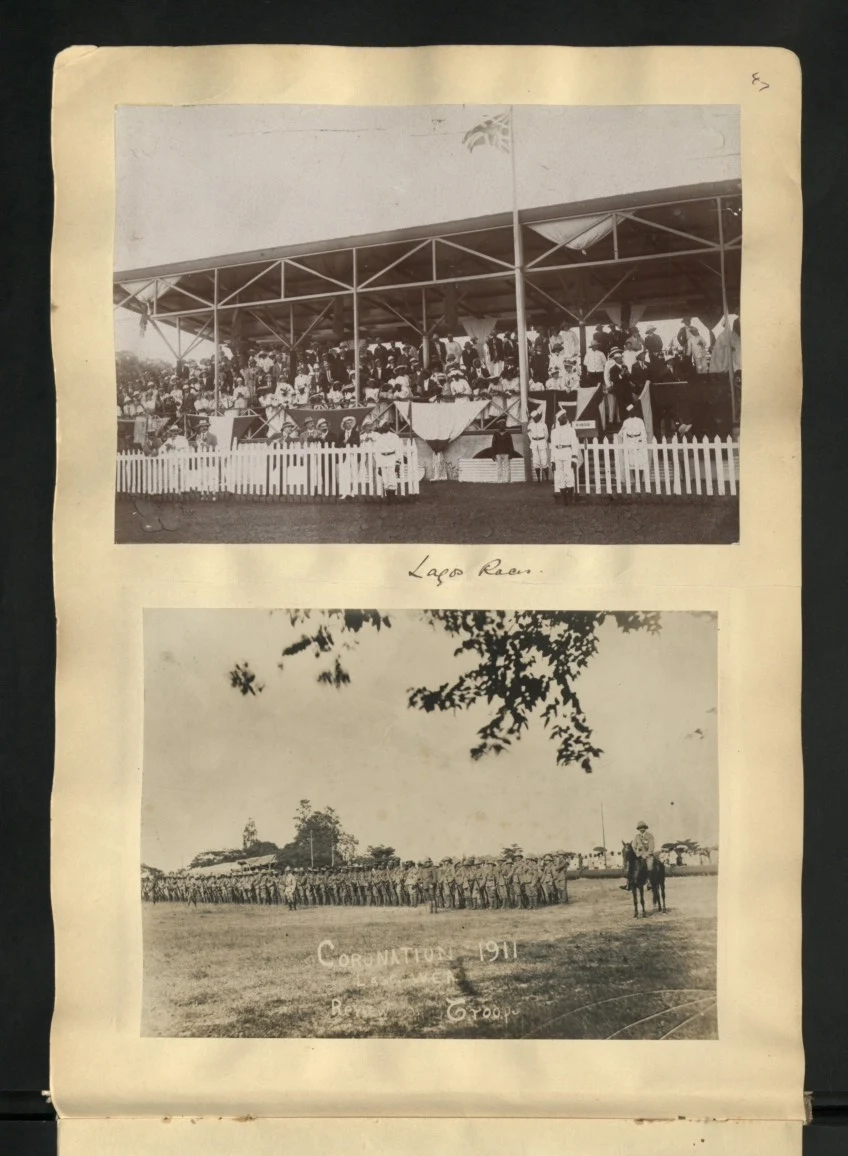
An album leaf preserved in the British Colonial Office collection puts two uses of open ground on one page. In the upper photograph, labelled Lagos races, spectators watch from under a covered stand behind a low fence. Below it, the caption identifies a troop review for the 1911 coronation. The archive does not supply an exact date for the upper frame or establish that the two photographs record the same occasion. Read with Aradeon’s later recollections, the images show why the arrangement of a public space matters: a stand, boundary or open field can give different groups distinct places to look, move and be seen. [2][3]
The old ground was used for Nigeria’s independence celebrations in 1960. By the time the concrete grandstand was built in the early 1970s, it had acquired a new architectural scale. Aradeon argued that the grandstand visually overwhelmed the neighbouring House of Representatives and a sculpture of Queen Elizabeth II by Ben Enwonwu. His point was about what a person in the city could see: putting up one monument can make others harder to read, even when they remain in place. The same ground could host quite different gatherings, but the concrete addition made some traces of its earlier architecture less visible. [2][4]
Neither a national ceremony nor a building phase exhausted the square’s use. The Biennial’s 2024 archive identifies it as one of the venues of FESTAC ’77 and records Miriam Makeba performing there. In a statement about his own installation, Victor Ehikhamenor recalled a different type of public gathering at the square: a religious crusade led by Archbishop Benson Idahosa. Those memories matter in different ways. One connects the square to a festival and to artistic exchange among African and diaspora publics; the other helps explain why Ehikhamenor saw an architecture for gathering when he looked at the same site. [4][6]
For Traces of Ecstasy, a 2024 pavilion, the artist Nolan Oswald Dennis designed overlapping curved walls using a pattern of concrete blocks and wooden supports. Curator KJ Abudu’s account connects that pattern to the open screens of mid-century buildings associated with African decolonisation, as well as to forms of temporary construction. In the pavilion the openings let viewers look between the enclosure and its surroundings. The design brought the built vocabulary of the square into the exhibition while creating a place to listen, walk and gather inside it. Curatorial documentation describes the intention and design; it supplies no evidence of how each visitor experienced the space. [4][5]
Sound was another way of working with the site. Abudu describes Evan Ifekoya’s contribution as using speakers made from dried gourds, spaced around the pavilion rather than grouped on one stage. The score brought recordings of water and Lagos street sound into contact with Yoruba drumming and the voice of Tafawa Balewa. A speech associated with a national ceremony therefore reached listeners through several points in a temporary structure, alongside sounds of living and moving through the city. The archival programme identifies the ingredients of the work, but the way a particular listener encountered them would have depended in part on where they stood. [5]
Adeju Thompson worked with a different kind of enclosure. In the same pavilion, Thompson hung large lengths of àdìrẹ, cloth patterned by keeping indigo from reaching selected areas during dyeing. Abudu traces that technique to Yoruba practice in southwestern Nigeria and describes the suspended cloth as recalling canvases that shade and shelter markets. The fabric was doing more than carrying a recognisable pattern: how it hung helped define a space for people underneath it. The installation made a connection between a temporary art pavilion and the practical ways people make places for gathering in Lagos. [5]
Ehikhamenor approached the square through devotional materials. His description of Miracle Central names white handkerchiefs associated with Nigerian Pentecostal worship and rosaries stitched onto lace, with other devotional objects suspended in the enclosure. These things helped him revisit the square’s life as a place of worship, alongside its more familiar association with independence. The objects speak to different Christian forms and local practices; their combination is the artist’s construction. It makes it possible to think about a religious gathering through the scale of an enclosure and the handling of everyday things, without treating religious experience in Lagos as uniform. [6]
The 2026 venue introduces a different set of surroundings. Eko Atlantic is built on land reclaimed along the Atlantic shoreline at Victoria Island. The developer presents it as an investment district with its own planned infrastructure. The description identifies the setting and its stated purpose; it does not establish who actually reaches the Biennial or how the move affects attendance. What can be established is that the November programme places the exhibition in a coastal development rather than within the architecture of the former racecourse. The 2024 work can help readers notice the difference without implying that the same work has been reinstalled. [1][4][10]
At the new site, the public programme listed Study for Reverberation, a collaboration between Thompson’s Lagos Space Programme and the Chicago collective Floating Museum, for an opening-day discussion about objects and memory. Thompson’s work with suspended cloth at the 2024 event is documented; the new programme establishes a collaboration and title, but it does not on its own establish how the new work was made or how audiences received it. Reading the two records together lets us follow a practitioner across editions without using a previous work as a substitute for evidence about the new one. [1][5][8]
The Biennial’s collection offers another form of continuity across venues. Its 2026 announcement groups works and artists associated with past editions alongside new loans and donations. The foundation’s account describes a planned permanent pavilion and collection as a way to maintain some of that work across the intervals between exhibitions. A collection can keep work available after a temporary venue closes, but it can only carry part of the experience forward: a length of cloth may be conserved independently of the structure it once crossed, and a sound file independently of the room where somebody heard it. What survives in a collection is a different record from what survives in a city. [5][8][9]
The curators, Chinyere Obieze, Furen Dai and Sam Hopkins, ask why some works go unseen, naming concerns that range from what institutions acquire to what they can safely show. Their question becomes more concrete alongside the history of the square. A viewer’s access to art can depend on how a wall is built, how a work is documented, or what happens between editions. The 2026 ticket page records free admission to public events for university students and children under thirteen. That is one specific public offer; it does not tell us which audiences can make the journey, or whose work they encounter once there. The historical record shows why those questions belong alongside a list of artists. [1][2][5][7][11]
A biennial can move, but a work made for a particular site carries traces of its old address. At Tafawa Balewa Square these ran from a remembered school parade to a recording of an independence speech and the practical shelter of hanging cloth. At Eko Atlantic the new programme asks what a museum might make visible. Lagos’s earlier exhibition offers one answer: begin with the people who already made and used a place, and let an artwork change how a visitor sees or hears what was there before. [1][2][5][6][7]
- [1]Lagos Biennial. Programme: Lagos Biennial 2026, The Museum of Things UnseenUndated page, consulted 2026-11-15; public opening 2026-11-14
- [2]Glendora Review: African Quarterly on the Arts. David Aradeon, Planning Lagos: The Unmaking of Tradition1996, vol. 1, no. 3
- [3]The National Archives UK, Colonial Office collection. CO 1069/64: album leaf showing Lagos races and a coronation troop reviewEarly twentieth century; troop review 1911, upper image undated
- [4]Lagos Biennial. LB 2024: REFUGEFebruary 2024 edition; consulted 2026-11-15
- [5]Lagos Biennial. KJ Abudu, Traces of EcstasyFebruary 2024 pavilion; consulted 2026-11-15
- [6]Lagos Biennial. Victor Ehikhamenor, Miracle CentralFebruary 2024 commission; consulted 2026-11-15
- [7]Lagos Biennial. Curators Announced for Lagos Biennial 2026Undated page, consulted 2026-11-15
- [8]Lagos Biennial. Lagos Biennial Announces Artist for its 5th EditionUndated page, consulted 2026-11-15; exhibition 14 Nov–6 Dec
- [9]Lagos Biennial. Àkéte CollectionUndated page, consulted 2026-11-15
- [10]Eko Atlantic. About Eko AtlanticUndated page, consulted 2026-11-15
- [11]Lagos Biennial. TicketsUndated page, consulted 2026-11-15
Did this publication help you understand the topic?
0 voluntary responses. Browser-based participation; responses are not a representative survey.
We welcome suggestions, contributions and recommendations.
Editorial standards ↗