On 14 November 2026, the exhibition Reconexão opened at Instituto 12 in Leblon, in the south of Rio de Janeiro, as part of Brazil’s Black Consciousness Month. Its paintings, photographs, videos and works using mirrors put the experiences of Black Brazilian women at the centre. In an interview published that day, the artist, Panmela Castro, described wanting to make room for affection, desire and the freedom to describe oneself. The line matters because it asks viewers to look beyond which people a gallery puts on the wall. Castro’s earlier work supplies a more precise question: what happens in the hours, conversations and exchanges that make an image possible? [1] [2] [3]
In Vigília, a series of portraits made at night, Castro begins by inviting someone she knows into the studio. The sitter stays in the room while Castro paints but need not hold a pose for the duration. The time in the room can include conversation and silence. Castro describes noticing the changes in the encounter and making decisions about what to render in detail and what to leave as a single mark. Her account gives the practice a concrete rhythm: a visitor arrives; the two people spend hours together; the painter makes and revises an image in the visitor’s presence. A face remains recognisable enough to name some of the paintings, but the method also leaves room for the evening to shape what is painted. [2] [3]
The changes Castro describes are material. She lists traces of dripping paint, thickly built layers and more restrained brushwork. Those differences tell a viewer something about how the surface was worked. They cannot tell a viewer, on their own, whether a silence between the two people was comfortable or tense. The artist calls the painting a memory of the encounter; the wording leaves room to distinguish a painter’s memory from a record that could reconstruct what was said or how the sitter felt. Her studio page places named portraits, including one of Mc Carol de Niterói dated 2021, alongside the account of the method. The individual named there is more specific than any general category of sitter. [3]
The time and place of the sitting also change the place of the viewer. In 2024 the Museu de Arte do Rio announced that its exhibition Ideias radicais sobre o amor would open with three unpainted canvases for Vigília no Museu. The artist would paint the portraits at night, when the museum was closed to visitors. The exhibition was also to include 50 photographs documenting the series. The blank canvases gave an opening visitor an unusual piece of information: they could see where an image would go before it existed. Photographs could then bring part of the process into view while the hours of the sitting itself remained outside ordinary opening time. In that arrangement, a museum can show how a work was made without opening every part of the making to spectators. [3] [4]
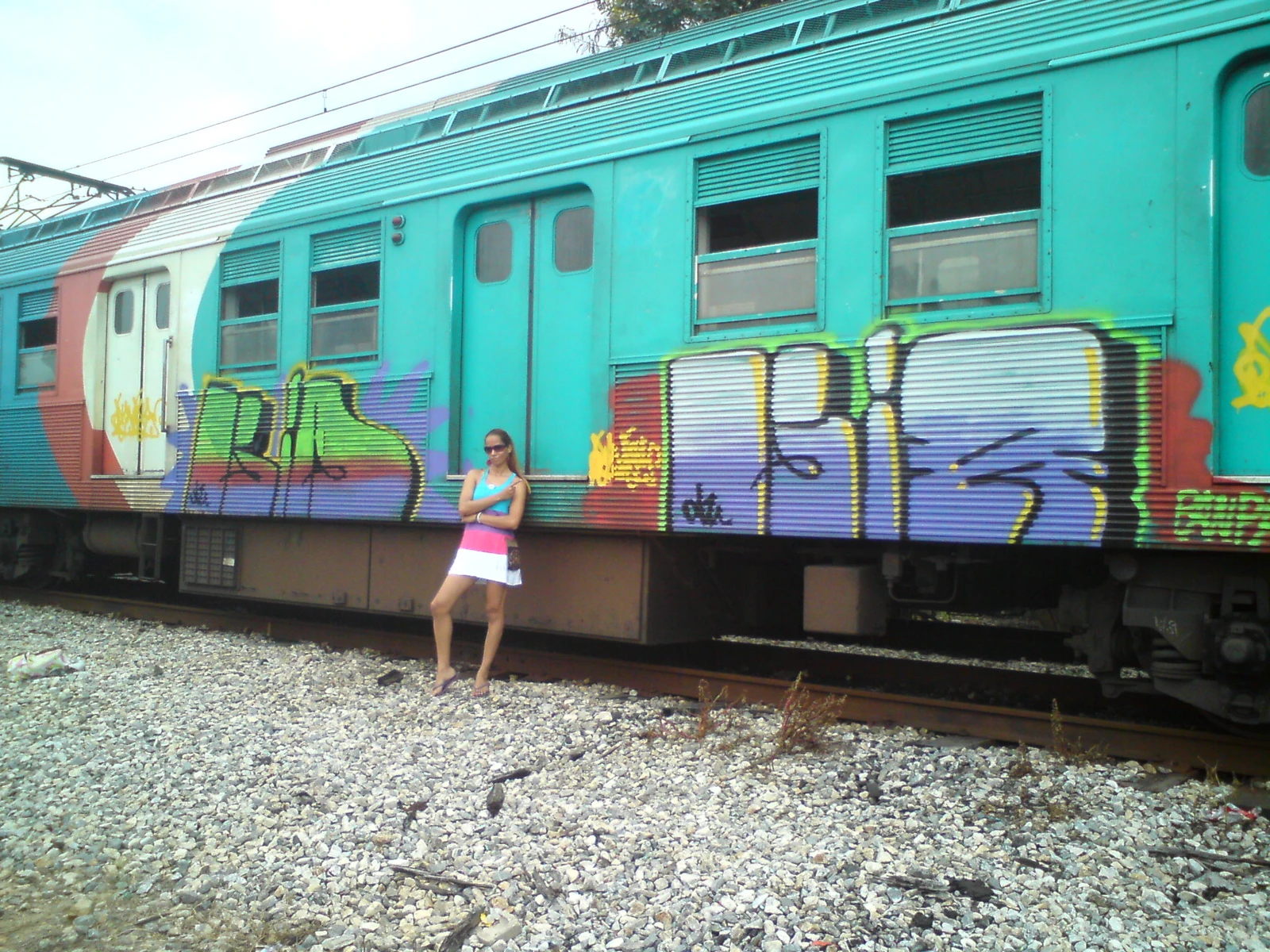
The distinction between the people present during the making and the people who encounter the result looks different in Castro’s earlier graffiti. In the archival photograph used here, she stands beside a spray-painted train carriage in Rio de Janeiro. The archive’s filename gives 2010 while its date field and the camera metadata both indicate November 2009. The picture does not establish who painted the lettering on the carriage. It does locate Castro in the early period of the street practice she recalled in November 2026, when she described making an image in the street as a way to affirm that her experience had a place in the city. [2] [8]
In July 2013, another public setting gave the act of painting a specific purpose. Brazil’s Secretariat for Policies for Women announced that Castro, also known as Anarkia Boladona, would work on the walls of Funarte during the Brasília launch of two calls for projects by women, one in visual arts and the other in film. The announcement proposed ten visual arts selections; it does not document who eventually received support. It does show that painting a wall could sit alongside a practical question about how women’s work gets made. Here graffiti was part of a public occasion on which the rules and resources for producing future projects would be announced. [5]
The words in a later mural show what can also happen after a wall has been painted. Writing in Interfaces in 2019, the Brazilian scholar Roberta Rosa Portugal analysed a mural Castro made in 2016 for the opening of a Frida Kahlo exhibition at Caixa Cultural in São Paulo. Castro translated a line about wings from Kahlo’s diary into Portuguese and put it alongside a statement about women belonging wherever they choose. Portugal tracks how the words change meaning as they move from a private diary drawing into an image on a public-facing wall. The researcher also reads Castro’s wording as a reply to a familiar saying that assigns women to the kitchen. Both the translation and its placement matter: a reader arriving at the exhibition could meet the two lines together before entering it. [6]
Portugal’s method is to read the documented mural, its language and its setting together. That tells us how one work makes a familiar claim about women available for disagreement. It cannot establish whether passers-by recognised the saying or changed their minds. The same distinction is useful in looking at Vigília. Where the mural makes a phrase available to people who were never part of making it, the studio practice gives someone a place in the room while a portrait takes shape. The surface that later meets the public is a consequence of that encounter. The material and the audience change, and so does the kind of participation the artist can offer. [3] [6]
Retratos Relatos offers a different arrangement. Sesc Santa Catarina’s notice for its 2025 exhibition traces the project to messages and stories Castro began receiving in 2019. It describes the work as developing through a residency at Sesc Santa Rita in Paraty and records ten women’s paintings and accounts being presented together. In this format the written or spoken account has a public life beside the picture. A viewer does not have to search a painted expression for signs of what a woman has lived through: the words give the person’s account a separate place in the exhibition. Putting testimony next to a portrait is an editorial choice as well as an artistic one, since it affects what viewers can know from each. [7]
Vigília and Retratos Relatos therefore offer distinct answers to how much of an encounter should be carried out of the room. One can make time together felt through a painted surface and leave parts of the exchange private. The other can place a story with the image so the speaker’s account remains distinguishable from what the artist makes of it. Neither exhibition description establishes what any participant disclosed outside the work, and there is no need to fill in what the public record leaves private. For a reader, that matters because the presence of a Black woman in an exhibition does not tell us whether her own account is audible there, any more than an omitted story proves that she was excluded from making the image. [3] [4] [7]
The Museu de Arte do Rio's instructions for Chá das Cinco, a work in the 2024 exhibition, show another way Castro separated participation from exposure. At a table set for tea, visitors could read advice a previous visitor had placed under a saucer and leave a new note for the next person. The exchange did not depend on two visitors meeting. It depended on a seat becoming free, a note being left in a particular place and the next visitor finding it. The text even specified when tea would be served and how much was available. Those small arrangements are part of how the work was meant to operate. They also help distinguish public participation in an artwork from an invitation to make one's own experiences public. [4] [9]
At Reconexão the exhibition announcement adds another visible material to the mix: mirrors. Castro told Agência Brasil that some works would invite audience participation, though the report does not identify the interaction offered by every object. A mirror changes a basic condition of looking: the observer can appear in the surface as well. In a display that also contains fixed images and recorded media, that possibility gives the viewer a different relationship to what is seen. Tickets for the opening were free and had to be reserved because the room had limited capacity. That is what was documented about entry; it does not tell us who was in the room or how visitors responded. [1] [2]
Black Consciousness Month gives the November opening its public context. Castro’s own account of the work gives it a more intimate one. In speaking about Reconexão she drew on her experiences and on stories other women had shared; when speaking about Vigília she returned to the hours she spends alongside one person. The two scales sit together in Leblon without requiring a sitter to stand in for all Black Brazilian women. The exhibition makes the question of representation tangible through choices about what kinds of images can be made, what words accompany them and which encounters remain only partly visible. [1] [2] [3] [7]
Put beside the 2016 wall and the 2024 canvases that began blank, the November exhibition shows why the act of portraying someone deserves attention in its own right. A wall can give a familiar saying new neighbours and new readers. An evening of painting gives a sitter time with an image that is still changing. Bringing these practices into view makes room for the people whose gestures, words and presence help give a portrait its shape. [1] [3] [4] [6]
- [1]Instituto 12 (event record on Sympla). Circuito Cultural Instituto 12 — Abertura da exposição Reconexão, de Panmela Castro2026-11-14 (event)
- [2]Agência Brasil / EBC. Circuito Cultural começa no Rio com celebração da Consciência Negra2026-11-14
- [3]Panmela Castro. VigíliaUndated; accessed 2026-11-15
- [4]Museu de Arte do Rio. Panmela Castro abre exposição individual no Museu de Arte do RioUndated page; exhibition opened 2024-08-09; accessed 2026-11-15
- [5]Secretaria de Políticas para as Mulheres / Presidência da República, Brazil. SPM e Ministério da Cultura lançam, na 3ª feira, editais para seleção de projetos de artes visuais e de cinema2013-06-28
- [6]Roberta Rosa Portugal, Interfaces (Universidade Estadual do Centro-Oeste). Conexões discursivas entre Panmela Castro e Frida Kahlo: uma leitura sobre os movimentos de sentidos2019, vol. 10, no. 2
- [7]Sesc Santa Catarina. Arte Sesc: Exposição Retratos Relatos2025-04-24
- [8]Dr. Sara Peterson / Wikimedia Commons. Panmela Castro com lata de spray, Rio de Janeiro, em 2010..jpgc. 2009–10; file title says 2010; catalogue date and EXIF give 2009-11-01
- [9]Museu de Arte do Rio. Ideias radicais sobre o amor — English exhibition text and instructions2024
Did this publication help you understand the topic?
0 voluntary responses. Browser-based participation; responses are not a representative survey.
We welcome suggestions, contributions and recommendations.
Editorial standards ↗