On 12 November 2026, Brazil’s Federal Regional Court of the First Region published its account of a listening meeting held six days earlier in Alcântara, Maranhão. Representatives of quilombola communities, Black communities with histories and institutions rooted in the aftermath of enslavement, pressed for greater influence over decisions about their territory, transparency about public spending, and consultation on measures that affect them. The court reported that part of the land had been registered in June and that work on the southern area was still under way. The meeting settled no claims. It did, however, put a practical question in front of the officials responsible for carrying out Brazil’s agreement with the communities and a regional human rights judgment: who gets to shape what happens after the state recognises the land as theirs? [1] [2] [3]
The dispute is older than the legal right the communities invoke. Maranhão’s government issued an expropriation decree in 1980 for the space project; the Alcântara Launch Centre was created in 1983 under military rule. Families were moved from the coast into planned inland settlements called agrovilas beginning in 1986. Brazil’s 1988 Constitution subsequently recognised the land rights of quilombola communities in Article 68 of its transitional provisions. The new constitutional guarantee did not restore the conditions under which households had worked and lived. The Inter-American Court’s judgment describes how the move altered access to land and resources on which people depended. That history explains why the remedies now reach beyond the ownership of house plots. [2] [3] [4]
Leonardo dos Anjos’s published account, edited with the participation of quilombola scholar Davi Pereira Júnior, gives the resettlement a household scale. He describes adults who received agricultural plots and children who grew up and formed families without an equivalent supply of land. His account also distinguishes improvements to the main road from the poor condition of local routes used by the villages. This is testimony about specific places and a past period, not a survey of present conditions. Its value is to show why official maps of settlement and infrastructure can look complete while a family’s ability to farm, travel or earn a living still depends on access outside the plot it was assigned. [2] [4]
Community organisations made that difference between a plot and a territory central to their demands. Pereira Júnior’s preface describes consultation workshops in which participants worked to create an association capable of receiving a collective title. A 2015 open letter reproduced in the same volume insists on the boundaries identified by the federal agrarian agency’s 2008 study and objects to a proposal that would have excluded coastal land. These records show residents acting through organisations and producing their own account of what a boundary would do. Their intervention was not simply a request for compensation for a past move; it was a claim to the authority to maintain a way of life across a connected territory. [2] [4]
The 2008 technical report by the National Institute for Colonisation and Agrarian Reform, known as Incra, identified around 78,105 hectares for collective title. The federal government’s account of the agreement signed on 19 September 2024 records that the title area included about 12,645 hectares on the coast north of the launch centre that the defence ministry had wanted for potential expansion. The parties accepted the continued operation of the centre within its existing area. The agreement drew a line between recognising land for collective ownership and retaining an operating space programme. It gave public agencies a defined area to work on, but a description of that area and a commitment to issue titles were still different from registration and control on the ground. [2] [3]
The Inter-American Court’s November 2024 judgment makes the distinction between collective and individual ownership explicit. It found that the individual titles previously issued to some resettled families did not provide legal security to the communities as a collective. The remedy requires a title that preserves communal ownership and self-administration. This does not erase the circumstances of households in the agrovilas. A November 2026 account by Brazil’s federal regional court acknowledges differences over individual and collective titles and over which institutions represent communities. The legal protection for a shared territory and the work of organising decisions within that territory must both be taken seriously. An agency’s ability to put one association’s name on a deed does not itself tell us how households participate in that association’s decisions. [2] [5]
Registration has advanced unevenly. The regional court reports that the northern area, approximately 45,000 hectares, was registered in June 2026. For the south, the court’s 12 November account describes an agreement among the federal government’s legal office, the federal judiciary and the Maranhão state court to examine chains of title, the records that show how ownership of a property has passed from one holder to the next. Five analyses had been sent to the federal legal office and 22 remained pending. The same account mentions an expected 185 million reais in Incra’s 2027 budget for compensation. That is an expectation reported at the meeting; it does not establish an approved appropriation, compensation paid or a date when the southern land will be registered. [1] [5] [6]
Brazil’s September 2024 expropriation decree explains why the investigation of private titles matters. It authorises Incra to expropriate rural property with valid private ownership in the recognised territory. It treats public land, land already registered to the community and invalid claims differently from valid private property. A review of a title determines which legal route the agency can use; a budget forecast cannot decide that question for a particular parcel. Compensation to private owners for expropriation is also separate from reparation owed to the quilombola communities under the judgment. Putting both payments in one category would obscure who is being paid and for what. [1] [2] [10]
The court also describes two different forums. Its own listening meeting can help agencies and courts coordinate work on titles and public services, and the account says the regional land commission will consider what role it can play next. The permanent forum required by the Inter-American judgment concerns the relationship between the communities and the launch centre. The judgment gives it specific work: preserving customary activities such as farming, fishing and visits to places of worship or burial; agreeing in advance on appropriate compensation for justified restrictions; and involving residents in monitoring impacts. Confusing these forums would make a meeting about access to public services appear to answer a different question: whether the people affected by launch operations can shape the rules under which those operations coexist with local life. [1] [2] [5]
Legal scholars Fábio Lima Quintas and Leossandro de Sousa Vila Nova use Alcântara to argue for an approach in which courts help organise a process that can learn from its results and be revised with the participation of the people affected. The November record shows one reason their approach matters: completing the task requires land officials, registries, lawyers and different levels of government to do work a court cannot do for them. It also shows the limit of coordination on its own. The community representatives’ preliminary consultation protocol is evidence that they are working out how they want to be heard. The regional court describes the protocol as something that may inform future discussions. It records no decision adopting it or accepting it as a substitute for the consultation required by the judgment. [1] [2] [7]
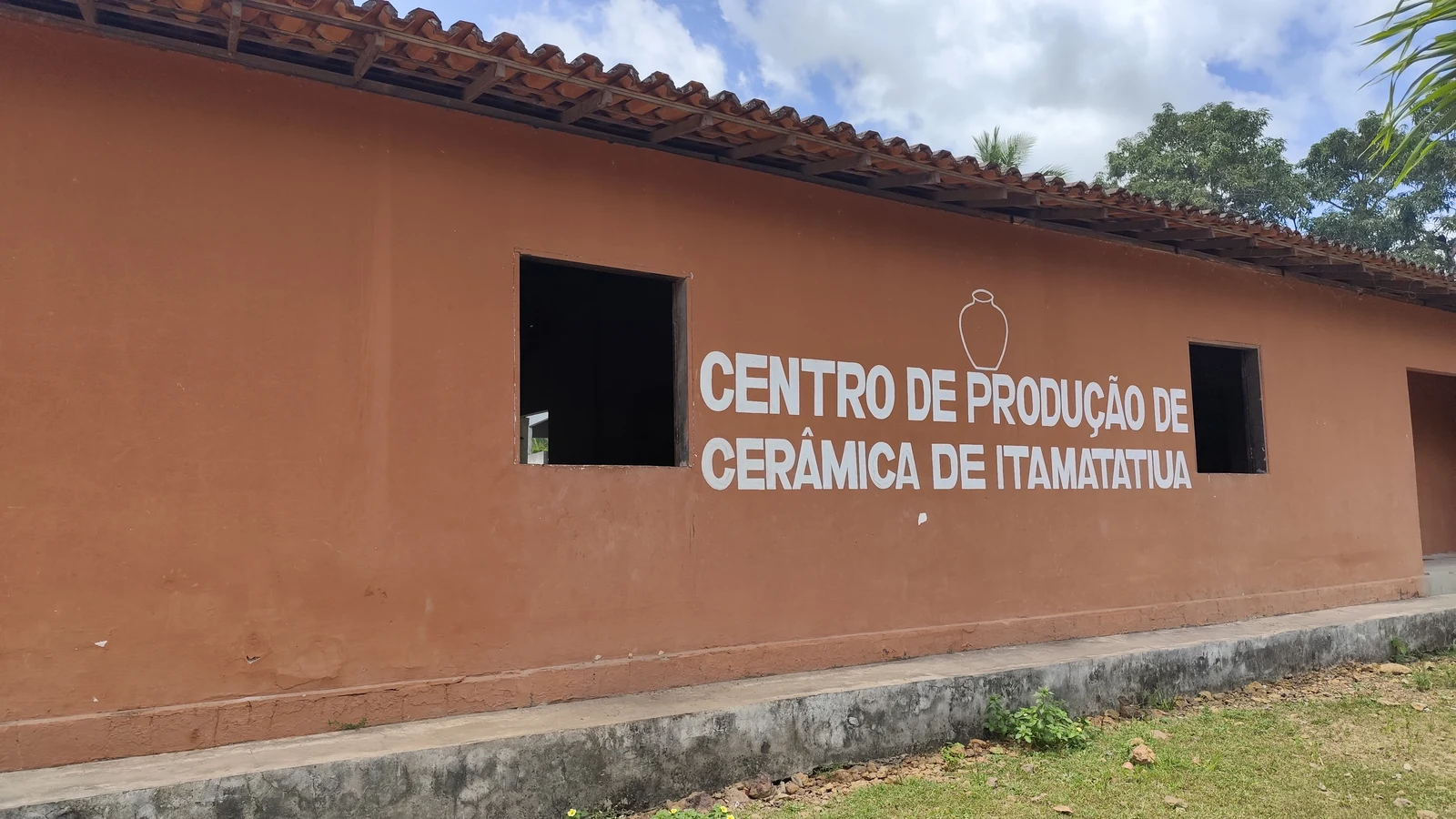
The historical photograph of the ceramics production centre in Itamatatiua, taken in August 2025, shows one of the institutions that a territorial record can easily miss. In collaborative research with potters, Arkley Marques Bandeira treats the craft as a relationship among techniques, materials, memory and collective identity. The centre gives women who make pottery a place to work and pass on knowledge. It is evidence of community organisation before the November meeting, not an outcome of that meeting or an illustration of all 171 communities covered by the judgment. It shows why use of territory cannot be understood simply by adding up private parcels: a working place and the social arrangements that sustain it have value to people who may never hold its title in their own name. [2] [8] [9]
Bandeira’s research follows pottery from the acquisition of materials through making and use. That approach helps show how a workshop sits within a territory rather than apart from it. A building can be recorded at one point on a map; the knowledge and work visible there depend on access to materials and on people having places to meet and teach. The photograph shows the centre’s exterior. The published research supplies the evidence about the craft and its organisation. [8] [9]
The federal court reports that Alcântara’s representatives also raised needs in sanitation, health, housing and infrastructure. Land registration can clarify who can make decisions about the land and protect it from conflicting claims. It does not build a sanitation network or keep roads open. The distinction appears in the 2024 record too: the federal legal office treated schools, health services and housing as further work after the agreement. There is continuity between that commitment, the earlier testimony about local roads, and the needs put forward in November. The difference now is that the communities can point to a registered northern area and a judgment that sets out duties. Whether services follow depends on additional decisions and spending that can be identified separately. [1] [2] [3] [4]
The 2024 agreement and the regional judgment did not invent the communities’ account of their territory. They gave effect to claims that residents had been organising and documenting for decades. What is now measurable is whether work in the southern area moves from property reviews to completed compensation and registration; whether the communities can govern collectively without losing the voices of households that disagree; and whether the launch centre and residents agree on rules that protect access and livelihoods. The November meeting made those responsibilities visible. Its value will depend on whether the institutions it brought together give residents a part in deciding how the obligations are carried out. [1] [2] [4] [5] [6] [7]
- [1]Tribunal Regional Federal da 1ª Região. TRF1 promove diálogo sobre direitos territoriais de comunidades quilombolas de Alcântara12 November 2026; meeting on 6 November 2026
- [2]Inter-American Court of Human Rights. Caso Comunidades Quilombolas de Alcântara vs. Brasil: Sentença21 November 2024
- [3]Agência Gov, via Advocacia-Geral da União. Acordo concilia território quilombola de Alcântara e Programa Espacial Brasileiro19 September 2024
- [4]Casa 8 / Nova Cartografia Social da Amazônia, hosted by Universidade Estadual do Maranhão. Leonardo dos Anjos: Direitos, resistência e mobilização: a luta dos quilombolas de Alcântara contra a base espacial2016; includes community letter dated 26 June 2015
- [5]Tribunal Regional Federal da 1ª Região. Reunião da Rede de Inteligência aborda solução multi-institucional para o caso Comunidades Quilombolas de Alcântara vs. BrasilNovember 2026; accessed 13 November 2026
- [6]Tribunal Regional Federal da 1ª Região. TRF1 encaminha ao CNJ pedido sobre execução de sentença da Corte Interamericana em Alcântara/MA2026; accessed 13 November 2026
- [7]Revista da Defensoria Pública da União. O Poder Judiciário diante da sentença da Corte Interamericana de Direitos Humanos no caso das Comunidades Quilombolas de Alcântara19 December 2025
- [8]Túllio F via Wikimedia Commons. Quilombo Itamatatiua - Alcântara - 20250828120957.jpgCaptured 28 August 2025
- [9]Revista Arqueologia Pública, Universidade Estadual de Campinas. Arkley Marques Bandeira: Aproximações entre a etnografia arqueológica e os modos de fazer na comunidade quilombola de Itamatatiua, Alcântara – Maranhão2018; includes documentation from 2016 and 2017
- [10]Diário Oficial da União, archived by Comissão Pró-Índio de São Paulo. Decreto nº 12.190, de 20 de setembro de 202420 September 2024; published 23 September 2024
Did this publication help you understand the topic?
0 voluntary responses. Browser-based participation; responses are not a representative survey.
We welcome suggestions, contributions and recommendations.
Editorial standards ↗