Angola’s Constitutional Court struck down five provisions of the country’s NGO law in a judgment dated 3 November 2026 and reported by Novo Jornal on 10 November. The parliamentary group of UNITA brought the challenge. The ruling removes parts of the March law that governed access to NGO status, funding and administrative suspension, while leaving the wider system of supervision in place. The distinction matters for community organisations in Angola: the state can recognise an organisation as an NGO for the purposes of a specific law, but that status is different from the underlying right of people to organise together. The court’s ruling turns on where one ends and the other begins. [1] [2] [3] [4]
The judges’ final order identifies the provisions that were declared unconstitutional with generally binding force. Four were struck on grounds of legal certainty and protection of legitimate expectations: Article 6(3), Article 13(2)(j), Article 30(1) and Article 30(5)(a). The fifth, Article 13(3), was struck on freedom of association grounds. These are individual provisions of Law 2/26, not the whole law. Reading the final order matters because the judgment also records arguments by the parties and separate opinions by judges. Those passages help explain the debate, but they do not themselves add to the list of provisions the court struck down. [1] [2] [3]
The dispute is partly about how many decisions stand between an association and its work. The March statute treats formation as one step and inscription under the NGO law as another. The court read inscription as a route for an already constituted nonprofit body to acquire a particular status and the benefits attached to it. But the law also set out a step called habilitação, or authorisation to operate under the scheme. It left essential features of that process to rules the executive would make. The judges found that the statute had not made clear enough how authorisation related to inscription or what criteria would govern it. The problem was therefore not the existence of a register alone. It was the uncertainty about what the administration could require before an organisation could qualify. [1] [3]
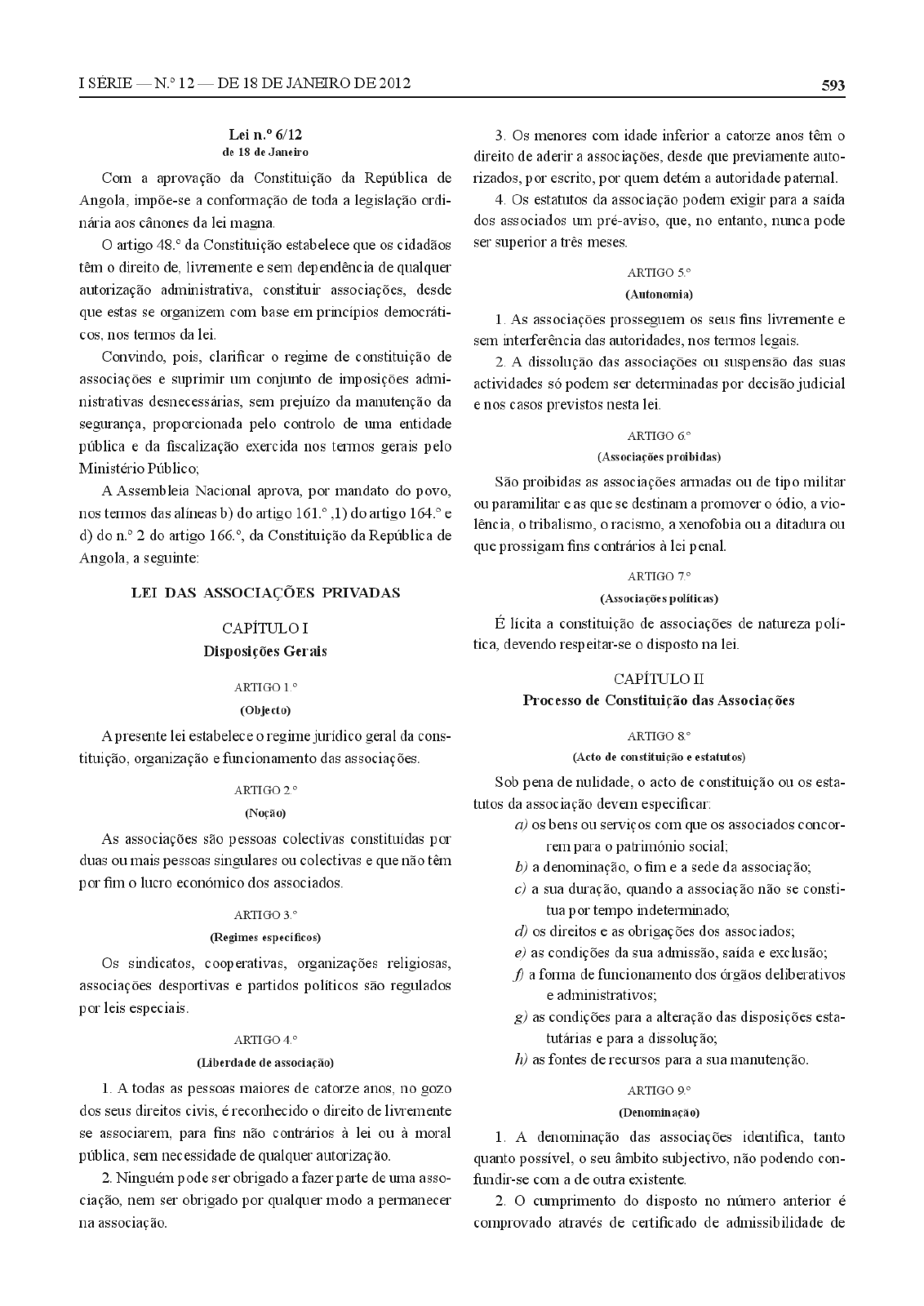
The opening page of the 2012 Private Associations Law, reproduced here from Angola’s official gazette, shows an earlier effort to separate public oversight from official permission. The preamble invokes the 2010 Constitution and says the legislature wanted to remove unnecessary administrative requirements. Article 4 sets out the freedom to associate; Article 5 protects organisational autonomy and requires judicial decisions for the dissolution of associations or suspension of their activities in the circumstances covered by that law. The act replaced the 1991 associations law. The 2010 Constitution protects the right to form associations without prior administrative authorisation and bars public authorities from dissolving them outside the law. It thus supplies a higher standard against which the legislature’s later choices about NGOs can be tested. The image is a record of that legislative choice, rather than an illustration of the 2026 proceeding. The November judges returned to the older law when discussing which kinds of decision an administrative body could make and which belonged to a court. [1] [4] [5]
That history does not begin with the registration of NGOs. In a study of associational life in colonial Angola, historian Joana Dias Pereira compared published statutes with other records, including those concerning groups that did not gain official recognition. The two sets of evidence show why a gazette can establish what a government recognised but cannot tell us everything people did together. Association could be a way to organise mutual assistance, cultural activity or collective demands under unequal conditions. The legal order has changed profoundly since colonial rule; the useful comparison is about evidence. A list of organisations recognised by a state never amounts to a full account of how people participate in public life. [5] [6]
Fernando Pacheco’s account of work by the Angolan organisation ADRA in rural Huambo gives a different view of that participation. Writing in 2004 about a community development experience, he asked what happens when outside institutions work to timetables and procedures that differ from those of local participants. It is a practitioner’s account of one setting, not a measurement of all Angolan NGOs. Its relevance is the relationship it describes: an organisation that can secure funding and satisfy official requirements still has to negotiate priorities with the people involved. The people who stand to lose from uncertainty over status or funding include those who rely on a project and those who want a say in how it is run. [3] [7]
The present law’s funding provisions show how that uncertainty can arise. The statute requires organisations to disclose their funding sources at inscription and limits the use of funds from sources convicted of specified offences. The ruling did not set aside the reporting requirement or the entire list of restrictions. It struck the list’s open-ended final clause and the paragraph setting out a consequence for violations. The latter pointed readers to an article that did not actually define NGO status, a defect the judges found significant for the freedom of association. A group and its funders need to know in advance what is prohibited and what it would cost to breach the rule. Clearer rules can serve public oversight and protect legitimate work at the same time. [1] [3]
Public support is another reason why status matters. The March law provides for material, technical or financial assistance through agreements and envisages a separate instrument for the use of public funds to support domestic NGOs. These are routes through which assistance may be granted, not appropriations or evidence that payments have been made. The difference matters to a small organisation deciding whether it can sustain a service: a provision allowing the state to support it is different from a signed agreement, and a signed agreement is different from money reaching the project. Pacheco’s account adds a further distinction: a funder’s timetable and a community’s timetable need not coincide, even when the resources are available. [3] [7]
Suspension raises a related question about what is being taken away. In its reasoning, the court distinguished the status conferred by the NGO law from the existence and activities of the association itself. Its final order nevertheless struck the specified parts of Article 30, including the first paragraph, which authorised administrative suspension on broadly framed grounds. The court’s distinction is important because losing access to a category of benefits is different from being required to stop organising altogether. Yet the practical effects can overlap: a legal person may continue to exist even if the loss of a particular status makes a funded activity harder to keep running. The public record of a decision should make clear which consequence an authority is imposing. [1] [3] [5]
The institution that supervises community organisations has already faced a separate constitutional challenge. In January 2026, the court upheld the presidential decree that set the organic statute of the Institute for the Supervision of Community Activities, or ISAC. It treated the creation of an administrative body as a matter within the executive’s powers. In August the ministry responsible for social action described a meeting convened through ISAC at which it stressed NGOs’ development role and the need for financial transparency and accountability. The January ruling concerned the institution’s legal basis, not the validity of every power later assigned to it. The November ruling is intelligible precisely because it reviews particular rules without undoing the institution. [1] [8] [9]
The ruling also sets out different institutional interests without requiring a judgment about anyone’s motive. The ministry presents NGOs as partners in public programmes and sees supervision as a way to improve accountability. Human Rights Watch’s March response argued that broad authorisation and suspension powers could expose independent groups to arbitrary interference. These positions make different demands on the same administrative system. Public authorities need to know how organisations with access to benefits use resources; organisations and communities need to be able to contest decisions and act independently. The court’s distinctions suggest what would make that tension easier to manage: criteria clear enough to assess, consequences clear enough to challenge, and a distinction between administering a benefit and controlling an association’s existence. [1] [3] [9] [10]
The historical sources also caution against measuring civic participation through legal categories alone. Pereira’s study found that the public record of statutes left parts of collective life out of view. Pacheco’s account shows that work with communities can be limited by funding and administrative timetables even when an organisation has the formal means to act. The 2012 and 2026 laws deal with some of those conditions, but neither can tell us how much discretion communities have inside the projects undertaken in their name. Keeping those levels separate makes it possible to ask what a court has changed without assuming that the ruling itself will change every relationship between a ministry, an organisation, its donors and the people it works with. [3] [5] [6] [7]
What the November judgment changes is the set of rules through which an administrative decision about status, finance or suspension can be justified. It does not show that an association has already regained funding, that a particular service has resumed or that any replacement rules have been adopted. The 2012 gazette and the November order together show the issue that will carry forward: Angola can recognise and supervise organisations that work with the state, but that supervisory relationship must leave room for the constitutional freedom to form associations and run their affairs. The next evidence will be in the wording of any replacement rules and in how authorities explain and review the decisions they make under them. [1] [3] [4] [5]
- [1]Tribunal Constitucional de Angola. Acórdão N.º 1166/20262026-11-03
- [2]Novo Jornal. Tribunal Constitucional chumba vários artigos da nova Lei das ONG2026-11-10
- [3]Assembleia Nacional de Angola / Diário da República. Lei n.º 2/26 — Lei das Organizações Não-Governamentais2026-03-02
- [4]República de Angola / Tribunal Constitucional. Constituição da República de Angola, Artigo 48.º2010
- [5]Assembleia Nacional de Angola / Diário da República. Lei n.º 6/12 de 18 de Janeiro — Lei das Associações Privadas2012-01-18
- [6]Joana Dias Pereira / VOLUNTAS. Engaging with Colonial Knowledge on African Associational Life: Angola Case Study from 1860 to 19742023-01-03
- [7]Fernando Pacheco / Centro de Estudos Sociais, Universidade de Coimbra. Caminhos para a cidadania e para a construção da democracia em Angola: obstáculos e avanços2004-09-16–18 (conference)
- [8]Tribunal Constitucional de Angola. Acórdão N.º 1060/20262026-01-14
- [9]Ministério da Acção Social, Família e Promoção da Mulher. MASFAMU reforça mecanismos de supervisão e cooperação com as ONGs2026-08-21 (meeting)
- [10]Human Rights Watch. Angola’s President Signs Repressive Civil Society Law2026-03-05
Did this publication help you understand the topic?
0 voluntary responses. Browser-based participation; responses are not a representative survey.
We welcome suggestions, contributions and recommendations.
Editorial standards ↗