On 11 November 2026, the Federal University of Bahia received the remains of an enslaved African man whom surviving records associate with the 1835 Malê uprising in Salvador. His remains had been held in collections at Harvard. Brazil’s human rights ministry said that the university would hold them temporarily and that decisions on final care would be discussed with the communities involved, especially the Islamic Cultural Centre of Bahia. The return therefore changed who holds the remains. It also brought into the open a question that the transfer itself cannot settle: who will decide how to care for a man whose own name is not known? [1] [2] [6]
The Brazilian ministry’s account dates requests by the Islamic Cultural Centre to 2022. It says the Arakunrin working group, which includes members of Bahia’s Muslim community, activists and researchers, approached Brazil’s foreign ministry in late 2024. The foreign ministry then took up negotiations with Harvard and the Peabody Museum. The sequence matters. Diplomats helped secure an international transfer, but the demand did not begin as a diplomatic initiative. People in Bahia had already identified the return as a matter of religious care and public memory and pressed institutions to act. [1] [2] [5]
The government says a formal commitment and technical cooperation agreement set conditions for temporary custody. The same process brought the remains of a woman of African descent to the National Museum at the Federal University of Rio de Janeiro on 11 November. The shared agreement did not give the two people a shared biography. The Bahia case is associated with an uprising in Salvador; the records for the woman lead to nineteenth-century Rio de Janeiro and a different route into Harvard’s collections. Two Brazilian universities now hold the remains temporarily, and evidence about one person cannot fill gaps in the record of the other. [1] [2] [6]
In the Bahia case, the ministry’s stated plans include scientific examination and Islamic funerary rites. Its report also says final arrangements will be worked out in dialogue with the communities involved. That wording leaves open what examination will take place, on whose authority and under what conditions. These are decisions about the treatment of a person, rather than incidental steps in the management of a collection. The public announcement gives a role to the Islamic Cultural Centre but does not specify the final decision procedure or make the future rites an accomplished fact. [1] [5] [6]
The committee’s 2022 report itself distinguishes cases in which it could identify a person or find a clear geographical connection from others in which available records were much thinner. For people known or thought to have been enslaved, it recommended consultation and set out several possible outcomes, including return or burial. That recommendation was part of a review of Harvard’s collections; it did not transfer custody. What changed in November is that institutions in Brazil could begin making decisions that previously depended on a university in the United States agreeing to release what it held. The Brazilian agreement concerns that transfer and temporary care, and should be read at that scale. [1] [2] [5] [6]
The two institutions describe evidence of the man’s identity differently. Harvard’s 2022 committee report identifies him as an unnamed enslaved African man from a group described in its records as Nagô and states that he was injured during the uprising. Brazil’s ministry uses more cautious wording about his participation and the circumstances of his death. Both accounts draw on historical records reviewed in connection with the collection, so their agreement does not amount to two independent identifications. The ministry reports that he will be known by a Yoruba name meaning companion. That choice gives the public a way to refer to him without claiming to have recovered the name he used in life. [1] [2] [3]
Harvard’s report traces a route from Salvador through a sender and recipient in Boston to a medical society and, in 1889, the Warren Anatomical Museum. The surviving entries can help establish a sequence of possession. They do not give the man a voice in it. Each transfer is described from the viewpoint of the people and institutions that handled or catalogued the remains. A return requires those records, but the fact that earlier institutions kept a ledger does not make their perspective sufficient to determine the treatment of the person they recorded. [1] [2] [5]
The uprising took place in Salvador in January 1835. Historian João José Reis describes its organisers as Muslims, many of them Yoruba speakers known in Bahia as Nagô. Enslaved and freed Africans took part, and organisers also drew in some people who were not Muslim. These distinctions matter for present memory. A shared religion helped organise the revolt, while African origins, language and the different conditions of enslaved and freed people shaped who could act together. The people who appear in the records cannot be reduced to an undifferentiated group, and one entry in a museum ledger cannot tell us a particular participant’s beliefs or role. [2] [3] [4]
Reis links some of those experiences to early nineteenth-century conflicts around Oyo and Ilorin in West Africa. He describes people captured or kidnapped and sold into Atlantic trafficking, and shows how a language shared in Bahia could bring together people whose earlier political ties differed. Testimony he cites also records African schooling and literacy in Arabic before enslavement. That history changes the way the record of the uprising is read. Religious learning in Salvador was neither an invention of the police files nor simply an unchanged survival from Africa. People used knowledge acquired in particular African communities to form new relationships under the conditions they faced in Brazil. [3] [4]
The archive also preserves fragments of a world that the collection record barely touches. The Public Archive of Bahia describes criminal files from the investigation and documents written in Arabic, including passages used as prayers or for protection. Reis reads such materials alongside questioning by the authorities. In one exchange he discusses, a man whom the authorities called Licutan asserted that he could also call himself Bilal. The encounter survives because investigators wrote it down, but it records an assertion of authority over a name. That history gives particular force to the care needed today when institutions name, describe or claim to identify a person who cannot answer them. [1] [3] [4]
The records made by investigators and those made by collectors also leave different gaps. The case papers can preserve a name or fragments of someone’s speech because an official was trying to establish a charge. A collection entry can record who handed over remains and still leave the person unnamed. Neither kind of record was designed to preserve the relationship of that person to his community. That is one reason contemporary consultation matters even where institutions have done extensive archival work. It brings a different kind of authority to a decision about care, without asking anyone living today to supply a personal history that the surviving documents do not establish. [1] [2] [3] [4]
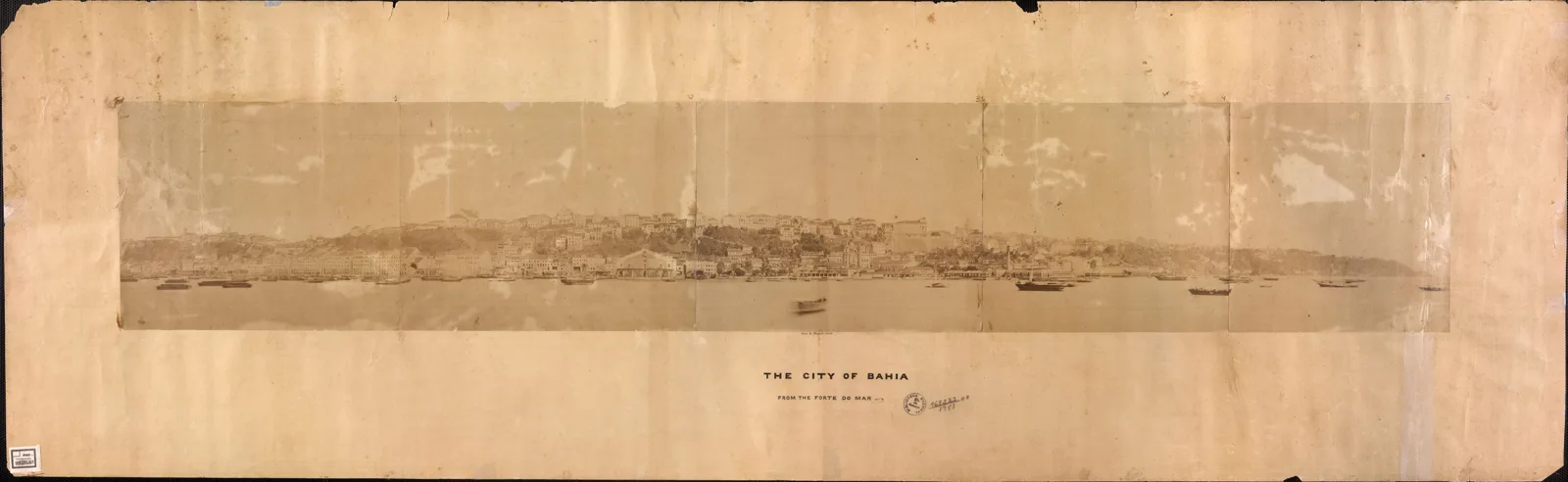
The archival photograph accompanying this review shows Salvador from the water roughly a quarter of a century after the uprising. Its waterfront, buildings and harbour give the documents an urban setting. The image is also a record of a particular vantage point: a city seen from Forte do Mar, with no access to the social relationships, places of worship or identities described in the criminal files. The photograph is not an illustration of the man’s life or of the fighting. Its distance from the event makes the contrast between different kinds of surviving evidence visible without reproducing an image of the returned remains. [3] [4] [7]
The Peabody Museum distinguishes its handling of ancestral remains from the procedure it describes for returning cultural items. For remains outside the United States law governing Native American repatriation, its guidance identifies a university committee that oversees returns. Harvard’s 2022 report recommends researching the history of possession and consulting communities or identifiable descendants about the appropriate course. In Bahia, the Brazilian government reports that advocacy and negotiations both mattered. Neither Harvard’s guidance nor the Brazilian announcement says that a museum’s procedure for reaching a transfer decision should govern the receiving university’s decisions about religious care. [1] [2] [5] [6]
These stages offer different ways to judge whether authority has moved. Brazil’s ministries could negotiate the transfer; the universities accepted responsibility for temporary care; Bahia’s Muslim community was named as a participant in deciding what happens next. There is no public basis in the documents cited here to turn that participation into a claim of exclusive decision-making power or to infer a new funding commitment. The strongest evidence of a further change would be a documented agreement on final care that identifies whose views were taken into account and how. An announcement of return and an agreement on the next steps answer different questions. [1] [5] [6]
The November handover matters because institutions that held the remains for generations no longer have custody of them. The archives of the Malê uprising make it possible to remember the people behind that change without claiming a certainty the records do not offer. For Bahia, the next measure of the return is whether temporary university custody makes room for the community’s role in determining respectful care, and whether the outcome is recorded without exposing the remains or speaking in the man’s name. [1] [2] [3] [4] [6]
- [1]Brazilian Ministry of Human Rights and Citizenship. Governo do Brasil repatria restos mortais de homem escravizado associado à Revolta dos Malês11 November 2026
- [2]Harvard University. Steering Committee Report on Human Remains in University Museum CollectionsFall 2022
- [3]Impressões Rebeldes, Universidade Federal Fluminense. Revolta dos Malês, by João José Reis25 January 2025
- [4]Secretaria de Comunicação Social, Government of Bahia. Arquivo Público da Bahia preserva documentos da Revolta dos MalêsFebruary 2025; records described date to 1835
- [5]Peabody Museum of Archaeology & Ethnology, Harvard University. Frequently Asked Questions: International and Domestic Returns Beyond NAGPRAUndated; accessed 13 November 2026
- [6]Brazilian Ministry of Human Rights and Citizenship. Governo do Brasil repatria remanescentes ósseos de mulher de ascendência africana em cerimônia no Museu Nacional/UFRJ11 November 2026; updated 12 November 2026
- [7]Benjamin Robert Mulock / Acervo Digital Afro-Brasileiro, via Wikimedia Commons. The City of Bahia: from the Forte do Mar1859–1861, catalogue range
Did this publication help you understand the topic?
0 voluntary responses. Browser-based participation; responses are not a representative survey.
We welcome suggestions, contributions and recommendations.
Editorial standards ↗