On 3 November 2026, UNESCO set out what it plans to change at Burundi’s National Museum in Gitega: repair the building, improve conditions for the collection and redesign the exhibition. UNESCO and Burundian authorities launched the project on 22 September with backing from the International Alliance for the Protection of Heritage (ALIPH). The decision concerns the rooms in which schoolchildren, families and researchers encounter a public account of Burundi’s past. It also gives the museum an opportunity to reconsider who can explain the objects and the histories they carry. The public announcements describe the work to be done; they do not announce a completed renovation or a new exhibition already open to visitors. [1] [2]
ALIPH’s July announcement identifies UNESCO as the implementing institution and names Burundi’s National Commission for UNESCO, the African Heritage School and ICOM Africa as partners. The November account describes close collaboration with the Burundian government and says the condition of the building has limited what the museum can do. These statements describe a division of responsibility: external finance supports a project carried out with national and regional institutions. Neither announcement specifies the sum awarded to Gitega, the award of a building contract or the eventual operating budget. Those distinctions matter for a museum whose conservators, educators and front-of-house staff will still need to be paid when the project ends. [1] [2] [7]
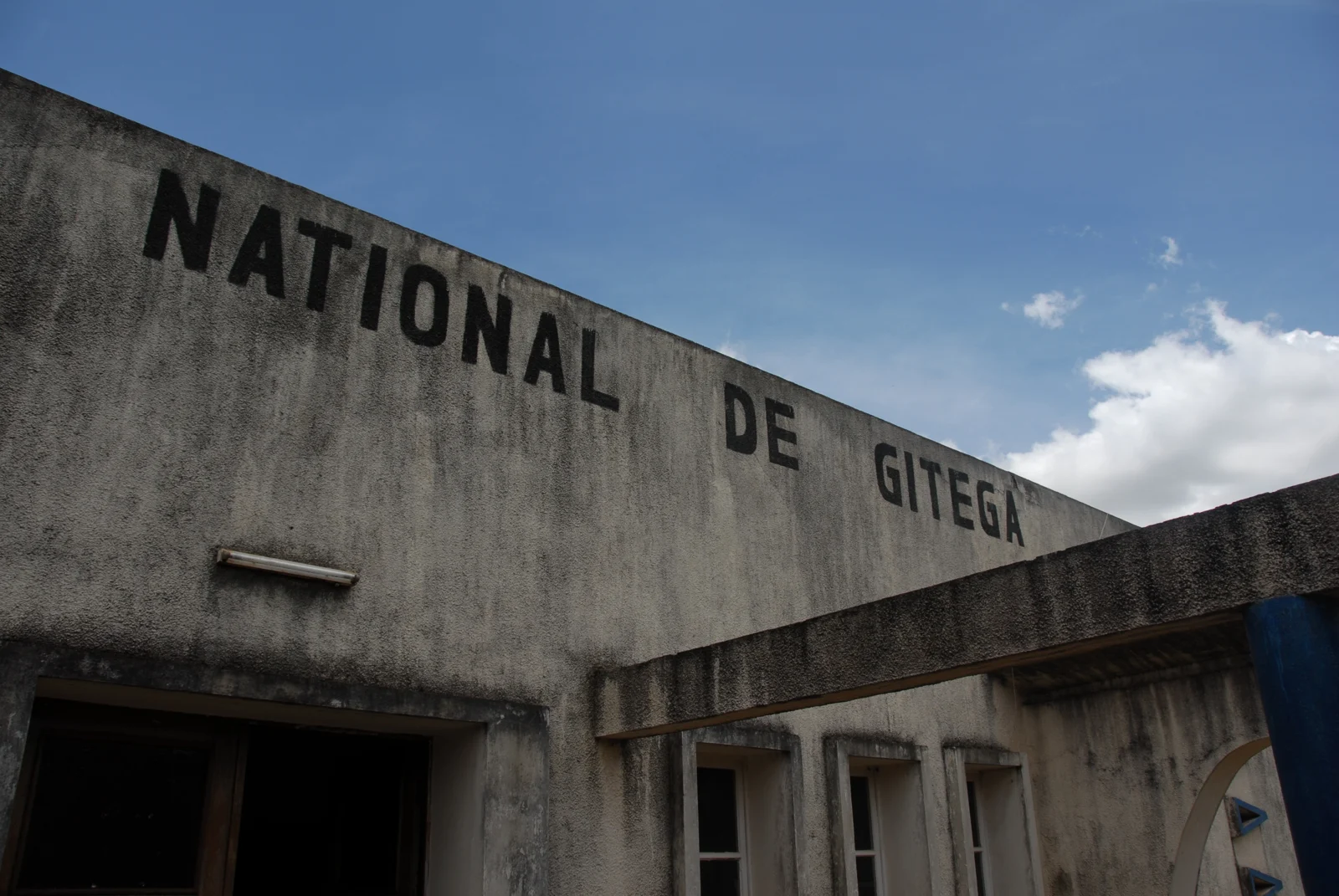
The building has already housed several ideas of what a public museum should be. UNESCO dates its construction to 1947, its inauguration to 1955 and its first opening to the public to 1957, under Belgian administration. The Burundian tourism authority still uses the name Musée National du Mwami, or National Museum of the King, alongside National Museum of Gitega. In the photographer Dave Proffer’s 2007 image, the word “national” is legible on the façade. The photograph records how the institution named itself at that moment; it cannot tell us what was on display or diagnose the condition of the building in 2026. The older name and the visible inscription are useful together because the institution’s royal, colonial and national histories overlap. [1] [3] [4] [8]
Burundian museologist Edouard Nzoyihera describes the institution as initially belonging to the mwami and becoming a state institution in 1960, with the court retaining some influence over its operation. Burundi became independent in 1962. The distinction matters: the collection was already being made into a national institution before sovereignty formally changed. Nzoyihera also traces the museum’s subsequent passage between administrative portfolios, including education and tourism. Those changes help explain why the museum’s work can be described in several ways: as care for a national collection, as a public education service and as an attraction for visitors. Each responsibility creates a different demand on the same rooms and staff. [1] [3] [4]
The making of the collection raises another question about authority. In interviews published by Nzoyihera, a museum conservator recalled that collectors called on holders of objects and gathered material at provincial centres, paying a fixed sum for acquisitions. The account tells us something about the method and geography of collecting. It cannot establish the provenance of every object, what individual holders understood about the transfer or whether every transaction followed the same practice. A display that connects an object to a named maker or place when the records allow, and identifies gaps when they do not, makes that history more intelligible than a label that gives only an object type and date. [4] [7]
The museum’s court holdings are one place to see why such detail matters. The tourism authority lists photographs of former kings and objects of ethnographic and archaeological interest. Nzoyihera links the shape of the permanent exhibition he studied to the era when most of the collection was assembled and identifies 1975 as the date of the last collecting campaign he discusses. That is evidence about the history of the collection and an earlier exhibition, not a finding that nothing has been acquired since. Royal objects can show how authority was organised and displayed. A visitor also needs to know whose work produced and maintained those objects, and what parts of life are harder to reconstruct from what the museum inherited. [3] [4]
Nor is the 2026 project the first time a funder has linked safeguarding to public display. The United States Ambassadors Fund’s 2008 review listed $25,000 to support the Gitega collection’s preservation and display. The entry described tools, clothing, instruments and other materials, and framed the work as expanding the museum’s capacity to protect and exhibit them. The report records the purpose and stated grant amount, rather than a measure of its long-term effects. Read beside the new project, it shows that the twin obligations have been recognised for years. The issue now is how the work of caring for the collection and sharing it will be supported in the ordinary life of the institution. [1] [2] [5]
In his published work on museums in Burundi and neighbouring countries, Nzoyihera argues that a national ethnographic display can freeze the society it seeks to explain. His response is to place objects alongside living practices, testimony and contemporary work, bringing more people into the making of exhibitions. In Gitega, that approach would change more than the choice of display cases. An exhibit might connect a court instrument to the different settings in which music is made and taught, while giving makers and performers a voice in how those connections are explained. Such a proposal follows from Nzoyihera’s argument; UNESCO has not announced that the museum has adopted it. [1] [4] [6]
The royal drum illustrates what is at stake. In 2014, the UNESCO intergovernmental committee inscribed Burundi’s ritual dance of the royal drum on the Representative List of the Intangible Cultural Heritage of Humanity. Its decision records the state’s plans for teaching younger people, supporting drumming groups and protecting sites and trees used in making drums. It also records community participation in the earlier inventory. That decision concerns a living practice, rather than a rule for the Gitega museum. It nevertheless shows why an instrument in a collection and the knowledge needed to make or play it have different conditions of survival. Display can help people see that relationship, but it cannot substitute for the practitioners and settings that sustain it. [6] [7] [9]
There is a practical reason to make those choices before the rooms are fitted out. The tourism authority’s description of the earlier museum assigns 168 square metres to exhibitions and 64 to storage, alongside offices and a patio. Those figures describe the premises as listed by the authority, not the dimensions of the proposed redesign. They make the trade-offs concrete: putting more material on view can leave less room for visitors to move or for staff to prepare objects, while adequate storage makes it possible to rotate what visitors see. A collection can serve teachers and researchers through study access and changing displays as well as through a permanent gallery. That depends on the staff who can identify, retrieve and explain its holdings. [1] [3] [7]
The same distinction applies to public access. A redesigned exhibition can make circulation and labels easier to use, but visiting also depends on when the museum is open, how a school can reach it and what a visitor can understand once inside. UNESCO’s 2015 recommendation treats physical and cultural access as connected obligations. Nzoyihera’s account adds a local reason to take that distinction seriously: a museum that gives contemporary audiences little place in its stories risks limiting who sees a reason to return. In Gitega, decisions about language, the use of guides and whether school visits can continue after a funded project ends will help determine whether a new layout becomes an enduring public service. These are possibilities raised by the evidence, not announced features of the new display. [1] [4] [6] [7]
There are also sound reasons for keeping some information off public labels or out of open digital catalogues. A maker’s name may be recoverable and appropriate to display; the circumstances of an object’s use or the knowledge shared by a practitioner may call for consultation and limits. The 2015 recommendation places dialogue with communities alongside museums’ responsibilities for protecting collections and making them accessible. Nzoyihera’s work points to a way of reconciling those aims: participation should give people some say over the interpretation and terms of use of what they contribute, instead of treating their testimony as material that can be collected and detached from them. [4] [6] [7]
The strongest opportunity in Gitega is therefore to use the rehabilitation to make the museum’s own history easier to see. A label can distinguish the period in which an object was used from the date it was collected, and say whether the account comes from a register, a former custodian or a later researcher. An educational programme can explain why a museum inaugurated under Belgian rule could carry the king’s title and later speak as a state institution. Neither choice requires abandoning the older collection. Both allow it to become evidence about how authority changed, while giving visitors ways to ask what the records leave out. [1] [3] [4] [6]
ALIPH’s support and UNESCO’s implementation give Burundi’s museum a chance to improve the conditions in which the collection is kept. The longer change will depend on whether the institution can care for objects, sustain access and give people whose histories appear in the galleries a role in how they are told. A building can reopen on a particular day. A museum becomes more useful to its public over time, as its staff have the resources and authority to keep those relationships alive. [1] [2] [4] [7]
- [1]UNESCO. UNESCO and ALIPH join forces to rehabilitate the National Museum of Gitega in Burundi2026-11-03 (project launch: 2026-09-22)
- [2]ALIPH. ALIPH: Protecting Heritage in a Fractured World2026-07-01 (posted 2026-07-02)
- [3]Burundi tourism authority. Monuments et musées: Musée national de GitegaUndated; accessed 2026-11-11
- [4]Universidade Lusófona, Departamento de Museologia. Edouard Nzoyihera, Les musées en Afrique orientale, in Sociomuseology & Sociomuséologie, vol. 1, Gitega section2024 (Gitega fieldwork cited: 2016)
- [5]U.S. Department of State, Bureau of Educational and Cultural Affairs. The U.S. Ambassadors Fund for Cultural Preservation: 2008 in Review2008 review
- [6]Les Cahiers de muséologie, Université de Liège. Edouard Nzoyihera, Réflexions sur les possibilités de réinventer les musées d’ethnographies en Afrique orientale : identité et société contemporaineNo date shown on article page; accessed 2026-11-11
- [7]
- [8]Dave Proffer / Flickr. Burundi National Musuem at GitegaCaptured 2007-03-25
- [9]UNESCO Intergovernmental Committee for the Safeguarding of the Intangible Cultural Heritage. Decision 9.COM 10.10: Ritual dance of the royal drum (Burundi)2014
Did this publication help you understand the topic?
0 voluntary responses. Browser-based participation; responses are not a representative survey.
We welcome suggestions, contributions and recommendations.
Editorial standards ↗