On 12 November 2026, Cabo Verde’s National Electoral Commission published the register figures for the presidential election scheduled for 15 November. It reported 419,448 registered voters, of whom 76,383, or 18.2 percent, were registered abroad. Those citizens are choosing the same head of state as voters on the islands. Yet the proportion of voters registered abroad does not tell us how much of the final count will come from outside the country. That depends first on whether people can cast a ballot, and then on a constitutional rule that can reduce the weight of the overseas vote if it exceeds a specified share of the domestic count. [1] [2]
That distinction matters in a republic whose ties to emigrants extend across several continents. The commission’s figures put 51,734 overseas registrations in Europe and the rest of the world, including 28,361 in Portugal and 12,273 in France. The Americas accounted for 14,926 registrations, most of them in the United States. Another 9,723 were in African countries, with Angola, São Tomé and Príncipe and Senegal among the countries the commission singled out. A national total for the diaspora describes an electorate with markedly different distances, consular networks and local circumstances. It tells us where people are registered, but gives no evidence that a voter in each of those countries faces the same journey to the polling place. [1] [3]
The constitutional framework for that vote took shape through changes after independence in 1975. The National Assembly’s chronology traces the end of the single party system to a constitutional revision in September 1990. The new Constitution, which came into force in September 1992, reduced presidential powers and set out the separation and interdependence of the branches of government. These were distinct decisions: opening political competition changed who could govern, while redesigning the presidency changed what winning that office meant. In the revised Constitution published in 2010, voters registered at home and abroad elect a president by direct and secret suffrage. They are electing a head of state with constitutional responsibilities, including powers over the promulgation or veto of legislation, rather than directly choosing the head of government. [2] [3] [4]
Aleida Mendes Borges’s study of Cabo Verde places these rules in a wider debate about external citizenship: the ability to exercise rights and take part in the politics of a country while living outside it. Her account treats emigrants as political actors with ongoing ties and interests. It also shows that the state shapes the ways in which those ties can become political representation. Citizenship is therefore only part of the story. Someone may remain Cabo Verdean abroad, take part in an association, follow public affairs and maintain family ties, while depending on a separate set of public institutions to get onto a register and vote. An election count captures one of those forms of political engagement. [2] [5]
In the presidential election the distinction extends to the candidates themselves. Article 109 includes registered voters abroad in the electorate. Article 110 sets a different standard for holding the office: a candidate must be a Cabo Verdean citizen by origin, hold no other nationality and have lived permanently in the country for the three years immediately preceding the candidacy, alongside the constitutional age requirement. So a citizen with another nationality may participate as a voter if registered and otherwise eligible, while that same second nationality precludes a presidential candidacy. The commission’s voter guide makes the distinction tangible: it says a valid passport from the host country can be used as identification at the poll. The document is evidence of identity there; eligibility still depends on the electoral register. [2] [3] [5]
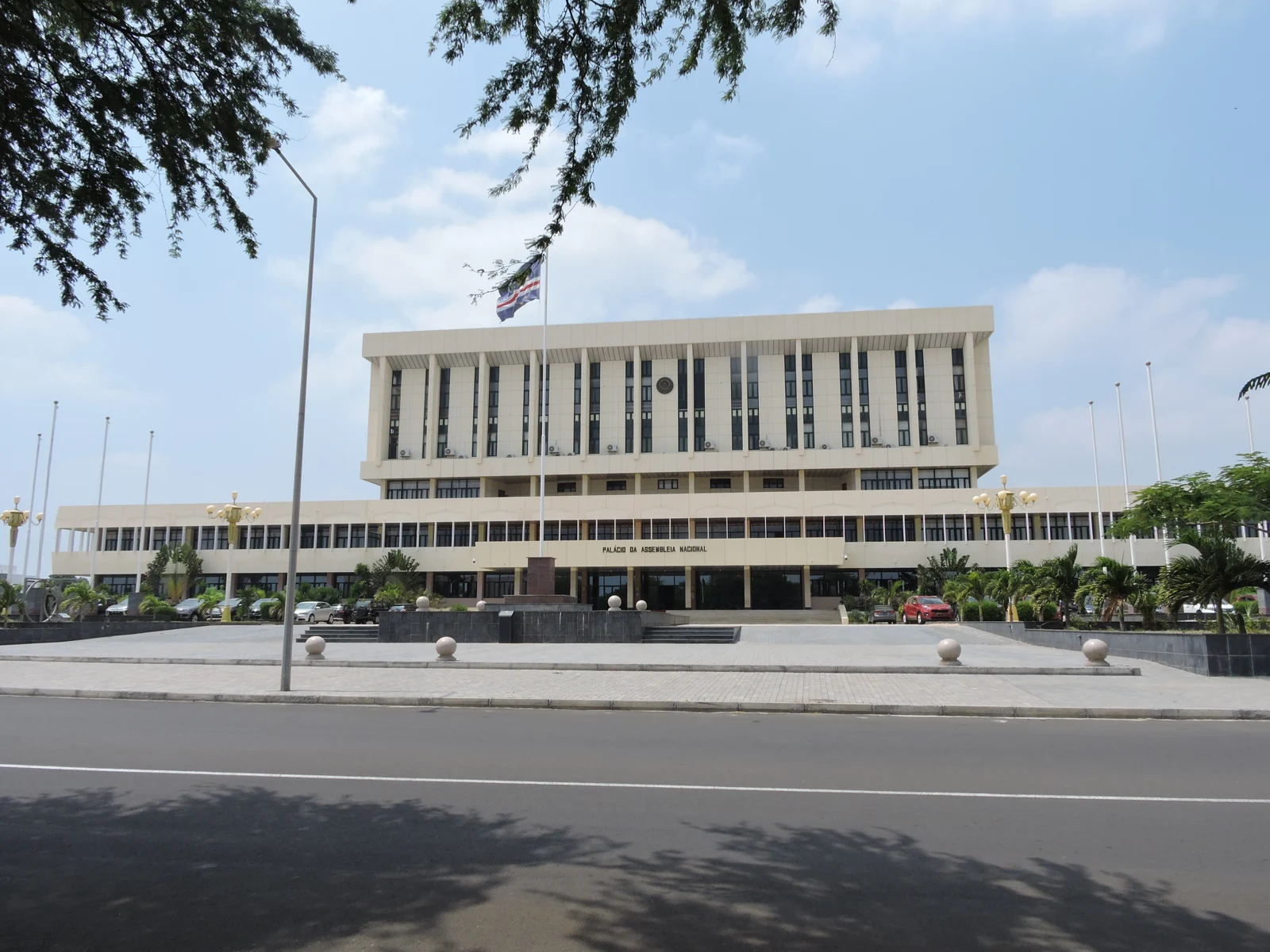
Mendes Borges also describes a different channel for representation in the National Assembly. External constituencies elect six of the Assembly’s 72 deputies, with two seats apiece for Africa, the Americas, and Europe and the rest of the world. A seat gives voters in a constituency representatives in a body that debates laws and holds government to account. A presidential ballot contributes instead to selecting a single officeholder for the country. The photograph of the Assembly in Praia, taken on 25 September 2021, documents the institution in which that other form of representation takes place. It does not show a polling station or the preparations for the current election. [2] [5] [8]
The practical work starts well before polling. The commission says a voter abroad must be registered in the relevant consular area. Its guide directs citizens to electoral registration services at diplomatic and consular posts to register or update their details, and to the commission or electoral services to identify where they will vote. This makes an address consequential. It connects an elector to the people who maintain the list and to the place where a ballot can be cast. Acceptance of an expired Cabo Verdean passport can remove one obstacle on polling day, but it cannot resolve an out of date entry on a list or shorten the distance to a polling place. [1] [3]
The electoral commission’s preparations show how many organisations have a hand in making that right usable. From 16 August to 11 September it visited Senegal, Portugal, France and the United States to assess the legislative elections and prepare for the presidential poll. It reported meeting electoral officials, consular representatives, parties, associations and members of Cabo Verdean communities. At its 25 September meeting in Praia, the commission pointed to registration through the Consular Portal as an advance. It also reported continuing demands for simpler access to registration and better electoral information, as well as a need for better coordination between the agencies responsible. That account records what the commission says it learned and planned to follow up; it provides no tally of applicants who registered through the portal or voters whose difficulties were resolved. [3] [6]
There is a distributional question behind the commission’s call for closer coordination. The register is national, but the work that makes it usable is spread across the commission, consular services and local registration bodies. The commission’s report from Praia does not say how much was spent on that work in each country or how resources were divided between registration, communication and polling. The 2026 figures count registrations and polling tables. A table count helps describe the scale of provision, but it does not reveal opening arrangements, travel costs or the help available to someone who finds a mistake in the register. The institutions that administer the vote are better placed than the headline register to account for those differences. [1] [3] [6]
The previous presidential election helps put the new register in perspective. Cabo Verde’s official result for 17 October 2021 recorded 56,080 people registered abroad and 15,132 who voted there, a turnout of just under 27 percent. Turnout inside the country was about 51 percent. The figures describe participation in one election. They cannot tell us why any particular person stayed away, whether the same people remained on the register five years later or how many would have voted under different arrangements. The much larger overseas register for 2026 is evidence of a change in the lists. The 2021 result is a reminder that the number who make it to the polls may tell a different story. [1] [6] [7]
The 2021 figures also show how the constitutional ceiling works. Article 113 compares the overseas vote with votes counted inside Cabo Verde. If the overseas total exceeds one fifth of the domestic count, the overseas total is reduced to that limit and each candidate’s overseas tally is reduced in the same proportion. The threshold does not compare the overseas register with the combined register. In 2021, the 15,132 ballots cast abroad were well below a fifth of the more than 176,000 cast at home. The old result can illustrate the rule, but says nothing about whether it will apply this time. Both sets of ballots must first be counted. [2] [7]
The 2021 return also shows why both geography and the kind of figure being compared matter. José Maria Pereira Neves received 51.75 percent of valid votes overall, with 57.67 percent of valid votes abroad and 51.24 percent at home. Those figures describe the ballots counted in each area. They do not show what people who did not vote would have chosen. Nor does the aggregate for the diaspora establish that people in each overseas constituency voted alike. In 2026, the commission’s published register distinguishes broad overseas regions and individual countries; the results can be read against that geography rather than assuming that the experience of voters in the largest communities represents everyone abroad. [1] [7]
The ceiling preserves the relative distribution of votes among candidates within the overseas count when it is triggered, while changing that count’s influence on the combined result. It reflects a constitutional choice about how to reconcile participation abroad with the influence of the resident electorate. Mendes Borges places that choice alongside the guarantee of seats in the legislature: the institutions give citizens abroad more than one way to act politically, and place a different limit on each route. The presidential threshold does not remove anyone’s name from the register, nor does it entitle overseas constituencies to the same influence in the presidential tally as they have in the Assembly. [2] [5]
Once the commission publishes the result, comparisons will be possible that the register cannot support. Its 2021 return separated registered voters, turnout, blank and invalid ballots, and candidate totals by area. Those categories make it possible to distinguish the people eligible to cast a ballot from the ballots cast and from the votes credited to candidates. With equivalent figures for 2026, readers will be able to compare the distribution of participation across areas and see whether the constitutional adjustment was needed. Evaluating the commission’s own preparations will require different evidence, such as its follow-up on registration access and on what the four visits found. A count can show a gap; it cannot by itself explain how that gap arose. [1] [2] [6] [7]
- [1]Comissão Nacional de Eleições de Cabo Verde. Presidenciais 2026: Mais de 419 mil eleitores inscritos para votar a 15 de novembro12 November 2026
- [2]República de Cabo Verde; Direção-Geral de Apoio ao Processo Eleitoral. Constituição da República de Cabo Verde (2010), articles 109–1152010 revised edition
- [3]Comissão Nacional de Eleições de Cabo Verde. Guia do Eleitor – PR 2026Undated; accessed 14 November 2026
- [4]Assembleia Nacional de Cabo Verde. Etapas e fases da ConstituiçãoUndated; accessed 14 November 2026
- [5]Aleida Mendes Borges, e-Journal of Portuguese History. Emigration and Citizenship: Diaspora Political Engagement in Cabo VerdeDecember 2022
- [6]Comissão Nacional de Eleições de Cabo Verde. CNE restitui resultados das missões à diáspora e reforça preparação das Eleições Presidenciais25 September 2026
- [7]Comissão Nacional de Eleições; Boletim Oficial da República de Cabo Verde. Edital n.º 01/EleiçõesPresidenciais/2021: mapa com o resultado total e a sua repartição por círculos25 October 2021; election 17 October 2021
- [8]VIEX – Ernest Niedermann, Wikimedia Commons. Cabo Verde - Parlamentsgebäude in Praia.jpg25 September 2021
Did this publication help you understand the topic?
0 voluntary responses. Browser-based participation; responses are not a representative survey.
We welcome suggestions, contributions and recommendations.
Editorial standards ↗