On 13 November 2026, Morocco’s finance ministry announced that it had signed a financing agreement in Rabat with the African Development Bank for the third phase of a programme covering economic governance and climate resilience. The bank put the amount at €434.4 million and listed water and electricity governance among several reforms the agreement is meant to support. In Casablanca, that commitment meets a change already made: in 2024, a regional company took over public services previously entrusted to Lydec. The question for residents is what the new operator and the authorities supervising it can be held to account for when a pipe leaks, a connection is out of reach, or a household disputes a bill. The signature does not establish a change to any of those services. [1] [2] [5]
The national programme is wider than Casablanca’s distribution network. The ministry lists reforms to public enterprises, measures concerning the business environment and support for renewable energy, alongside governance of water and electricity. It names ministries and national bodies with different responsibilities, including the Interior Ministry and the National Office for Electricity and Drinking Water. The total announced for the programme therefore cannot be read as an allocation to Casablanca. The ministry’s account establishes that financing was agreed. It does not set out a city allocation, a tariff schedule, the release of funds or a schedule of completed work. Those distinctions matter when the same announcement is used to describe both an institutional reform and the resources available for local services. [1] [2]
Casablanca’s earlier arrangements help explain why an agreement between national institutions does not settle local accountability. In his study of water provision under delegated management, Mohamed Said Saadi describes the 1997 concession as a way for public authorities to entrust operations to a company while retaining a role in defining and supervising the service. Delegation does not by itself identify who can set or change tariffs, enforce investment commitments or hear a complaint. Saadi, who served on the elected council and chaired a commission reviewing the contract, argues that locally elected representatives had less power than the responsibilities they were expected to answer for. His account describes the institutions of that concession; the regional company that replaced it has to be judged on its own arrangements. [3] [5]
In Saadi’s account, billing disputes and public mobilisation in 2006 gave elected representatives an immediate reason to press for changes in how the contract operated. The institutional point is that residents used political channels as well as their relationship with the supplier. A bill could be an individual problem, but a change affecting many bills was also a question for the authorities that approved and supervised the arrangements. Saadi’s position on the council gave him access to the review process and shaped the questions he asked of it. His article is evidence of how that particular review worked and of his interpretation of local power. It does not establish that present complaints follow the same route or that today's regional arrangement produces the same outcomes. [3] [5]
Béatrice Allain-El Mansouri’s comparative work on Moroccan cities adds a second point. A connection rate can hide different conditions in neighbourhoods whose residents live in housing with insecure tenure, irregular planning status or poor infrastructure. In the cases she examined, the existence of a distribution network and the means by which households gained access to it were separate matters. This is a useful distinction for Casablanca even though the paper does not measure current conditions there. A water pipe can pass near a home without giving its occupants a regular connection. A programme can improve the efficiency of a network while the cost or administrative conditions of joining it remain beyond what a particular household can meet. [3] [4]
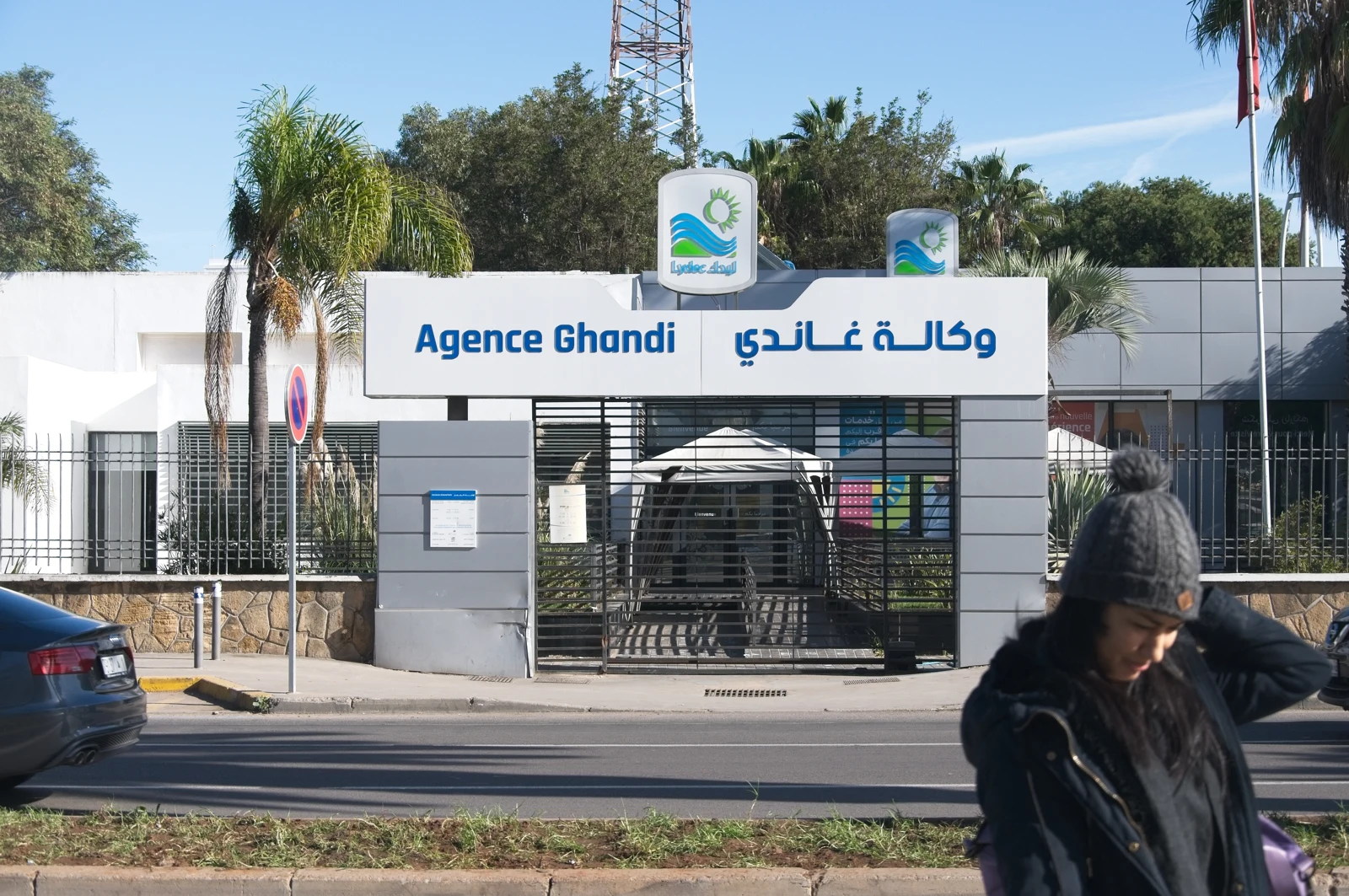
The photograph of Lydec’s Ghandi office in December 2022 documents the older arrangement at one point of contact between the utility and the public. At that date Lydec’s name was on the office where customers encountered the service, even though the company did not make every decision that affected supply. A photograph of an office cannot tell us whether a disputed charge was resolved or a connection was affordable. It does show how an institution becomes visible to the people who must deal with it. The distinction between that public face and the authorities behind it is one that any successor service must make intelligible to residents. [3] [5] [8]
The 2024 records distinguish two parts of the transition. Veolia announced in July that it had agreed to sell its stake in Lydec to the Casablanca-Settat regional multiservice company, subject to administrative approvals. The Competition Council’s notice described the proposed acquisition and identified water and electricity distribution and wastewater services among the operations concerned. Those documents concern ownership and competition oversight. Lydec’s notice to the public on 30 September addressed service management: it said the regional company would take charge on 1 October under the reorganisation linked to Law 83-21 of July 2023 and in agreement with the delegating authority. The sale announcement alone would not have established who would operate the service or when. [5] [6] [7]
This chronology also establishes what the new financing cannot explain. The regional company was due to assume service management more than two years before the November 2026 signing. The loan therefore cannot be credited with creating the Casablanca operator or bringing about the initial transfer. Its relevance is to the next stage of a reform that the Moroccan authorities were already carrying out. As the ministry describes it, the financial agreement supports a programme across several sectors, with implementation resting with Moroccan public institutions. The ministry’s announcement offers no basis to attribute a particular change in a Casablanca bill or the repair of a local network to the Bank. [1] [2] [5] [6]
The choice of a regional operator also changes the scale at which decisions can be made. The Competition Council describes a company responsible for several services and situated within a broader framework for regional companies. A regional service can plan beyond the limits of a single municipality, where the distribution network and the settlements it serves already cross those boundaries. Whether that helps a specific community depends on what the regional contract requires and which works are financed. A large service territory can bring more of the network into one plan, while still leaving a resident uncertain about whether to address a complaint to the operator, the municipality or another authority. The handover notice identifies who assumed management. It does not describe how every such dispute will be resolved. [3] [5] [6]
Evidence from the network itself adds a different perspective on climate resilience. Faycal Taghlabi, Lhoussaine Sour and Abdelkader Agoumi published a 2020 engineering study of leak detection in one older Casablanca sector. They compared a model with a field test that produced controlled flows using hydrants. The work illustrates the information needed to locate losses and make a repair possible. It is a pilot, not a current survey of Casablanca or an evaluation of the regional operator. The study nevertheless makes clear why announcing a more efficient network and documenting a service improvement are different things. Detecting a leak is one step. Establishing when it was repaired, and whether supply became more reliable for nearby customers, requires operating records beyond that test. [4] [9]
The financial question for residents is also more specific than the size of the loan. Someone already connected to the network can benefit from quicker repairs and fewer interruptions; a household outside the network may be more concerned with the price and conditions of getting a connection. The scholarship on Moroccan water provision gives reason to examine those outcomes separately. Even where improvements are financed, the source of money for initial works may differ from the revenue that pays for maintenance. The ministry’s announcement does not explain how those costs will be distributed in Casablanca, whether through general revenues, charges or a separately financed project. A comparison would need to identify what was actually funded and who could use the service afterward. [1] [3] [4] [9]
For the same reason, the question of oversight should follow the problem that a resident is trying to solve. The operator can be expected to know whether it received a complaint and what action it took. A public authority responsible for the agreement should be able to explain which service standards apply and how it checks them. The national institutions named in the November announcement can account for the measures they are financing or implementing. These are separate records, even when the same household has a stake in all of them. Saadi’s account of elected councillors pressing a contractor for answers is a reminder that the power to request information and act on it matters as much as the name on the bill. [1] [3] [5] [6]
The Casablanca case gives the financing agreement a concrete test. The 1997 delegation and the 2024 handover each changed who ran the service. The 2026 signature is a further decision about how Morocco finances a wider reform programme. For residents to see what it changes in their own neighbourhoods, they will need records that connect the national commitments to the regional service: who authorised the work, what was paid for, where it was delivered, and what the operator did when it fell short of an agreed standard. The announcement opens that line of inquiry. The next useful evidence is the programme’s actual financing and implementation records alongside service figures that residents can compare across places and over time. [1] [2] [4] [5] [9]
- [1]Morocco, Ministry of Economy, Finance and Public Performance. Cérémonie de signature de l’accord de financement relatif au Programme d’appui au renforcement de la gouvernance économique et de la résilience au changement climatique – Phase III13 November 2026
- [2]African Development Bank Group. Morocco secures nearly 4.8 billion dirhams for reforms and resilience13 November 2026
- [3]Mohamed Said Saadi, Mediterranean Politics. Water Privatization Dynamics in Morocco: A Critical Assessment of the Casablancan Case25 October 2012; published online
- [4]Béatrice Allain-El Mansouri, Collège international de philosophie and Fondation du Roi Abdul Aziz. L’accès à l’eau potable dans les quartiers urbains défavorisés au Maroc. Entre efficacité et équité17–18 October 2008
- [5]Lydec, filed with Autorité Marocaine du Marché des Capitaux. Communiqué sur la réorganisation des services publics dans la région de Casablanca-Settat30 September 2024
- [6]Conseil de la concurrence, Morocco. Communiqué relatif à la prise de contrôle de Lydec SA par Société Régionale Multiservices Casablanca-Settat SA18 July 2024
- [7]Veolia. Morocco: Veolia signs an agreement to divest its stake in Lydec5 July 2024
- [8]Bertrand Soubeyrand, Wikimedia Commons. Accueil agence Lydec Ghandi à Casablanca, Maroc.jpg25 December 2022
- [9]Faycal Taghlabi, Lhoussaine Sour and Abdelkader Agoumi, Drinking Water Engineering and Science. Prelocalization and leak detection in drinking water distribution networks using modeling-based algorithms: a case study for the city of Casablanca (Morocco)2020
Did this publication help you understand the topic?
0 voluntary responses. Browser-based participation; responses are not a representative survey.
We welcome suggestions, contributions and recommendations.
Editorial standards ↗