On 6 November 2026, UK defence minister Luke Pollard told Parliament that Britain had made no payments to Mauritius under the Chagos agreement signed on 22 May 2025. He said the government would implement the agreement only with the full support of Mauritius and the United States. The statement concerns a treaty between Britain and Mauritius; the United States operates the Diego Garcia base jointly with Britain but did not sign the treaty. For Chagossian families in Mauritius, Seychelles and Britain, the delay has a separate consequence. The agreement describes a route towards resettlement and a fund intended for their benefit, but neither a signature nor a payment timetable establishes when a family could return or who would decide the terms. [1][2][5][11]
Mauritius is pursuing a narrower administrative step while that larger question remains open. On 23 October its Cabinet recorded the setting up of a special desk in the Home Affairs Division to speed up requests from Chagossians to resume Mauritian citizenship. The announcement does not set out new eligibility rules or report that any requests have been granted. It follows earlier statements about who Mauritius envisages taking part in a possible programme of return. The two decisions operate on different things: a citizenship desk can deal with a person’s status in relation to Mauritius, while the agreement would govern the powers through which Mauritius could establish settlements on some of the islands. [2][4][13]
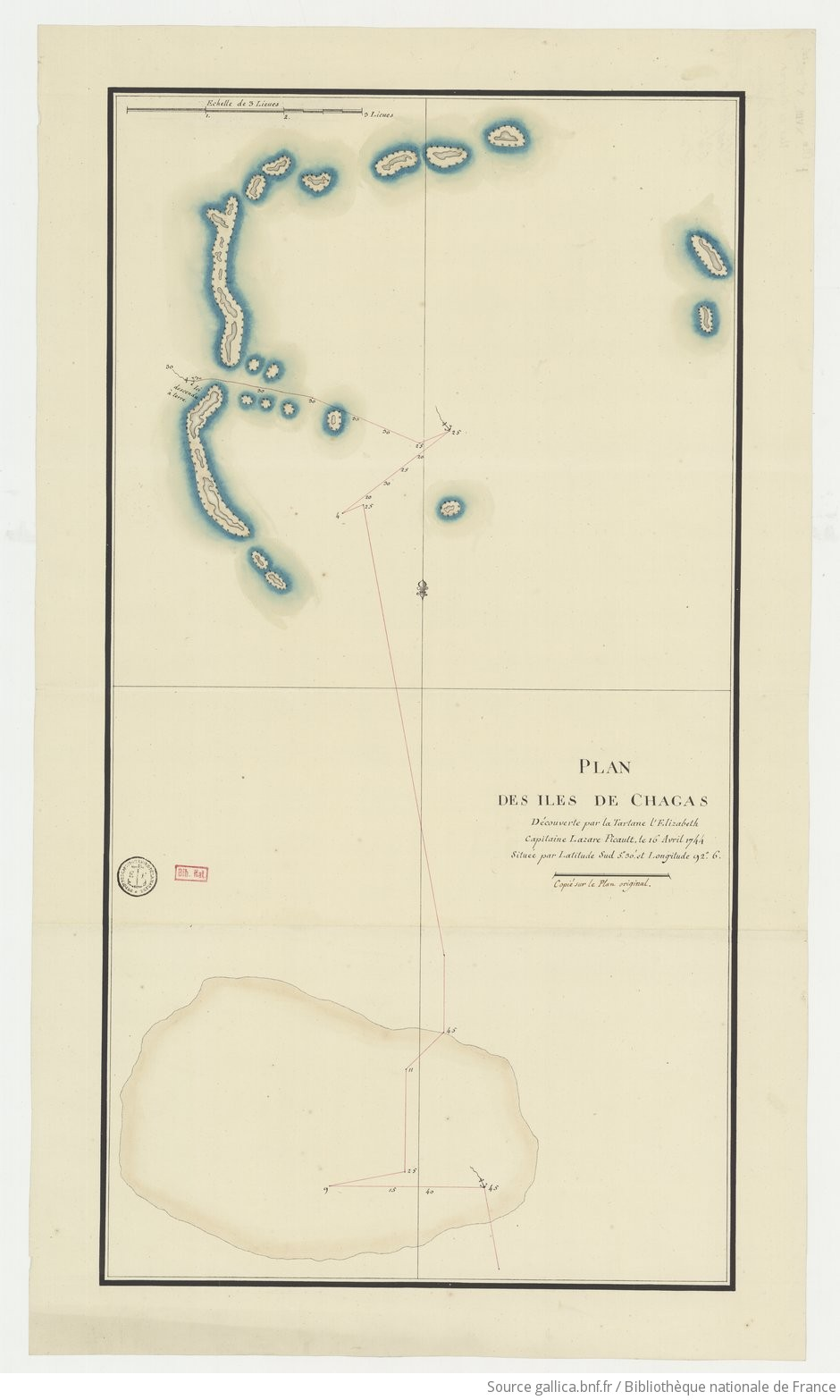
The eighteenth-century chart reproduced here gives one early view of the archipelago. It traces island outlines and a ship’s route, and records the voyage of Lazare Picault in 1744; the surviving copy is catalogued to 1745. It was drawn for navigation. It predates the settled Chagossian society that developed around coconut plantations under French and then British rule. Laura Jeffery traces the beginnings of that society through the arrival of enslaved workers, many from East Africa and Madagascar via Mauritius, and later contract workers, many from India. The map can show where a ship went. The history of labour and settlement explains how the islands became a home whose meaning cannot be read off a maritime chart. [5][7]
Britain separated the islands from colonial Mauritius in 1965, three years before Mauritian independence. In 1966 it made Diego Garcia available for defence use by the United States. The removal of the islanders was a process: people who had travelled away were prevented from going home, supplies and employment were curtailed, and the remaining residents were removed. By 1973 the population had been displaced, principally to Mauritius and Seychelles. Jeffery shows why a new passport could provide a route onward without restoring what was lost. The British citizenship changes of 2002 and 2022 widened access across generations, and some families moved again to Britain. They remained part of the Chagossian diaspora even where citizenship, residence and birthplace no longer coincided. [5][6]
Mauritius’s campaign challenged the division of its territory before independence. In its advisory opinion of 25 February 2019, the International Court of Justice concluded that decolonisation had not been lawfully completed and that Britain was obliged to end its administration of the archipelago as rapidly as possible. It treated resettlement as a human rights issue for the General Assembly to address as decolonisation was completed; it did not order a particular resettlement scheme. Political scholar Zaki Nahaboo argues that the territorial question placed one date and one political unit at the centre of the case, whereas some Chagossian accounts placed the ongoing experience of a dispersed people at its centre. Both histories matter: the 1965 separation explains the Mauritian state’s claim, while the removals and later migrations explain why a transfer of authority would leave questions of community representation unresolved. [6][8][9]
The 2025 treaty translates that distinction into a set of powers. Article 1 recognises Mauritian sovereignty over the whole archipelago, including Diego Garcia. Article 2 would authorise Britain to exercise specified Mauritian rights and powers at Diego Garcia for the base. The initial term is 99 years from entry into force. Article 6 leaves Mauritius free to implement resettlement on the other islands under Mauritian law and within the terms of the agreement. The provision leaves the decision whether and how to run a programme with Mauritius, and it excludes the island that was home to many of the people removed. A family’s link to Diego Garcia therefore does not carry the same practical prospect of return under the treaty as a link to one of the other islands. [2][5][10]
The treaty also sets out who would sit in the room when it was being put into effect. A joint commission would have representatives appointed by Britain and Mauritius and would decide by agreement of the two countries. The United States could bring issues to it and send a representative to give views and advice. The commission could invite other interested people, but the treaty does not reserve a seat for a Chagossian representative. That structure is different from a board overseeing a community fund. A voice in deciding how money is spent would not of itself give Chagossians a standing role in decisions about access to the islands. [2][9][12]
Members of Chagossian Voices and Chagos Asylum People, and independent advocates, told a UK parliamentary roundtable in December 2024 that housing, transport and other infrastructure would determine whether people could live on the outer islands. They described particular stakes for older islanders, for whom a long period of construction could put a return beyond reach. Chagossian Voices reiterated its call for participation and return, including to Diego Garcia, at a July 2026 event in Geneva alongside the UN Expert Mechanism on the Rights of Indigenous Peoples. These are positions put forward by specific participants and organisations. Their argument is about what a return would mean in practice, including whether people can choose a place to live, sustain a livelihood there and shape the rules that affect them. [2][9][10]
Other views emerge in the House of Lords committee’s December 2025 report. Its online survey, open from 19 November to 1 December, accepted 3,123 self-selected responses across several countries. The committee made the questions available in French and Mauritian Creole and acknowledged that language, literacy and internet access still limited participation. The responses offer evidence of the concerns raised, rather than a representative measure of what all Chagossians want. They include demands for a role in governing funds, support for people who may never resettle and better information about the conditions on the islands. A UK minister said on 4 November 2026 that a separate contact group last met on 12 October. That forum gives some community representatives a route to officials, but the answer does not document a decision on resettlement or give the group authority to set the treaty’s terms. [10][11][14]
The money also has distinct purposes. Under the treaty and its accompanying letters, the United Kingdom would make annual payments to Mauritius and would provide £40 million for a trust fund for Chagossians. The letters schedule the trust fund transfer after the first anniversary of entry into force. Pollard’s answer describes the absence of payments under the agreement as of 6 November; it does not show that a scheduled payment is overdue. The implementing bill in the previous UK parliamentary session fell when that session ended. The treaty itself provides for an exchange of notes confirming that each party has completed its internal requirements. The British government’s stated insistence on US support is a condition of its present policy, separate from the treaty’s procedure between its two signatories. [1][2][3]
Mauritius’s published trust fund bill offers a concrete proposal for how money might be governed. It provides for seven Chagossian members on a board of twelve, with five recommended by the Chagos Refugees Group in Mauritius, one by the Chagossians Committee Seychelles, and one chosen from nominees of UK Chagossian associations. The seven would choose one of their number to chair. The draft also provides for audit by Mauritius’s Director of Audit and for annual reporting to the National Assembly. These are proposals in a published bill, rather than evidence of appointments or disbursements. They give some specificity to the debate about who speaks for a dispersed community: a majority on a board can affect how money is spent, while the allocation of places and the rules for selecting members shape whose priorities reach the board. [2][11][12]
Eligibility raises another question. The trust fund bill defines its beneficiaries by reference to birth in the archipelago before 31 December 1973 or being a child of someone in that category. A UK minister reported in December 2025 that Mauritius envisaged the same generations as eligible to take part in resettlement and that qualifying UK-based Chagossians could be eligible for Mauritian citizenship. Those statements identify a proposed route for some families. They do not make the October 2026 desk a general resettlement office, and they should not be confused with the wider scope of the British citizenship route opened in 2022. The history of repeated displacement helps explain why the boundaries of a scheme matter: a grandchild may be part of a family whose members have different nationality histories and different prospects under each measure. [4][5][8][12][13]
The November answer clarifies one stage of the process: the agreement had not produced a payment to Mauritius. The citizenship desk records a separate step, and the published trust fund bill shows how Port Louis proposes to organise a possible resource. Whether those steps lead to a workable return depends on decisions still to be made about eligibility, housing and services on the outer islands, and about the part Chagossians in different countries will play in those decisions. The history that began with the creation of an island society, and continued through the removal and dispersal of its people, gives those questions a scope that neither the boundary of Mauritius nor the perimeter of a military base can by itself settle. [1][2][4][5][8][10][12]
- [1]UK Ministry of Defence, via UK Parliament. British Indian Ocean Territory: written answer 358382026-11-06
- [2]Governments of Mauritius and the United Kingdom. Agreement concerning the Chagos Archipelago including Diego Garcia, and accompanying exchanges of letters (CP 1334)2025-05-22
- [3]UK Parliament. Diego Garcia Military Base and British Indian Ocean Territory Bill: latest news and status2024–26 parliamentary session; status consulted 2026-11-07
- [4]Prime Minister’s Office, Mauritius. Highlights of Cabinet Meeting – Friday 23 October 20262026-10-23, item 6
- [5]Anthropology Today, via University of Edinburgh. Laura Jeffery, The Chagos Archipelago: A limited victory for decolonizationDecember 2024
- [6]International Court of Justice, via United Nations. Legal Consequences of the Separation of the Chagos Archipelago from Mauritius in 1965, advisory opinion (A/73/773)2019-02-25
- [7]Bibliothèque nationale de France, via Wikimedia Commons. Plan des isles de Chagas, after Lazare Picault1744 voyage; surviving chart copy catalogued to 1745
- [8]The British Journal of Politics and International Relations, via Birmingham City University. Zaki Nahaboo, Historicising Mauritian self-determination at the International Court of Justice2024-12-06, online publication
- [9]Chagossian Voices. EMRIP 2026, Palais des Nations Geneva2026-07-13 to 2026-07-17, event dates
- [10]House of Lords International Relations and Defence Committee. Summary note of virtual roundtable with Chagossian representatives2024-12-11, roundtable
- [11]House of Lords International Relations and Defence Committee. Chagossian views on the UK-Mauritius Chagos Agreement (HL Paper 234)2025-12-17; survey 2025-11-19 to 2025-12-01
- [12]Mauritius National Assembly. The Trust Fund for the Benefit of Chagossians Bill (No. XXXII of 2025)2025-12-12, explanatory memorandum
- [13]UK Foreign, Commonwealth and Development Office, via UK Parliament. Diego Garcia Update: written ministerial statement HLWS11672025-12-15
- [14]UK Foreign, Commonwealth and Development Office, via UK Parliament. Chagossian Contact Group: written answer HL41482026-11-04; meeting date 2026-10-12
Did this publication help you understand the topic?
0 voluntary responses. Browser-based participation; responses are not a representative survey.
We welcome suggestions, contributions and recommendations.
Editorial standards ↗