On 12 November 2026 the Republic of the Congo published three laws approving amendments to the oil production sharing contracts for Nanga II bis, Nanga IV and Nanga V. The laws are dated 29 September and the amendments were signed on 14 August. Publication matters because the amendments themselves make it the point at which the changes take effect. All three set a fixed threshold of US$90 a barrel. The Nanga II bis amendment also names a new operator. Those are changes to the terms of exploration and any production governed by the contracts. They establish neither the discovery of commercially recoverable oil nor a new stream of money for the Congolese budget. [1] [2]
The threshold matters because a production sharing contract divides barrels before the state can turn its share into public spending. In the Congolese contracts reviewed by researchers for the country’s Extractive Industries Transparency Initiative, a royalty is assessed on production, a portion of oil can be used to recover eligible costs, and the remaining oil is shared under the contract. Another provision governs the split when the applicable oil price exceeds a specified level. The researchers found that this threshold, known as the prix haut, could have an unusually large effect on who received the value of production. It also affects the calculation of the cost recovery ceiling in the Nanga V contract. [2] [3]
For Nanga II bis and Nanga V, the earlier contracts published in the official gazette set the threshold at US$76, then US$74 and US$72 across successive periods. The new definition replaces those steps with US$90 for the life of each contract, without indexation. The Nanga V contract illustrates what this does. It calculates a separate pool of oil from the value above the threshold, after the corresponding royalty, when the contract price exceeds that level. Raising the threshold therefore narrows the range of prices at which that pool exists. It also changes the input to the cost recovery ceiling, which uses the lower of the contract price and the threshold. Those two mechanisms must be read together. [1] [2]
The calculation does not yield a single answer about the Treasury’s eventual receipts. At prices below both the old and the new threshold, the change in the threshold by itself would not create a separate pool. At prices between them, it can change which rules divide the value of the same barrels. If production never starts, neither formula divides any oil. If it does start, costs, volumes, the contractual price and the other sharing provisions still matter. The financial models commissioned by ITIE Congo found large variations between past contracts, even when the researchers applied their terms to hypothetical projects. Their estimates illustrate why these clauses matter; they are not forecasts for the Nanga permits. [1] [2] [3]
At Nanga II bis, the contract puts Sino-Congolaise Energies in charge of conducting petroleum work for the contractor. The amendment records the hydrocarbons minister’s approval in August of the transfer of Dingheng Mining’s participating interests and the operating role to that company. The original agreement followed an exploration permit granted to the state oil company, the Société nationale des pétroles du Congo, or SNPC, in 2023. The November publication therefore records an arrangement made through Congolese ministerial approval and a contract with the national company. It also shows why an operator’s name should not be used as shorthand for who owns every interest or who receives all the proceeds. [1] [2]
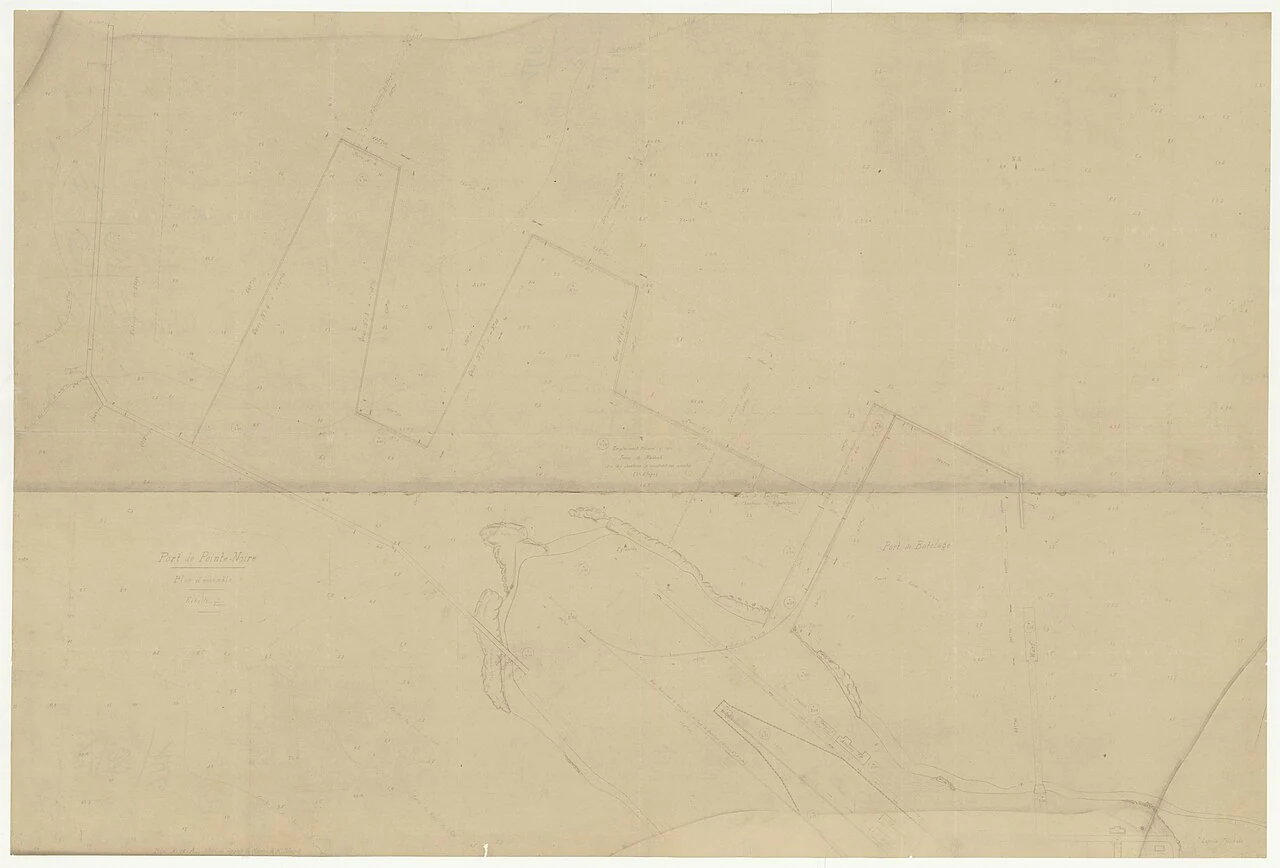
The port plan reproduced here shows a much earlier way of making the coast legible to government. The Bibliothèque nationale de France dates it to 1927 from the French hydrographic inventory and identifies it as an attachment to a mission report. Its scale, outlines and soundings register what surveyors needed to know about a harbour. A separate map drawn in 1931 and published in 1933 names petroleum prospecting as the mission that commissioned it. The port plan does not plot today’s blocks. Read beside the prospecting record, it shows how colonial agencies made the coast an object of measurement for different purposes before the independent Congolese state negotiated its own petroleum arrangements. [4] [5] [6]
The SNPC’s institutional history puts a later break in the late 1960s and early 1970s. It describes exploration arrangements with France’s ERAP and Italy’s AGIP in 1968 and records AGIP’s discovery at Loango Marine in the early 1970s. This history, published by the national company, views the sector through permits, wells and corporate partnerships. It helps establish a sequence in which Congolese authorities granted rights to more than one foreign operator. It does not establish whether coastal residents shared the benefits on the terms they would have chosen. The difference in perspective matters: a survey gives the shoreline a scale, and a company chronicle gives investments a chronology, but neither makes a record of every affected livelihood. [4] [5] [6]
The fiscal regime described in the EITI study dates from another institutional change. The 1994 hydrocarbons code shifted the country to production sharing and existing concessions held by major operators were converted. The regime that developed thereafter did not produce a single standard economic outcome. The researchers found increasingly differentiated thresholds and cost recovery rules across licences. Negotiators could use those provisions to encourage investment under particular conditions. In exchange, the state assumed the risk that the same terms could give it a smaller share than another set of rules would have delivered, especially early in a project. The 2026 amendments belong to that history of bargaining permit by permit. [1] [3]
The creation of SNPC in 1998 added a company with its own accounts to this system. The company’s history says it took over Hydro-Congo’s upstream rights and obligations and began marketing cargoes in 1999 from both the state’s entitlement and its own. This was a way for Congolese officials and company staff to participate more directly in selling crude. It also created an enduring accounting question: which barrels are being sold on behalf of the state, and which belong to the company as a participant? The Nanga II bis amendment makes the distinction concrete. SNPC keeps a 15 percent participating interest alongside the new operator; that interest is separate from what the Republic is owed under the fiscal provisions. [1] [6] [8]
The published evidence gives the public two ways of evaluating the deal. The parties describe the amendment as a way to make terms simpler and investment more predictable. That explanation is consistent with the removal of the changing thresholds, but the financial modelling also shows why predictability matters to each side for different reasons. An operator can assess whether the rule lets it recover costs under the price scenarios it considers plausible. For the state, the same calculation has to be read alongside the timing of revenue and how much of the upside it retains when prices rise. Agreeing on a number does not settle which price scenarios are likely, or who can best absorb the risk when they prove wrong. [1] [2] [3] [7]
In the Revue congolaise de gestion, Victor Kagni, Maixent Loubassou Nganga and Moyo Nzololo approach oil contracts through the unequal information available to the parties and the stability of their bargains as oil prices change. Their analysis asks how parties choose contractual arrangements when the conditions that make them attractive can change over time. The EITI modelling starts from a different question: given the terms in force, what revenue follows under specified assumptions about price, cost and production? Put together, the two approaches explain why a fixed threshold can be simpler to administer without resolving what the bargain is worth. Stability of the rule and distribution of the proceeds are distinct questions. [1] [3] [7]
That distinction matters when the national oil company appears on more than one side of the public accounts. A state can be entitled to barrels as sovereign, while the national company can have an interest as a participant in the project. The proceeds of sales, the company’s own costs and a remittance to the Treasury are different entries. The EITI reporting on Congo traces state oil sold through SNPC, including flows handled outside a direct Treasury payment. The country’s published production and cost data have helped researchers compare expected revenues with reported figures for earlier permits. Those records show what a future Nanga audit would need to reconcile; they give no basis for imputing the same outcomes to these exploration blocks. [2] [3] [8]
Timing is especially important for a budget that depends on selling oil. The EITI study compared past licence records and showed why production and revenue do not necessarily move together. A new project may add barrels while the public share of their value changes because its contractual terms differ from those of older projects. That is a reason to read licence accounts alongside aggregate export and budget figures. The distinction also guards against treating a countrywide revenue change as proof that a particular contract has succeeded or failed. The same care applies to the Nanga amendments: the publication dates are firm, while the economic results remain conditional on what happens under the permits. [1] [3] [8]
The November publication makes the state’s present choice visible: a single, higher threshold replaces the earlier schedule in the two contracts for which that schedule is quoted here, and the same US$90 threshold now governs all three amended agreements. What remains to be seen is whether exploration turns into production and how the state reports the value it receives if it does. The historical record shows successive changes in the authority to survey, grant permits, operate wells and account for oil. The next meaningful evidence will be records that connect the new contractual terms to decisions and money the public can follow. [1] [2] [4] [6] [8]
- [1]Republic of the Congo, Journal officiel. Journal officiel no. 46: Laws 15-2026, 16-2026 and 17-2026 and annexed Nanga amendments12 November 2026; approval laws dated 29 September; annexes signed 14 August
- [2]Republic of the Congo, Journal officiel. Special issue no. 1: Nanga II bis and Nanga V production sharing contracts22 August 2025
- [3]Resources for Development Consulting for ITIE Congo and EITI. Understanding state oil revenues and sales in the Republic of Congo through financial modellingJanuary 2022
- [4]Bibliothèque nationale de France. Port de Pointe-Noire1927 (year assigned from the French hydrographic inventory)
- [5]Bibliothèque nationale de France. Carte de la région de Pointe-Noire : Mission de prospection des pétrolesSurvey map drawn in 1931, published in 1933
- [6]Société nationale des pétroles du Congo. SNPC : un quart de siècle d’histoire et d’expérience tournée vers l’avenir2023
- [7]Victor Kagni, Maixent Loubassou Nganga and Moyo Nzololo, Revue congolaise de gestion. Le partage de la rente pétrolière au Congo dans un jeu à somme constante2019, no. 28
- [8]Extractive Industries Transparency Initiative. Republic of the Congo: EITI country and validation recordsUndated live page; accessed 14 November 2026
Did this publication help you understand the topic?
0 voluntary responses. Browser-based participation; responses are not a representative survey.
We welcome suggestions, contributions and recommendations.
Editorial standards ↗