On 12 November 2026, UNESCO updated the programme for Congolese Rumba Week in Paris, scheduled for 23–27 November. The two Congos’ joint inscription of rumba on the Representative List of the Intangible Cultural Heritage of Humanity in 2021 is the reason for the gathering. One of its scheduled discussions will follow a piece of music from creation to digital distribution to examine how income is divided among artists and rights holders. The programme puts a question in public that musicians raised when the two countries sought recognition: who gets paid when the music travels, and what say do its practitioners have over the institutions that keep it in circulation? The published programme announces a discussion; it does not establish any change to payments or contracts. [1] [2]
The question was already on the table in the joint nomination. Women practitioners who participated in preparing it called for fair pay and respect for their rights within groups, as well as more opportunities to learn instruments. The dossier proposed that performers of different ages and genders sit on bodies responsible for implementing the safeguarding plan. It also called on the organisations that administer copyright to distribute earnings fairly to rights holders. Read together, these requests link musical education to bargaining power. Learning an instrument can open a route into an ensemble, while a place in a group gives a musician a stake in how performances and recordings are credited and paid. Public recognition of rumba as a whole cannot resolve either question for that musician. [2]
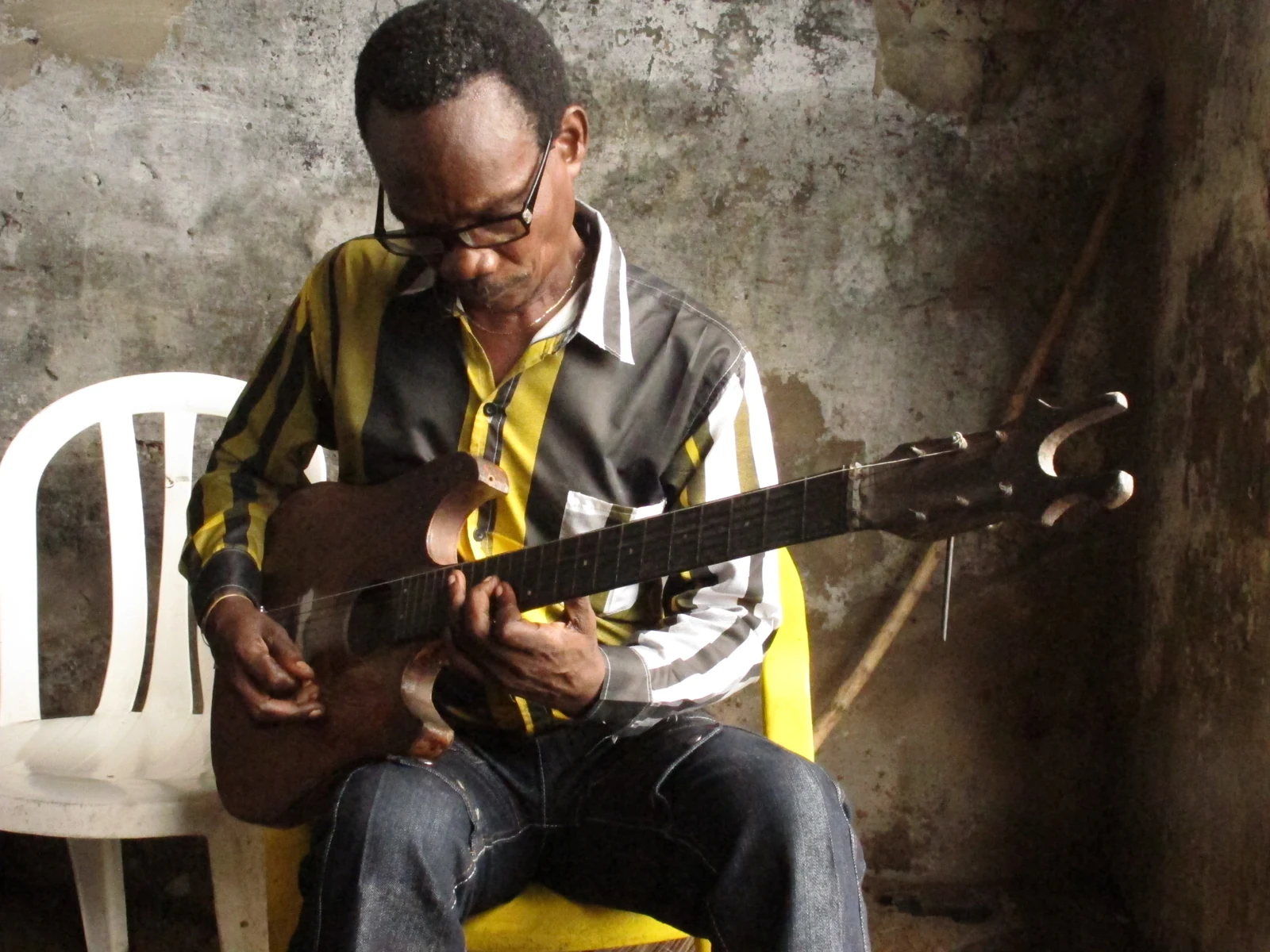
The image accompanying this essay documents one of those working relationships: Michel Missy of Bakolo Music International plays a guitar that photographer Jeanne Vu Van describes as made in Kinshasa, on 2 December 2014. The guitar makes visible a part of the practice that a recording alone might leave out: the work of making and maintaining an instrument. The nomination identifies instrument making and apprenticeship as part of the way musical knowledge passes on. A single photograph cannot tell us how common local production was, or what the guitarist or instrument maker earned. It gives a concrete point of reference for an institutional proposal that could otherwise read as a general promise to keep a musical style alive. [2] [3]
The history of music on the two banks also complicates the idea that safeguarding starts by deciding on a single authentic sound. The nomination connects rumba with nkumba, a dance of the historical Kingdom of Kongo, and describes the music as a changing urban practice. Isabela de Aranzadi’s study traces an Afro-Atlantic exchange shaped by enslavement, emancipation and subsequent movement of workers and musicians. It argues that Afro-Cuban recordings reached cities with musical practices already shaped by earlier contacts. Forced displacement and later movements took place under different conditions; linking them explains how sounds could travel without making the people who carried them interchangeable or reducing the result to a single journey from one shore to another. [2] [4]
Recording and distribution mattered because they gave musicians ways of making something new out of what reached them. De Aranzadi examines Spanish phrases and titles in Congolese recordings as one sign of urban experimentation, including instances where artists used a language they did not necessarily speak fluently. The University of California, Santa Barbara’s collection of African 78 rpm records names Congolese labels including Opika, Ngoma and CEFA alongside European companies. It holds recordings associated with African Jazz, O.K. Jazz and Orchestre Bantou Jazz. The collection establishes that recordings survive under these names and labels; it is not an inventory of the music everyone heard. Unrecorded performances, work that was never credited and material lost after release have a much smaller chance of appearing in such a catalogue. [4] [5]
The record could also carry a political voice beyond the place where it was made. Joseph Kabasele’s Independence Cha Cha became associated with the independence of the Belgian Congo in 1960. De Aranzadi places it alongside later music that conveyed disappointment after independence. There is room in the same repertoire for the excitement of a new political order and a listener’s recognition that daily life had not changed as hoped. The two countries’ shared nomination therefore does not imply a shared colonial administration or a single independence story. It provides a way for Kinshasa and Brazzaville to work together on a practice that crossed borders even as political authority on each bank took a different path. [2] [4] [6]
What travelled changed with the people doing the listening. Bob W. White traces how the guitar-driven dance passage called the seben became a more separable part of a song in the 1970s and how touring artists in the 1980s played it on its own for some audiences abroad. In group interviews in Kinshasa during 2003–05, by contrast, listeners often returned to what a song’s words said about their lives. These are observations from specific settings, not a division between all Congolese and all foreign audiences. They show why preserving a dance sequence or a recognisable guitar sound is only part of the task. Maintaining a recording’s words, names and performance context can preserve ways of listening that a commercially successful excerpt leaves behind. [7]
White’s account of libanga, the singing of names in dedications, illustrates how musicians have made a living by adapting those relationships. Dedications could mark friendship and recognition; in the 1990s he describes them also becoming a more explicit source of income, with some people paying to be named on records. In November 2026, Sophie Douce reported hearing dedications at a Kinshasa venue where musicians still perform the older repertoire. These accounts concern different moments and do not establish what any musician is paid today. They do give the Paris discussion a useful historical contrast. A payment for singing a dedication comes from a relationship the musician helps create. A payment for a streamed recording can also depend on who registered the work, who controls the recording and what agreements determine how revenue is shared. [1] [7] [8]
The administrative structure behind recognition was itself built across the river. In a published interview, Congolese cultural management scholar Ribio Nzeza Bunketi Buse recalls separate national scientific committees and a mixed commission that reconciled contributions and prepared a joint submission. The dossier names institutions on both sides, including the Institut des Musées Nationaux du Congo in the DRC and the heritage and archives directorate and the Union des Musiciens Congolais in the Republic of the Congo. In a separate interview from Brazzaville, Henri Ossebi, who took part in the process, stressed that inscription itself brought no automatic funds. The institutional achievement was to establish a joint commitment. Financing regular activity and letting practitioners influence decisions still depended on institutions in the two countries. [2] [9] [10]
Some of the planned work can already be seen in Kinshasa. Douce reports that the National Rumba Museum opened in December 2025 at Papa Wemba’s former home. At the National Institute of the Arts, she describes students learning and performing the repertoire and quotes ethnomusicologist Jean-Romain Malwengo on a project to transcribe songs drawn from recordings and broadcasts. These are different forms of work. A museum can preserve objects and make them available to visitors. Transcription can help a student learn material previously passed down mainly by ear. Neither replaces the relationship between a novice and experienced players, or secures an income for an ensemble between performances. The Kinshasa examples are evidence of activity there; they do not measure the reach or results of the joint plan in Brazzaville. [2] [8]
The Brazzaville inventory helps recover what can be lost if one city’s institutions stand in for both banks. It lists musicians, dancers, researchers and the copyright office among the people and bodies with knowledge of the practice. It also proposes recording older repertoire on analogue and digital media and incorporating rumba into arts education. Those activities address different audiences: a collection can preserve a performance for study; a course creates time and space for someone to learn how to play; a rights office can help make a recording’s use accountable to the people who made it. The public value of bringing them together lies in keeping those roles visible and preventing the most prestigious institutions from becoming the only ones entitled to say what deserves support. [2] [11]
The 2003 UNESCO convention provides a standard for that division of authority. Its participation provision asks governments to involve the people who create, maintain and transmit heritage in managing it. The Representative List provides international visibility; the convention leaves safeguarding decisions to be made through the work of states, communities and relevant institutions. That distinction matters when a national commission wants funding for a school or when a musicians’ organisation wants an accounting of payments. The two claims demand different kinds of decisions and evidence, even if they belong to the same effort. The convention’s reporting provisions offer a place for governments to describe what they have done, while the nomination gives practitioners a record against which to read those accounts. [2] [8] [12]
For the week in Paris, the relevant choice is how to connect the public discussion of platform revenue with work already under way in Kinshasa and proposed in Brazzaville. A recorded song may involve a writer, singers and instrumentalists, the party that controls the recording, and the services that distribute it. The visibility of a band or the size of a listening audience says little about the part each performer receives. Documentation can help people identify their contribution and understand which uses generate revenue. It can also let a new musician study the repertoire without treating older recordings as ownerless material. The original request from women practitioners makes the stakes concrete: being invited to represent the tradition does not settle who gains access to instrument training, receives a performance fee or takes part in decisions after the celebration ends. [1] [2] [8] [11]
The two Congos used their joint nomination to claim a place for a cultural practice sustained through clubs, studios, families and neighbourhoods. The anniversary is an occasion to see how that authority can travel back to the people who keep it alive. Musicians on both banks have already shown how to remake the genre through new sounds, audiences and ways of making a living. What public institutions can add is durable support for that capacity: room to learn and perform, an accessible record of who made the music, and a place for practitioners to decide how their work is preserved and paid. [1] [2] [7] [9] [10] [11] [12]
- [1]UNESCO. Congolese Rumba Week: Celebrating five years of living heritage at UNESCO10 November 2026; updated 12 November 2026
- [2]Democratic Republic of the Congo and Republic of the Congo, submitted to UNESCO. Rumba Congolaise: formulaire de candidature ICH-02, dossier 017112020 nomination cycle; inscribed 2021
- [3]Jeanne Vu Van via Wikimedia Commons. Michel Missy, Bakolo Music International.jpgCaptured 2 December 2014
- [4]methaodos.revista de ciencias sociales. Isabela de Aranzadi: La rumba congoleña en el diálogo afro-atlántico. Influencias caribeñas en África desde 18002016
- [5]University of California, Santa Barbara Library. African 78rpm Recording CollectionUndated collection record; accessed 13 November 2026
- [6]UNESCO. From Nkumba to Rumba: the Rich Intangible Cultural Heritage of the Congos25 March 2022; updated 20 April 2023
- [7]Musiques : Recherches interdisciplinaires, Université Laval. Bob W. White: Listening to the Aesthetics of Popular Culture: Hermeneutics and Power in Congolese rumba17 December 2025; Kinshasa group interviews 2003–05
- [8]The UNESCO Courier. Sophie Douce: New life for Congolese rumba2 November 2026; updated 3 November 2026
- [9]Congo Profond. Entretien exclusif avec Ribio Nzeza sur l’inscription de la rumba congolaise à l’UNESCO24 April 2026
- [10]Les Dépêches de Brazzaville. Entretien avec Henri Ossebi sur l’inscription de la rumba16 December 2021
- [11]Republic of the Congo, submitted to UNESCO. Inventaire du patrimoine culturel immatériel du Congo : Rumba congolaise28 March 2017; submitted with the 2020 nomination
- [12]UNESCO. Convention for the Safeguarding of the Intangible Cultural Heritage17 October 2003
Did this publication help you understand the topic?
0 voluntary responses. Browser-based participation; responses are not a representative survey.
We welcome suggestions, contributions and recommendations.
Editorial standards ↗