On 3 and 4 November 2026, immigration chiefs meeting in Freetown agreed that a valid ECOWAS National Biometric Identity Card issued by any member state should be accepted as proof of identity and Community citizenship at all official border crossings from 1 January 2027. The ECOWAS Commission announced the declaration on 9 November. A country is meant to accept another member’s card even if it has yet to issue its own. For a trader who crosses between Aflao and Lomé, the promise concerns a decision made by an officer at the crossing: whether a credential issued on one side will be recognised on the other. The declaration sets a deadline for acceptance. It gives no evidence yet that all posts have the instructions or equipment to meet it. [1] [7]
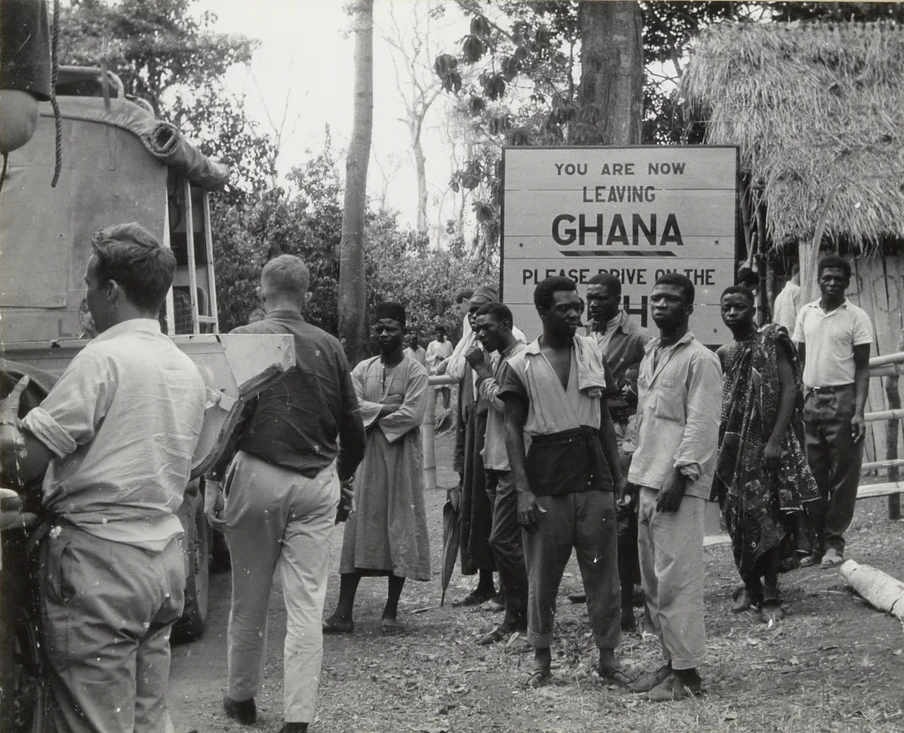
An archival photograph from 20 February 1962 shows a sign telling people they are leaving Ghana at the border with Togo. H.F.J.M. Crebolder’s photograph records a point at which state authority was made visible through a sign, a police hut and the road itself. It cannot tell us which papers the people in the frame carried or why they were there. Its value is more specific. It shows the border as a place people physically inhabited before ECOWAS negotiated common rules for passing through it. The Freetown agreement concerns a different instrument of authority at a crossing: one state’s ability to check an identity document issued by another. [1] [2] [3]
The Protocol on Free Movement of Persons, Residence and Establishment, concluded at Dakar on 29 May 1979, set out three stages: entry, residence and establishment. Its first stage allowed Community citizens to visit another member state for up to 90 days without a visa through an official entry point, subject to documentary requirements and the receiving state’s power to refuse admission under its laws. Permission was required to extend a stay beyond that period. The protocol recognised a regional status with practical value for short visits while retaining national authority over entry and longer stays. A document that proves Community citizenship matters because that status already exists in the legal framework. It does not by itself confer a right to take up any job or establish a business without further procedures. [3] [6]
The revised ECOWAS Treaty reaffirmed that arrangement in 1993. Article 59 recognised entry, residence and establishment in accordance with the relevant protocols and committed member states to give effect to those rights. The treaty and the 1979 protocol together explain why the administration of a crossing is part of regional integration: member states agreed on the entitlement, then had to organise how their own authorities would give it effect. [3] [10]
In Abuja in December 2014, the ECOWAS Authority amended its 1985 travel certificate decision to establish the national biometric card as a regional travel document. It envisaged rollout by 2016 and instructed the Commission to set up a monitoring and evaluation committee. It also linked the card to security cooperation and called for data protection when national authorities transfer biometric information. These provisions make clear that the card was designed to ease movement and help states verify identities. Those objectives can coexist, but implementation determines which one travellers feel most directly. A reliable check can speed a crossing; the same requirement can add a barrier if a post has no way to complete the check. The 2016 rollout target in the decision was a timetable, and later ECOWAS records show that deployment remained uneven. [4] [5] [9]
Sierra Leone’s own experience helps explain why the new commitment separates acceptance from issuance. In June 2024, the Commission’s delegation met officials in Freetown to discuss recognition of other countries’ cards. A Sierra Leonean foreign ministry official identified the card’s price relative to the local identity document and the difficulty citizens faced when other countries did not recognise it. The Commission’s account is evidence that those concerns were raised at the meeting; it does not measure how often cards were refused. In February 2026, the Commission and the World Bank, acting as co-secretariat, convened national identity and immigration authorities on a roadmap to connect national systems to the regional card. A Sierra Leonean civil registration official said deployment was still limited to some countries. Freetown’s January date addresses one part of that problem: a receiving country’s willingness and ability to recognise a card should not depend on whether that country already issues one. [1] [5] [9]
Yeboah and colleagues show why an immigration service cannot assume that everyone entitled to move can claim the entitlement in the same way. In 2019, they observed the Ghana–Togo crossing and interviewed 23 purposively selected ECOWAS migrants travelling to or living in Ghana, as well as officials and a union representative. Their comparison covered traders, students and professionals, among others. Some salaried professionals in the study received employer help with residence and work paperwork. Other participants had less access to information and support. The interviews illuminate how those resources matter; the small, deliberately varied sample cannot show how common an experience was among all travellers. The Freetown commitment speaks directly to one documentary step at the border, while the differences observed by the researchers can persist in enrolment and in the procedures that follow entry. [1] [6]
The 2024 International Organization for Migration study of women in small-scale cross-border trade places that distinction in the working day. Its qualitative research included focus groups in Aflao and in Togo, with people recruited through groups the researchers could reach. Participants and officials described a trade that depends on several kinds of support. At Aflao, the study identified Ghana Shippers Authority staff providing information in the customs baggage hall. It also documented a regional traders’ association offering information through border desks, including on requirements affecting particular goods. For a person carrying merchandise, the immigration decision on whether she may enter and the customs decision on the goods concern different obligations. Accepting a card could make one part of a journey easier while leaving the other requirements in place. The group discussions help explain why a single indicator of border processing would miss parts of that working day. [6] [7]
Arhin-Sam and colleagues offer a wider explanation for the gap between the rules and experience. Their study drew on a 2019 research project in four West African countries and on deliberation with regional scholars and civil society participants. They argue that the uneven implementation of free movement reflects differences in national priorities and administrative capacity, alongside cross-border ways of making a living that do not fit neatly into official categories. In their account, some efforts to formalise movement also strengthened controls. This is a historical interpretation of earlier programmes, not a finding about the Freetown declaration. It does help explain why installing card readers alone would be a poor measure of the new commitment. The same machines could support faster acceptance or add a check without reducing delays. The practical difference turns on the instructions and alternatives available to officers and travellers. [1] [8]
In Freetown, the immigration chiefs asked national administrations to brief border staff, issue procedures and equip posts where needed. They also asked the Commission to complete common specifications and a regional verification mechanism, revive the monitoring committee envisaged in 2014, seek resources, report annually and take the recommendations to the competent ECOWAS bodies. The Commission’s account distinguishes a January 2027 acceptance date from a call for national rollout plans by December 2030. That separation sets an earlier operational deadline for authorities that receive travellers with existing cards. The announcement does not itemise funded equipment purchases, signed contracts or installed systems. Published national instructions and subsequent reports would let people see where the commitment has moved from a regional meeting to a working process. [1] [4] [9]
It matters, too, what an official check will reveal and to whom. The 2014 decision explicitly coupled some data transfers with compliance with personal data protection rules. The 2026 roadmap discusses interoperability, meaning that systems built by different authorities can work together, while the Freetown announcement asks for a common verification mechanism. Neither announcement sets out a complete technical design. An officer could be given a means of confirming a card without gaining general access to an issuing country’s identity register. What actually happens depends on the systems chosen, the data they disclose, who can use them and how mistakes can be corrected. Those details affect travellers who have little opportunity to contest a mismatch while standing at a crossing. An implementation report can establish whether verification works without disclosing anyone’s biometric data. [1] [4] [9]
The declaration calls for affordable cards, issuance in border areas and for nationals abroad, closer links to civil registration and better information for traders and other travellers. Sierra Leone’s concerns about price and Ghanaian researchers’ accounts of unequal access to administrative help explain why these are consequential commitments. For someone who travels often, access depends partly on whether the civil registration and identity offices can issue a document within reach of home and at a cost that makes sense. For the official at the crossing, access depends on whether the national instructions and verification tools recognise a neighbouring country’s valid card. A measure of progress that tracks acceptance alone would leave out people who cannot obtain the credential in the first place. One that tracks cards issued alone would leave out what happens to holders at the border. [1] [5] [6] [8]
The first public test of the Freetown commitment is therefore specific. National authorities can say where and how cards will be accepted from January, while the Commission can report which crossing points can verify them and what happens when verification fails. At Aflao and Lomé, a traveller’s experience would reveal something that neither the 1962 photograph nor the adopted rules can establish: whether this particular reform makes an everyday crossing more predictable. The right to move regionally, established long before the biometric card, will continue to depend on how national institutions exercise their authority in that encounter. [1] [2] [3] [6] [7]
- [1]Economic Community of West African States Commission. ECOWAS Heads of Immigration Sign Freetown Declaration to Mandate ENBIC Acceptance by January 1, 20279 November 2026; meeting 3–4 November 2026
- [2]H.F.J.M. Crebolder / African Studies Centre Leiden / Wikimedia Commons. Crebolder album, NSAG Collection, Crebolder 1 – 087: Ghana–Togo border20 February 1962; archival photograph, digitisation date unspecified
- [3]Economic Community of West African States / United Nations Treaty Series. Protocol relating to Free Movement of Persons, Residence and Establishment29 May 1979; UN registration 1 February 1996
- [4]Economic Community of West African States Authority of Heads of State and Government. Decision A/DEC.01/12/14 amending Decision A/DEC.2/7/85 establishing a travel certificate for ECOWAS Member States15 December 2014
- [5]Economic Community of West African States Commission. ECOWAS Conducts Advocacy on the Deployment of The ECOWAS National Biometric Identity Card in Liberia and Sierra LeoneJune 2024; Freetown meeting 18 June 2024
- [6]Thomas Yeboah, Leander Kandilige, Amanda Bisong, Faisal Garba and Joseph Kofi Teye / International Migration, Wiley. The ECOWAS Free Movement Protocol and Diversity of Experiences of Different Categories of Migrants: A Qualitative Study2021 journal issue (first published 2020); fieldwork February–May 2019
- [7]International Organization for Migration. Study on Women in Small-Scale Cross-border Trade – Benin, Ghana and Togo2024; validation workshops in April 2024
- [8]Kwaku Arhin-Sam et al. / South African Journal of International Affairs. The (in)formality of mobility in the ECOWAS region: The paradoxes of free movement2022; draws on 2019 research and November 2019 deliberations
- [9]Economic Community of West African States Commission. ECOWAS Holds Virtual Consultation with Member States for the Development of a Roadmap from Foundational Identification Systems to the ECOWAS National Biometric ID9 February 2026
- [10]Economic Community of West African States Commission. ECOWAS Revised Treaty1993; 2010 reprint; Article 59
Did this publication help you understand the topic?
0 voluntary responses. Browser-based participation; responses are not a representative survey.
We welcome suggestions, contributions and recommendations.
Editorial standards ↗