On 6 November 2026, Gabon’s industry minister signed a memorandum with South Manganese Investment Limited for a proposed processing project using manganese from M’Bembélé, in the Ndjolé area. A day earlier in Shanghai, Gabon, Eramet Comilog and Sinohydro signed a letter of intent to study how to supply electricity to a different proposed plant, an alloy works near Libreville. Both steps advance a Gabonese policy already set in a 2025 decree: exports of unprocessed manganese are to stop on 1 January 2029. The question is what it will take to turn an export rule into durable industrial capacity, and who will pay for the infrastructure on which that capacity depends. [1] [2] [3]
The deals are distinct. Gabon’s industry ministry says the M’Bembélé project would begin with capacity for 180,000 tonnes of metallurgical products per year, with a larger expansion envisaged by 2030. It puts the estimated cost at about 116.7 billion CFA francs. Those figures are the ministry’s description of the project, not evidence of secured finance, a disbursement or a finished plant. The ministry identifies South Manganese’s Gabonese subsidiary as the company that had previously discussed the proposal with officials. The memorandum concerns a particular project and operator; it does not settle the investment plans of every manganese producer in Gabon. [1] [3]
The Shanghai letter concerns the power supply for Eramet Comilog’s proposed alloy works. It follows a July agreement between Gabon and Eramet that set out three industrial scenarios under study. Eramet said those scenarios could process up to 700,000 tonnes of ore annually by the end of 2031, subject to conditions including access to energy. That figure measures potential ore processed, whereas the industry ministry’s M’Bembélé figure describes potential metallurgical output. Adding the two would obscure both the units and the projects. The dates matter too: the scenarios extend beyond the start of the export prohibition, and the July announcement did not say the facilities would all be ready by 2029. [1] [2] [3] [4]
The decree gives the government a way to change the terms on which firms sell Gabonese ore abroad. It applies to mining operators and other entities involved in selling or exporting raw manganese. It names forms of locally processed product that may be exported under the new rule, including ferromanganese and silicomanganese. It also assigns the mining ministry, working with customs, a role in monitoring and tracing what is produced and exported. This is more specific than a promise to industrialise: export eligibility will depend on what has happened to the material before it reaches the border. Whether officials can apply that distinction consistently depends on the procedures and evidence available to them. [3]
Earlier decisions about the same industry show why an infrastructure commitment matters as much as an announcement about ore. In the early years of commercial extraction at Moanda, the Gabonese mine did not have a direct route to a Gabonese mineral port. Brice Ibouanga, Magloir-Désiré Mounganga and Vivino Max Thiery Mouyalou reconstruct the route through the Republic of Congo: an aerial cableway linked Moanda to Mbinda, from where a dedicated rail link joined the Congo–Ocean railway towards Pointe-Noire. The mine’s commercial reach depended on a chain of facilities crossing a national boundary. The deposit alone did not determine where the industry would employ people or where it would buy transport services. [5] [6]
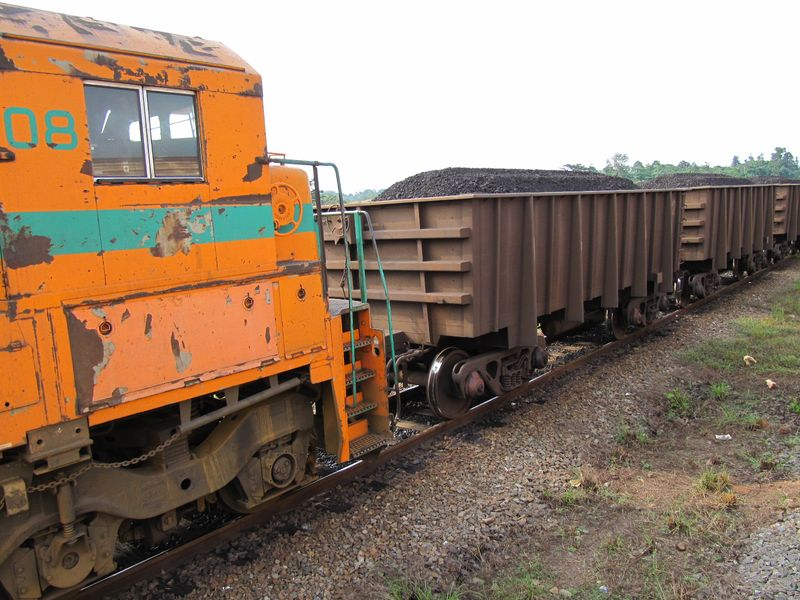
That geography changed as the Transgabonais reached the mining region and the Owendo mineral terminal opened in the late 1980s. The older route remained in use for a time, then ended in 1991. Moving the route onto Gabonese territory gave the state a different relationship to the infrastructure used for exporting the ore. It also concentrated traffic on a corridor that other businesses and passengers use. Vincent.vaquin’s 2010 photograph of loaded ore wagons records the freight system that grew out of that choice. It shows the kind of movement on which an export industry relied, rather than the site or outcome of either 2026 agreement. [5] [6] [7]
The move to local processing also has precedents. In its own chronology, Comilog dates the opening of an ore enrichment and agglomeration facility at Moanda to 2000. It records an initial silicomanganese pour in 2014 and the opening of the Moanda metallurgical complex the following year. This history makes it possible to distinguish three stages often collapsed into one: extracting ore, preparing or concentrating it, and making a metallurgical product. The change proposed for 2029 concerns the conditions under which producers may export; it does not introduce processing to Gabon for the first time. Existing operations provide experience, while the November agreements point to a much larger task of matching proposed plants to power and transport. [2] [3] [4] [6]
Rail access is one of the places where those projects meet public life. The International Finance Corporation’s review of a separate railway rehabilitation project describes the Transgabonais as Gabon’s only railway and reports 8.9 million tonnes of freight in 2024, of which 8.4 million tonnes were mining products. The same line carries passengers. Ibouanga and his co-authors, drawing on documents, interviews and field observation, describe constraints on the line and argue that planning must account for users beyond the manganese companies. A busier mineral corridor can support local production, but how capacity is assigned will also affect passenger service and shipments of ordinary goods. [5] [8]
The rail concession also complicates the idea that the state and foreign firms act on opposite sides. In the IFC’s account, the Gabonese state holds a minority share in SETRAG, the rail concessionaire, alongside Comilog and Meridiam, and is expected to fund part of the separate rehabilitation programme. The state sets the export rule, participates in the operator and faces decisions about public spending. These are different forms of authority. Knowing that the state has a shareholding does not tell a passenger whether a service will be reliable; knowing that rehabilitation is planned does not establish that the works are complete. [3] [8]
The railway disclosure offers a way to tell a commitment from an expenditure. The IFC lists its Phase III transaction as approved on 24 June and signed on 30 June 2026, with disbursement still pending in the disclosure last updated on 3 July. It describes planned contributions for works by SETRAG and the state, including new rails, pedestrian crossings and changes to traffic management. These works concern the existing corridor; they are not the financing for either November plant proposal. They illustrate the records that will eventually allow the public to distinguish a project’s estimated cost from who has agreed to fund it, when money moves and what gets built. [2] [8]
The same distinctions apply to electricity. An alloy plant needs an operating supply, not simply an undertaking to examine one. The Shanghai letter names the parties that will study the option, but the presidency’s account does not specify a power tariff, a purchase agreement or a final construction decision. A workable arrangement must resolve who builds and pays for the necessary supply and what terms apply to the plant. If the supply relies on shared infrastructure, the arrangements can also matter for other users. Those are questions raised by the proposed works, not evidence that a particular tariff or allocation has been adopted. [2] [4]
For workers, building a plant and keeping it in operation are different sources of employment. The July roadmap also mentions a proposed industrial seed fund and a biochar supply chain using forestry by-products. These initiatives describe ways a processing project might draw in local enterprises. Their effect would depend on what the plants actually buy, what training is available and who can meet the terms of supply. An increase in output alone cannot establish how many durable jobs or orders for Gabonese firms result. The government’s two new agreements are best read as steps towards answering those questions rather than as the employment results themselves. [1] [2] [4]
Gabon’s extractive industries transparency report for 2023 already lists mineral transport agreements between SETRAG and three producers, including Comilog and CICMHZ. It also describes the mining code’s provisions for local skills, employment and procurement. That history matters for M’Bembélé: the group’s local subsidiary enters the proposed processing project with a place in the existing transport system, while processing would add a different set of demands and potential suppliers. A future disclosure of transport terms, actual procurement or training expenditure could show where the benefits accrue. The November announcements do not provide that detail. [1] [5] [9]
The next test of the policy is whether the rule, the proposed plants and the services they need can be made to work on the same timetable. The history of Moanda shows that Gabon has changed the geography of manganese before: first by redirecting its exports to Owendo, then by building facilities that processed some of the material at home. The November agreements open another stage. Its public value will be visible in the terms for financing and power, the kinds of work sustained at the plants, and the capacity left for other users of the railway. Those are results that a signed memorandum cannot deliver on its own. [1] [2] [3] [5] [6] [8]
- [1]Gabon Ministry of Commerce, Industry and Transformation. Signature d’un mémorandum d’entente entre le Gabon et la Chine2026-11-06
- [2]
- [3]Journal officiel de la République gabonaise. Décret n°0435/PR/MMRG portant interdiction d’exportation du manganèse brut extrait sur le territoire de la République Gabonaise2025-11-11; reproduced gazette issue 93, 1–7 December 2025
- [4]
- [5]ACAREF, vol. 3 no. 8. Brice Ibouanga, Magloir-Désiré Mounganga and Vivino Max Thiery Mouyalou: L’acheminement du manganèse vers le port d’Owendo : enjeux infrastructurels2024-08; fieldwork includes 2024 observations
- [6]Comilog. HistoireUndated chronology; accessed 2026-11-11
- [7]Vincent.vaquin / Wikimedia Commons. Transgabonais-minerai.jpgCaptured 2010-08-06
- [8]International Finance Corporation. SETRAG III, project 49419: Environmental and Social Review Summary2026-02-10; updated 2026-07-03
- [9]ITIE Gabon. Rapport ITIE Gabon 20232023 reporting year; accessed 2026-11-11
Did this publication help you understand the topic?
0 voluntary responses. Browser-based participation; responses are not a representative survey.
We welcome suggestions, contributions and recommendations.
Editorial standards ↗