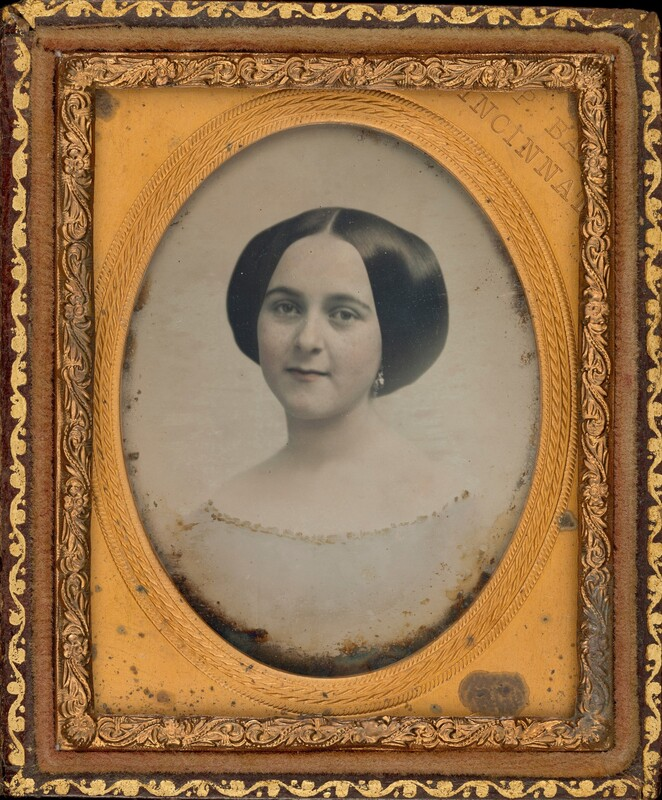
At the National Gallery of Art in Washington, D.C., an oval portrait shows a woman looking out from a gilded mount. Near the upper right, letters pressed into the brass identify the studio: J. P. Ball, Cincinnati. The gallery dates the photograph to about 1850 and does not name the woman. On view in Remember Me: Picturing African Americans in Early Photography, which opened on 7 November 2026, it invites visitors to look at two things at once: the person in the picture and the trace of the Black photographer whose workshop produced it. [1] [2] [3]
The portrait is small enough to hold in one hand. The area of the image visible inside the mount is about five centimetres high. The woman’s dark hair, parted at the centre, and the pale dress give the face room in the composition. The dark marks near the edge are visible on the surviving object; the gallery’s record does not assign a cause to each one. A photograph of the piece on a screen can make the details easier to see, but it also changes the experience of looking. A little object meant to be handled can become larger than the viewer’s hand, and the reflective surface becomes a flat image. [3] [4]
That surface is a clue to how the portrait was made. A daguerreotype records the image directly on a polished, silver-coated copper plate. The photographer exposed a sensitised plate in the camera, then developed and fixed the image. There was no negative from which to make a run of identical prints. The decorated mount and protective case belong to the photograph’s material history, as does the colour the gallery describes as applied by hand. The catalogue establishes the medium and attributes the portrait to Ball; it does not name the person who added colour to this particular plate. [3] [4] [5]
The surviving mount identifies Ball’s business more securely than the image identifies the sitter. That difference matters. The signature places an African American photographer in the history of a technique often told through inventors and processes alone. It does not establish the woman’s name, ancestry, circumstances, or reasons for sitting. The Smithsonian’s research on Ball’s Cincinnati practice documents both Black and white clients. Inferring this woman’s identity from appearance or assigning her a story because of the exhibition’s subject would erase the distinction between what can be seen and what can be known. [2] [3] [5]
Ball’s studio was also a place of collaboration. At the Smithsonian American Art Museum, an earlier exhibition brought together his photographs and landscape paintings by Robert Seldon Duncanson, a Black artist who worked with Ball in Cincinnati. The Smithsonian dates their collaboration roughly from 1845 to 1855 and records that Duncanson worked on hand colouring photographs. Paintings and photographs could be seen in the same gallery. That combination helps explain why a portrait business belonged to the history of art as well as commerce. It brought different skills into a single space and made pictures something people could come to see as well as buy. [5] [6]
Remember Me places Ball alongside Glenalvin Goodridge and Augustus Washington, other early Black studio photographers. The exhibition’s curators point to the fact that all three put their names on works at a time when daguerreotypists did not always identify themselves. A studio mark gives a historian something more durable than an assumption about the person in front of the camera: it identifies work that can be connected to a practice, a market and sometimes an address. Yet marks survive unevenly. This portrait is unusually legible about its maker and relatively quiet about its subject. The exhibition is valuable partly because it lets that imbalance remain visible. [2] [3]
Ball used visual media on a very different scale in 1855. His travelling panorama addressed the Atlantic slave trade and slavery in the United States. The archivist and scholar Dorothy Berry reconstructs how its painted scenes would have passed before an audience as canvas was wound from one roller to another. A visitor to Ball’s portrait gallery could choose where to look and how long to stay with a picture. A panorama directed attention in sequence. Its guide moved from Africa and the Atlantic into American scenes. In one setting Ball’s business offered clients a durable likeness; in the other he used a public spectacle to ask viewers to follow a history across places. [5] [6]
The panorama has not survived in the form described in its guide. Berry distinguishes between the physical work and the evidence that remains: the printed description and an illustration of Ball’s gallery, which shows the space where pictures were displayed rather than the panorama itself. That distinction is useful far beyond this exhibition. A contemporary illustration can document how a business presented itself to readers without supplying an unmediated view of its visitors or their reactions. The guide can tell us what scenes were advertised and how they were ordered, but it cannot give back a performance or establish what any particular audience took from it. [6]
Frederick Douglass, whom Ball photographed, offered a contemporary way of thinking about pictures in an address in Boston on 3 December 1861. Douglass treated images as things that influence the way people feel, remember and understand public life. He also observed how quickly a portrait can be made to look more admirable after the person in it succeeds. That makes his address useful beside Ball’s work. The camera’s capacity to register detail does not settle how a picture will be read. The studio, the setting in which an image appears, and what viewers already believe can all affect what they see in a face. [5] [7]
The National Gallery’s exhibition also includes a section on portraits of both free and enslaved people. Those objects introduce a question that neither a studio label nor the apparent composure of a sitter can resolve: what say the person had in making or circulating the picture. Credit for a photographer and agency for a subject are two different matters. In the later studio work that the exhibition includes, photographers such as Addison Scurlock and James Van Der Zee made portraits of couples, families and groups. Seen together, the sections let viewers consider both the possibilities a studio offered for shaping a likeness and the unequal circumstances under which a likeness could be made. [1] [2]
The exhibition depends on a more recent movement of objects. The National Gallery acquired the Ross J. Kelbaugh collection in 2023. Its account of the acquisition describes a group of 248 works; the exhibition presents about 70 works from the gallery’s holdings. The two figures describe different things. A collection may contain pictures unavailable to most viewers, while an exhibition makes a smaller set visible in a particular sequence. The object record does another kind of work: it gives Ball’s portrait an accession number, a description of its materials and a transcription of the studio mark, details a reader can follow even after the gallery arrangement changes. [1] [2] [3] [8]
Berry’s account of digitising a copy of Ball’s panorama guide shows why the move from an object to something searchable matters. The guide had been bound with other abolition pamphlets. Preserving the volume helped it survive, but the way it was catalogued made the individual work harder to discover. Adding an accessible digital record changes how somebody can encounter the pamphlet; it does not recover the missing canvas. There is a similar distinction between making a portrait downloadable and restoring the sitter’s name. Access can widen the circle of people who study a picture, including people who may recognise contexts the catalogue misses. A gap in the record remains a gap until there is evidence to fill it. [3] [6] [9]
The easiest history to tell would be one in which nineteenth-century photography simply recorded an established social world. Ball’s studio, in the records that survive, was part of making that world visible. It required technical skill, people who could work across painting and photography, clients, and spaces where images could be shown. His panorama used a different technology and a different relationship to its audience. The exhibition makes room for both the work of people building an image-making practice and the lives of people who passed through such spaces, even where the surviving record names one and not the other. [2] [3] [5] [6]
Ball’s portrait remains a particular thing: a little plate, a brass surround, a studio mark and a face. The exhibition cannot give the woman back her name. It can let visitors see the workmanship and the credit that travelled with her image, and learn to recognise the difference between a carefully documented picture and a complete account of a life. [1] [3] [6]
- [1]National Gallery of Art. Remember Me: Picturing African Americans in Early PhotographyExhibition opened 7 November 2026
- [2]National Gallery of Art. Remember Me: Picturing African Americans in Early Photography (curatorial release)20 July 2026; updated 29 September 2026
- [3]National Gallery of Art / James Presley Ball. Portrait of a Womanc. 1850
- [4]Library of Congress Preservation Science. Photographs: Early Ungilded Daguerreotype ImagesUndated; accessed 14 November 2026
- [5]Smithsonian American Art Museum. J. P. Ball and Robert S. Duncanson: An African American Artistic Collaboration2023 exhibition
- [6]Dorothy Berry / Winterthur Portfolio. Splendid Mammoth Afric-American Image Search: A Personal Essay17 July 2026 online
- [7]Frederick Douglass Papers Project. Pictures and Progress: An Address Delivered in Boston, Massachusetts, on December 3, 18613 December 1861
- [8]National Gallery of Art. Rare Early Photographs of African American Life7 September 2023
- [9]National Gallery of Art. Free Images and Open AccessUndated; accessed 14 November 2026
Did this publication help you understand the topic?
0 voluntary responses. Browser-based participation; responses are not a representative survey.
We welcome suggestions, contributions and recommendations.
Editorial standards ↗