African officials are scheduled to begin four days of digital-policy deliberations in Libreville on 26 October 2026. The African Union’s published programme places data sharing, digital identity, artificial intelligence and cybersecurity before experts, with ministers due to meet on 29 October. These subjects reach into the relationship between public institutions and the people whose records they hold. A system that connects administrative files can change how services are delivered and how decisions about a person are made. The political stakes include who can use those records, for which purposes and under whose supervision. [1]
The agenda includes draft arrangements for cross-border data flows, interoperable identity systems and digital public infrastructure. It also includes media literacy and digital inclusion, particularly for women and young people. Their designation as drafts matters: the programme identifies choices for consideration, with a ministerial declaration expected at the end of the session. Those choices concern the rules and institutions that could make different systems work together. Their public value depends on the rights, responsibilities and routes to challenge a decision that accompany the connections being proposed. [1]
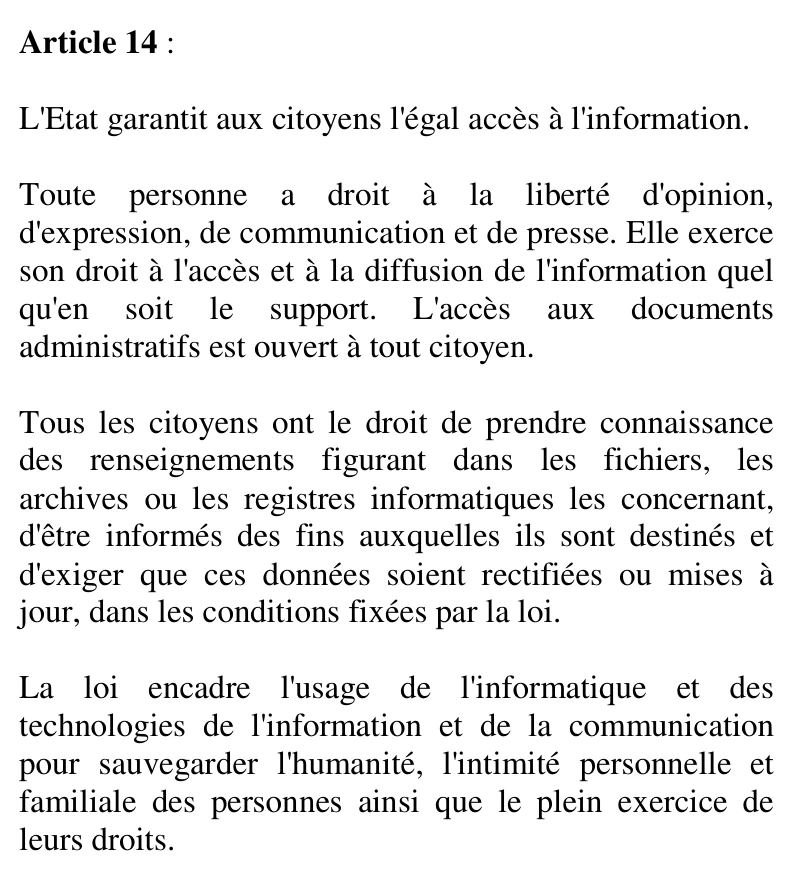
Gabon’s own constitutional text offers a precise starting point. Article 14 of the Constitution promulgated on 19 December 2024 recognises citizens’ access to information held about them in files, archives and computerised registers. It also recognises their right to know the purposes of those records and require correction or updating under the law. This places a person inside the legal relationship created by an administrative record. The institution holding information has responsibilities towards the person described by it, alongside whatever public task the record serves. [2]
The same article protects access to administrative documents and links the regulation of computing and communication technologies with privacy and the exercise of rights. Article 18 recognises respect for private life, while Article 19 addresses the confidentiality of communications. These provisions make digital government a question of public authority bounded by rights. The image accompanying this essay reproduces the actual Article 14 from the December 2024 official text. It records the constitutional formulation of those rights; their practical exercise also depends on legislation, accessible institutions and effective remedies. [2]
The concern has a history within Gabonese law. The preceding 1991 constitutional framework, in the official consolidation listing amendments through January 2021, protected the secrecy of postal, telegraphic, telephone and telematic communications. It also assigned the law a role in limiting computer use to safeguard personal and family privacy and the exercise of rights. This earlier text shows that the public consequences of information systems were already a constitutional concern before the present continental AI agenda. The technologies named in the provision also preserve the vocabulary of an earlier communications environment. [3]
Reading that earlier formulation with the current debate identifies a continuing institutional problem. The administration’s ability to collect and process information has to be related to the position of the person concerned. The older provision expressed that relationship through protected communications and legal limits on computing. This is a history of changing legal formulations around information and authority, with different technologies entering the relationship over time. It supports a present inquiry into the rules governing public records, while leaving the actual performance of a particular system to evidence about its operation. [3]
Ethiopian scholar Abeba Birhane gives the debate a further dimension in her 2020 study of algorithmic colonisation. She uses the concept to examine power over the infrastructures through which people are classified and social problems are defined. Her argument concerns business models and decision-making authority, including the importation of systems built around priorities distant from the communities expected to use them. The concept directs attention to the assumptions embedded in a proposed solution: whose problem it addresses, which knowledge informs its design and which institution can question its categories. [4]
Birhane also places local participation at the centre of an alternative approach. Her study argues for involving people who may bear the effects of a technology in its design, development and governance, with particular attention to marginalised groups. This is a substantive account of agency. Communities contribute knowledge about the circumstances in which a system will operate, while public institutions and developers remain responsible for the decisions they take. Her framework gives the Libreville discussion an important question about representation: how can affected people influence the rules and classifications through which digital services organise their lives? [4]
The AU Data Policy Framework, endorsed in February 2022, connects this concern with the organisation of the economy. It treats data as a strategic asset and proposes a people-centred approach to value creation, public services and regional markets. It identifies concentrated markets, unequal capabilities and discriminatory automated decisions as risks. In this account, the benefits of data depend on institutions that can manage competing interests. National authorities, firms, regulators and citizens occupy different positions in that system, with different capacities to obtain information and influence its use. [5]
The framework therefore links infrastructure with regulatory capacity. It calls for clear responsibilities, capable independent regulators, safeguards for personal data and coordination across competition, trade and taxation policies. It also recognises that governments themselves must follow protection rules. This distributes accountability across the public and private actors involved. A nationally located database can still be governed through arrangements that give people little influence; meaningful authority requires the capacity to supervise access, processing and use. The framework locates trust in legitimate institutions and enforceable responsibilities as well as secure equipment. [5]
The African Commission’s 2019 Declaration of Principles on Freedom of Expression and Access to Information adds a rights-based account of access. Principle 37 calls for universal, affordable and meaningful internet access, including infrastructure, digital skills and attention to marginalised communities. These provisions connect digital participation with the material conditions needed to exercise it. A person needs an attainable means of reaching a service and understanding its requirements. Public decisions about connectivity, market competition and accessibility help determine who can participate in institutions that increasingly communicate through digital systems. [6]
The declaration also addresses power over personal information. Principles 40–42 set out protections concerning privacy, surveillance, access to one’s information and effective remedies. They call for independent oversight and safeguards around targeted surveillance, and reject indiscriminate collection of communications. As the Commission explains, this declaration is a soft-law elaboration of African Charter rights. Its principles give the current policy discussion a standard for examining institutional arrangements. They connect the ability to build and connect systems with people’s ability to understand, challenge and obtain redress for the use of information about them. [6]
The 2014 Malabo Convention develops a complementary institutional design. Its provisions on personal data assign national protection authorities responsibilities that include informing people and data controllers of their obligations, receiving complaints, conducting audits and imposing administrative penalties. The treaty also calls for the human, technical and financial resources needed to carry out that work. This makes supervision an institutional task with staff, expertise and powers. An authority needs the means to examine processing practices and communicate the result of a complaint if the protections are to become usable in everyday administrative relationships. [7]
The convention’s provisions also address the information supplied about processing, including its purposes, the categories of data, the bodies with access and arrangements for transfers. These details identify the decisions hidden inside the broad phrase ‘data sharing’. They make it possible to distinguish an agreed purpose from an unlimited permission to circulate information. The treaty is cited here as an African legal framework, without assuming identical ratification or implementation across countries. Its design illustrates how governments can organise supervision around particular activities and responsibilities as they consider more connected systems. [7]
The AU’s 24 October message to the Tana Forum connects these issues explicitly with economic sovereignty. Delivered by deputy chairperson Selma Malika Haddadi, it places digital skills, infrastructure and regulatory capacity alongside resource governance and the financing of African institutions. The message identifies the forthcoming Libreville meeting as part of that agenda. Its account of sovereignty concerns the capacity to make and sustain public choices. It also connects the credibility of continental ambitions with whether young people can influence their development and see opportunities within them. [8]
That account makes accountability part of the sovereignty question. The Tana message calls for transparent contracts, public oversight of revenues and institutions that command trust. These are stated priorities rather than evidence that particular projects have fulfilled them. Applied to digital policy, the message connects control over strategic resources with the way public authority is exercised. The relevant capacity includes building institutions, financing their work and sustaining follow-up. The distribution of benefits and responsibilities therefore belongs within the discussion of who governs Africa’s digital development. [8]
The AU’s founding institutional design identifies how the present meeting fits into collective decision-making. Articles 14–16 of the 2000 Constitutive Act establish specialised technical committees, composed of ministers or senior officials, with responsibilities for preparing programmes, coordinating work and following implementation. Their reports and recommendations go to the Executive Council. This gives continental policy a route through institutions with different roles. The committee provides a setting for officials to work on common problems, while its recommendations remain part of a wider chain of decisions and implementation. [9]
Following that chain keeps the present choices concrete. Continental deliberation can establish shared directions and standards; institutions must then exercise the responsibilities assigned to them. The Constitutive Act’s emphasis on supervision and implementation places continuing work alongside the production of recommendations. For the public, the significant outcome will be the authority these arrangements create over information and the safeguards accompanying it. The Libreville agenda brings that relationship into view: African collective capacity can be developed through institutions that remain answerable to the people whose work, identities and opportunities their systems help organise. [9]
- [1]African Union. 6th Ordinary Session of the AU Specialized Technical Committee on Communication and ICT26–29 October 2026; programme accessed 26 October
- [2]Republic of Gabon / Journal officiel. Loi référendaire n°002-R/2024 portant Constitution — articles 14, 18 et 1919 December 2024
- [3]Republic of Gabon / Journal officiel. Constitution de 1991, consolidation listing amendments through January 2021 — article premier1991, as amended through January 2021; accessed 26 October 2026
- [4]Abeba Birhane / SCRIPTed. Algorithmic Colonization of Africa6 August 2020; volume 17(2), pages 389–409
- [5]African Union. AU Data Policy FrameworkEndorsed 2–3 February 2022; edition accessed 26 October 2026
- [6]African Commission on Human and Peoples’ Rights. Declaration of Principles on Freedom of Expression and Access to Information in AfricaAdopted at the 65th session, 21 October–10 November 2019
- [7]African Union. Convention on Cyber Security and Personal Data Protection — articles 10–1227 June 2014
- [8]African Union Commission. Message delivered at the 12th Tana High-Level Forum on Security in Africa24 October 2026; forum 23–25 October
- [9]African Union / Pan-African Parliament Open Data Portal. Constitutive Act of the African Union — articles 14–1611 July 2000; original adopted text
Did this publication help you understand the topic?
0 voluntary responses. Browser-based participation; responses are not a representative survey.
We welcome suggestions, contributions and recommendations.
Editorial standards ↗