On 6 November 2026, Mauritius’s Cabinet reported that the country’s main reservoirs were at 49.6 percent of capacity the previous day. Mare aux Vacoas, which supplies upper Plaines Wilhems and Moka, stood at 33 percent. Ministers also recorded 40,000 applications for help buying water tanks and pumps. Officials had completed 27,000 surveys and forwarded 17,000 eligible applications to the Development Bank of Mauritius. Suppliers had asked for a higher grant, citing rising tank prices, and two ministers were to meet them. The Cabinet reported a request and a planned meeting; it announced neither an increase nor the number of households that had received equipment. [1][2]
For households in upper Plaines Wilhems, the distinction between a reservoir and a water service is already concrete. In October, ministers described a response intended to sustain supply on alternate days by area. Boreholes, river abstraction and mobile filters were part of the effort to get more water into the system; tankers and shared storage were intended to reach residents during interruptions. A tank at home can stretch the usefulness of the hours when the network runs. Whether it fills depends on what reaches the property and at what pressure. The emergency has therefore exposed two questions at once: how to get more water to La Marie treatment plant, and who has the means to store the water once it gets past the plant. [1][3][4][5]
The October response had already widened the tank and pump scheme to households without tanks. The Government Information Service described support for tanks, a pump and fittings. The application form shows how that broad category is translated into a decision: it asks about the main residence, whether the applicant owns or rents it, existing equipment and previous awards. It requires identification and a way to contact the applicant, and allows a water bill or proof of address to be attached. A tenancy appears on the form as a category; the form alone does not establish how quickly renters can arrange installation, or whether they have room for it. The scheme makes domestic storage a matter of public support, while the work of accommodating and maintaining the equipment remains at the property. [4][5]
There is a practical reason to keep applications, surveys and referrals separate. They mark different stages between a family asking for help and a tank becoming usable. A referral to the Development Bank means that an eligible file has passed one stage. It does not say when equipment becomes available, whether the supplier can provide it at the amount covered or how soon it will be connected. The price question matters because the supplier sits between the decision to subsidise storage and its delivery. A revised amount might address the purchase price, while the hours and pressure of piped supply would still determine what the installation achieves. The 6 November record gives a measure of administrative progress, but not yet a measure of water service restored. [1][3][4][5]
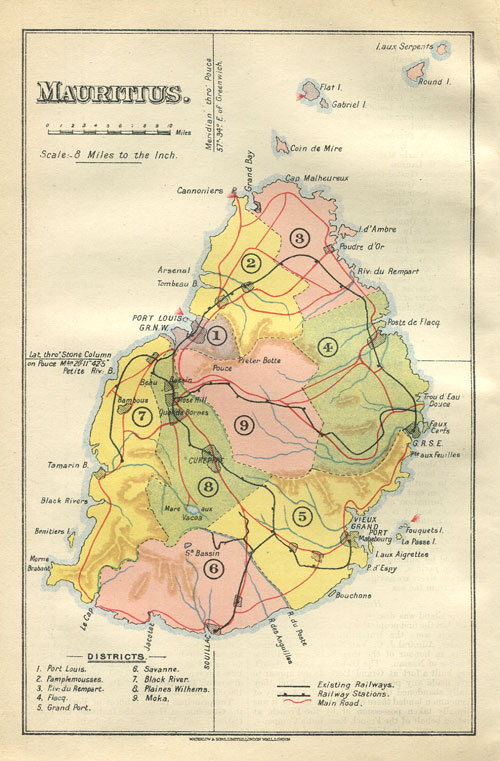
The effort to bring more water to La Marie belongs to a much longer history of moving water across the island’s central plateau. A small map printed by Waterlow & Sons in 1910 labels Mare aux Vacoas near Curepipe in Plaines Wilhems. Its legend marks roads and railways; the map situates the reservoir among settlements and transport routes, but says little about how water reached particular homes. The Water Resources Unit dates the first masonry dam to 1885 and records a raising of the dam in 1892. Further enlargement followed prolonged drought in 1915, and a canal completed in 1922 diverted water from Rivière du Poste. The sequence shows how a store of domestic water built at one site became dependent on infrastructure reaching into other catchments. [2][6]
That engineering history ran alongside a different history of entitlement. In their study of water allocation in small island states, Lianne Oosterbaan and Aleksandra Peeroo trace Mauritian rights to take water from adjoining rivers to nineteenth-century legislation and the expansion of sugar estates. A river could be held in the public domain while a landowner with an established right retained access to part of its flow. Political independence in 1968 brought changes in administration, including the creation of a national public water authority in 1971, without erasing those rights. The same period also saw continued public investment in feeding the reservoir, including the Parc aux Cerf canal in 1971. The enduring features of the system are both physical and legal; public investment and inherited entitlements can coexist. [2][7][8]
Oosterbaan and Peeroo distinguish a change in formal rules from a change in who actually draws water. Using Mauritian statistics for 2010–2023, they find that the public utility accounted for most groundwater abstraction over the period, while holders of inherited water rights took a large share of abstracted surface water. That distinction matters in reading the present programme: an additional borehole, a river diversion and a grant for a household tank act on different parts of the system. The historical abstraction figures describe a distribution of access. They do not quantify what any rights holder drew in November 2026 or establish what caused the fall at Mare aux Vacoas. The authors’ work helps explain why the sources available to the utility are a question of allocation as well as geography. [1][3][7]
The Water Resources Act of 2024 puts that distinction into statutory form. Its text treats surface waters as part of the public domain and vests underground water in the state, subject to the Act. It also sets out a route to register existing water rights, with evidence of title and of the quantity assigned. The enacted text envisages an application to the Supreme Court where certain changes would affect a registered right. In considering such a request, the court is to weigh public consumption and environmental needs, among other factors. These provisions describe how claims may be reconciled; the cabinet account of the current response does not say that ministers obtained a court order or that they changed an existing right. A new institutional framework gives the state tools, but the use of those tools has to be established separately. [1][7][8][9]
Rainfall sets a physical limit that neither the grant nor a legal change can remove. Reena H. Seebocus, Michel R. Lollchund and Miloud Bessafi examined Mauritian rainfall from 1950 to 2016 and used a precipitation index at several time scales to identify dry and wet episodes. Their work shows why a dry spell and a prolonged drought need different measures. It also clarifies the limits of reading a single reservoir percentage: rainfall records measure precipitation against past conditions, while storage reflects what has flowed in, been transferred or been drawn out of a particular system. The researchers’ series ends a decade before the cabinet figures. It is historical evidence of drought variability, not a diagnosis of the current reservoir reading. [1][2][10]
Even when a reservoir or borehole can yield more water, the network determines how much treated water reaches the customer. In its performance audit, signed in December 2025, Mauritius’s National Audit Office reported that non-revenue water averaged about 60 percent across the island in 2024, with variation between supply zones. This is a category for water put into the network that brings in no revenue, including losses and water supplied without billing; it is not a finding that 60 percent of water physically leaked. The auditors identified ageing pipes as a major cause of the problem. Their finding makes it possible to distinguish the benefit expected from an increase in treatment capacity from the benefit that residents can actually experience at the tap. [3][9]
The same audit shows why pipe renewal depends on how work is organised, not only on how much money a budget sets aside. It found that an average of 39 percent of the capital grants made available through the pipe replacement programme over the period it examined had been used. It also reported a faster pace of renewal after 2023 when the authority used its own teams and small and medium-sized contractors alongside its existing arrangements. The budget record and the work record answer different questions: a grant makes spending possible, while the reported length of pipe replaced shows where implementation has started to catch up. Neither figure gives a November 2026 reading of pressure or hours of supply in a particular street. [3][9]
There is a corresponding difference between more water at the treatment plant and a more dependable day for residents. The October cabinet records identify works at Mare Longue and plans for additional pipelines to La Marie. The November cabinet reports monitoring those projects as reservoir stocks continue to fall. A transfer, once operating, can help meet demand in an emergency; the public system must still allocate the additional volume among supply zones and get it through pipes that serve different elevations and pressures. An alternate-day schedule can spread scarcity, but it also asks households to organise cooking, washing and other daily tasks around the periods when water runs. Shared storage and tankers matter precisely where domestic equipment or regular network service is unavailable. [1][3][4][9]
The household grant is a useful response to a specific problem: it can help residents keep water available between turns on the network. The history of Mare aux Vacoas explains why that relief is only one part of the public decision. Mauritius has expanded the infrastructure that moves water across catchments, built a public utility and restated the public status of water in law, while retaining procedures that recognise older claims to use it. What matters now is whether those institutions can convert a scarce supply into dependable service. The next evidence of progress will be equipment delivered and installed, water actually reaching La Marie, and fewer or shorter interruptions in the places the response is intended to serve. Each is a different result, and each can be measured without mistaking the number of applications for the amount of water a household can count on. [1][2][5][7][8][9]
- [1]Prime Minister’s Office, Mauritius. Highlights of Cabinet Meeting – Friday 06 November 20262026-11-06, item 2; reservoir data as of 2026-11-05
- [2]Ministry of Energy and Public Utilities, Mauritius. Water Resources Unit: Mare aux Vacoas ReservoirUndated; consulted 2026-11-07
- [3]Prime Minister’s Office, Mauritius. Highlights of Cabinet Meeting – Friday 23 October 20262026-10-23, item 4
- [4]Government Information Service, Mauritius. Government rolls out measures to address water shortage2026-10-14
- [5]Central Water Authority, Mauritius. Application for Water Tank and Pump Grant 20262026 form; consulted 2026-11-07
- [6]Waterlow & Sons, via Wikimedia Commons. Mauritius Waterlow map 19101910; exact publication date unknown
- [7]Geoforum. Lianne Oosterbaan and Aleksandra Peeroo, Decolonising water resource allocations: towards a typology of experiences in small island developing statesMarch 2026; Mauritian abstraction series 2010–2023
- [8]Government Gazette of Mauritius, via National Assembly. The Water Resources Act 2024 (Act No. 9 of 2024)2024-07-25
- [9]National Audit Office, Mauritius. Performance Audit Report: Sustainable Water Resources Management2025-12-01; principally 2012–2024 with 2025 follow-up
- [10]South African Journal of Science. Reena H. Seebocus, Michel R. Lollchund and Miloud Bessafi, Analysis of extreme rainfall and drought events using statistical and fractal methods: A case study of MauritiusSeptember–October 2021; rainfall series 1950–2016
Did this publication help you understand the topic?
0 voluntary responses. Browser-based participation; responses are not a representative survey.
We welcome suggestions, contributions and recommendations.
Editorial standards ↗