On 13 November 2026, the Académie des Sotigui unveiled 101 commemorative stones on Avenue Kwame Nkrumah in Ouagadougou, according to Agence de Presse Africaine’s account of the ceremony. A hundred honour individuals; the other is dedicated to a gallery of customary and traditional leadership. The new stones extend the Rue des Étoiles, which opened on the same avenue in February 2025. A list of honourees is now part of a route that people use for work, shopping and travel. The Academy’s rules reveal how a name makes it onto that route, and where the authority to decide remains. [1] [2] [5] [6]
The project allows candidates to enter through registration, proposal or selection by the organisers. The Academy’s president describes an eleven-member committee that examines candidates and chooses names for the Academy to validate. The rules give members a three-year term and put disputes over interpretation before the Academy’s president. That procedure gives the public ways to put forward names, but it does not give nominators a vote over the result. It also differs from the procedure for naming a public road: at the November ceremony a municipal representative defended the value of the project, while the published selection rules assign the decision about individual distinctions to the Academy and its committee. [1] [2] [3] [8]
Those decisions include the categories in which achievement can be recognised. The rules group candidates under science and knowledge, sport and leisure, arts and culture, defence and security, and citizenship and Pan-Africanism. The November account puts filmmaker Aminata Diallo Glez and rapper Smarty alongside honourees from other fields. It also identifies a collective marker for customary leadership, and the project’s online directory gives individual entries to authorities including the Mogho Naaba Baongho and the Naaba Boussouma. The rules and the record of the ceremony show how the project brings different forms of authority together on the same street. Recognition on a stone confers visibility; it does not give the person or institution named there a new legal power. [1] [2] [4]
The presence of figures from outside Burkina Faso has been part of the project since its first edition. In its bulletin of 23 February 2025, FESPACO reported that 140 people were honoured and quoted the municipality’s representative putting the number from outside Burkina Faso at 24. The rules describe recognition of non-nationals as exceptional and subject to validation. For November 2026, APA reported that the Pan-African category included Marcus Garvey, Patrice Lumumba, Malcolm X and Nelson Mandela. That selection places several distinct political traditions in the same commemorative space. It can put different histories in conversation, but the category on the marker cannot on its own explain why those traditions mattered or how they differed. [1] [2] [3] [5]
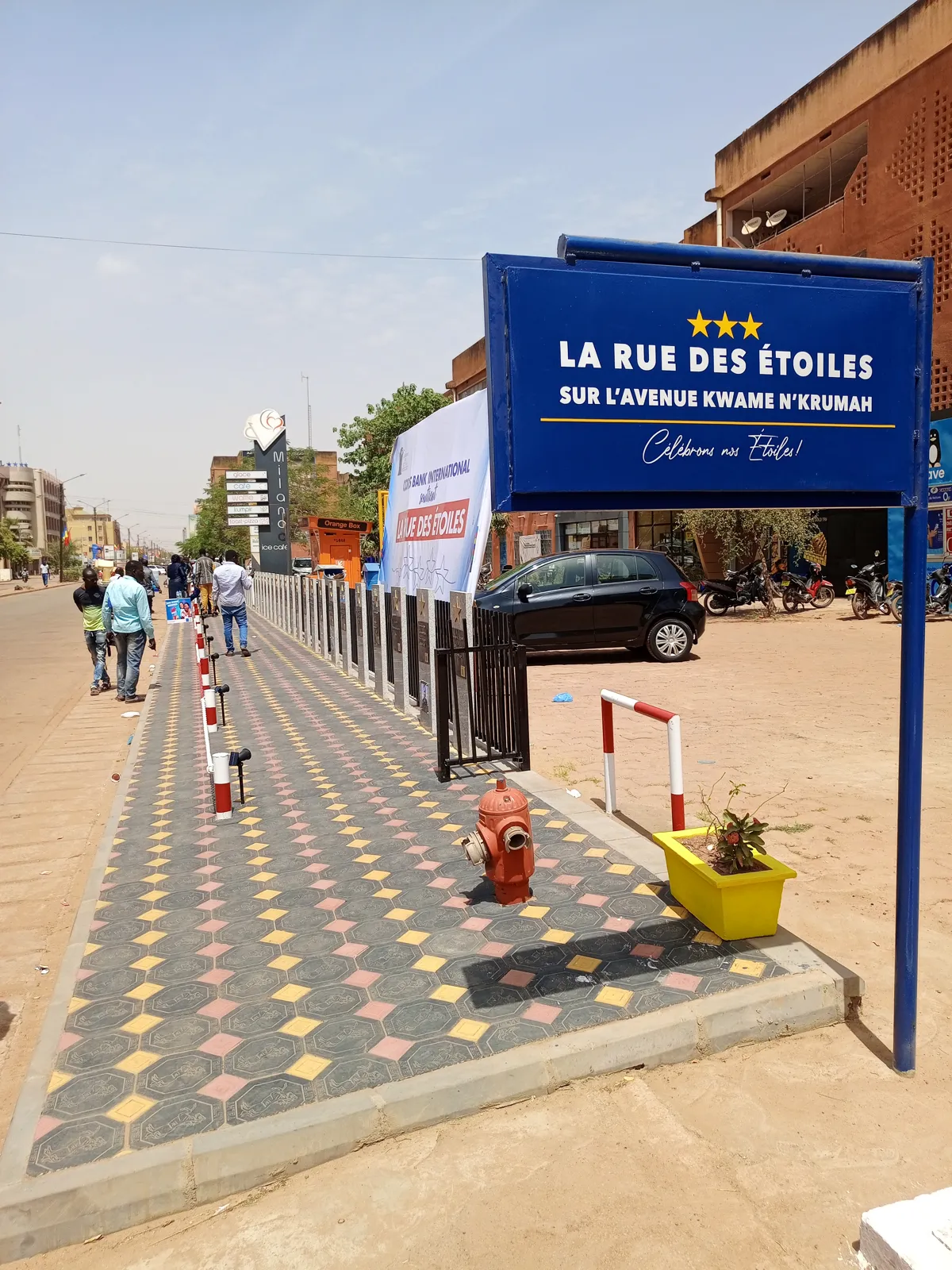
The first edition also shows how the project was presented to residents. FESPACO, the Pan-African film and television festival, covered the unveiling in the bulletin that documented its own February 2025 programme. The inaugural image shows the title of the trail, the arrangement of the stones along a pedestrian path, and the surrounding businesses. It records how the street looked at the launch, before the November 2026 additions. The view is useful because it shows what the rules describe only in outline: the commemorative space is part of the ordinary street, where a person can encounter it without going to an awards ceremony or entering a museum. [2] [5] [9]
The image also shows a branded banner. It establishes that a sponsor was visible on the avenue in February 2025; it cannot establish who paid for each stone, what financial terms applied, or whether the same arrangements financed the second edition. The rules state that the project is intended to help attract visitors and contribute to local economic activity. That is a purpose, not a measure of benefits already received by nearby businesses. The ceremony account and the selection rules speak far more clearly about the public recognition attached to the project than they do about how the costs of making and maintaining it are divided. [1] [2] [5] [9]
The organisers did not choose a blank space. In a 2002–2003 study at the Université de Ouagadougou, geographer Clémence Namalgambamba Ouédraogo traced the development of the city’s commercial and administrative zone. She describes building along Avenue Kwame Nkrumah as part of an earlier phase of that development, with shops below apartments, and examines the expansion created by a government decree in November 2000. The avenue’s importance to the new trail comes partly from those earlier decisions about where to put commerce, housing and services. The Academy can place new stories in view because the road was already a destination and a route through the centre. [2] [6] [9]
Naming a road and placing a marker on it do different things with the same urban resource: the attention of people who pass. On 18 May 2025 the municipality named a newly laid out avenue for former Ghanaian president John Jerry Rawlings. The government account presented the choice as a tribute to his relationship with Thomas Sankara and to the ties between Burkina Faso and Ghana. The name became part of the official geography of another road. On Avenue Kwame Nkrumah, the Academy adds names and biographies while the underlying street name remains. The two projects show how a city can express Pan-African connections through different institutions and at different scales. [2] [5] [8]
What passers-by read also depends on the other signs around them. Sayouba Ouédraogo and Issa Ouédraogo, researchers at Université Joseph Ki-Zerbo and Université de Ouahigouya, studied privately produced signs in ten selected neighbourhoods. Their observations and interviews found multilingual signage with French dominant and relatively few references to neighbourhood names. They examined everyday commercial signs, not the Rue des Étoiles, and their study does not tell us which languages readers of the trail prefer. It shows why it is worth paying attention to the format in which an institution writes a place into public view. Shopkeepers, customers and visitors can all use the same street while looking for different cues about where they are and what is there. [6] [7] [9]
The granite markers add two layers to what visitors can learn. One is the name and field visible on the street. The other is the biography the visitor can reach by scanning a code. The Academy’s online directory illustrates that second layer: its entries for customary leaders give them a shared category while linking to separate individual profiles. The design allows more information than could comfortably fit on a stone. It also means a reader without a working phone or data connection must rely on what is physically inscribed, while an online reader can encounter the same profile without setting foot on the avenue. The street and the website serve overlapping publics, with different conditions of access. [2] [4] [7]
A further difference is how durable the two forms of evidence are. A stone can remain legible even if the site it points to moves, but the name alone may leave readers without the chronology needed to understand the distinction. A digital entry can be corrected or expanded, but a visitor needs to know who is responsible for maintaining it. The committee rules describe who chooses an honouree and who interprets the selection rules. The directory shows what readers can consult now. Together they make it possible to distinguish the authority to award a place on the avenue from the continuing work of making that place useful as a historical resource. [2] [3] [4] [9]
The November gallery also shows why the wording of a marker matters. A collective dedication presents customary authority as a subject worthy of commemoration; the individual profiles can help a reader distinguish the institutions and places represented. At the ceremony, the Academy’s scientific committee president praised customary authorities for their contribution to mediation and social cohesion. That is his account of their public significance, not a finding about how a particular dispute was handled. A good street history can preserve the fact that an institution was honoured while giving readers the means to understand what that institution did, where its authority came from and how it differed from the others named nearby. [1] [3] [4]
The new stones make the work of selection visible on one of Ouagadougou’s main avenues. The first edition records and the older studies show what changed: a route already used for commerce and public services now also carries a programme of commemoration, with the municipality, the Academy and a selection committee playing different roles. What that programme can teach depends on the information people can actually read, on the street or in the directory, about why each person or institution was chosen. [1] [2] [4] [5] [6] [7]
- [1]Agence de Presse Africaine. Ouagadougou inaugure 101 stèles de mémoire13 November 2026
- [2]Académie des Sotigui / La Rue des Étoiles. Règlement de la Rue des ÉtoilesUndated; accessed 13 November 2026
- [3]Académie des Sotigui / La Rue des Étoiles. Mot du présidentUndated; accessed 13 November 2026
- [4]Académie des Sotigui / La Rue des Étoiles. Liste des ÉtoilesUndated; accessed 13 November 2026
- [5]FESPACO official festival bulletin, no. 1. Inauguration de la Rue des étoiles : 140 personnalités du Burkina Faso et du monde distinguées23 February 2025
- [6]Université de Ouagadougou, via IRD. Diagnostic des activités de la zone d’activités commerciales et administratives (ZACA), Clémence Namalgambamba Ouédraogo2002–2003; field data include October 2002
- [7]
- [8]Service d’Information du Gouvernement, Burkina Faso. Commune de Ouagadougou : une avenue en hommage au Président John Jerry Rawlings18 May 2025
- [9]KONATEYaya226 via Wikimedia Commons. La rue des étoiles à Ouagadougou.jpg22 February 2025
Did this publication help you understand the topic?
0 voluntary responses. Browser-based participation; responses are not a representative survey.
We welcome suggestions, contributions and recommendations.
Editorial standards ↗