On 11 November 2026, the African Commission on Human and Peoples’ Rights called for stronger cooperation on rescue at sea and on finding missing people after a boat sank off Lompoul, in northwestern Senegal. Separately, Senegal’s navy said two of its units had assisted four boats on 10 November and rescued 759 people. The Commission’s statement and the navy’s announcement describe different events. Read together, they raise a question that has been on the Atlantic route since Senegal and Spain began joint patrols two decades ago: who is responsible for a person in distress, and how far does that responsibility extend once the vessel is back at port? [1] [2] [3]
Senegal’s Interior Ministry reported that, by the evening of 7 November, 21 bodies had been recovered and one person had survived the Lompoul wreck. That was an early count. In its later statement, the Commission cited reports of at least 39 deaths and said search operations were continuing. It described 6 November as the reported date of the wreck. Neither statement establishes the final number of people on board. The navy’s count from 10 November answers a different question: how many people it says it took to safety from four other boats. Adding those figures together would obscure what is still unknown about the missing and what is known about the separate rescues. [1] [2] [3]
The Commission addressed states of origin, transit and destination. It recognised their authority to police borders and investigate smuggling, while insisting that enforcement must not compromise rescue or obstruct access to protection. Its November statement did not establish a new patrol, allocate a budget or announce a tracing agreement. It restated a standard against which those decisions can be judged: a person’s claim to help in distress does not turn on whether a state authorises the journey. A government can report a successful rescue and still have work to do on identification, appropriate referral and keeping families informed. [1] [4]
That distinction becomes clearer when the route is read through the operations that changed who patrolled it. In February 2007, Frontex announced a third phase of HERA following operations in the summer and autumn of 2006. The agency described aircraft and vessels supplied by European states and patrols conducted with Senegalese authorities. It said the aim was to prevent departures and thereby reduce the risk of lives being lost. The same announcement described a separate activity in the Canaries: interviewing people who had arrived to learn whether others had facilitated the crossings. The stated objectives tell us what the agency sought to achieve. They do not establish what happened to everyone whose journey was interrupted. [5] [12]
Senegal was an actor in that arrangement: the patrols described by Frontex depended on cooperation with its authorities. Spain brought personnel and resources to a route leading to its own territory. The European Court of Auditors’ account of HERA places its launch after tighter controls along another route, through the Strait of Gibraltar. That chronology helps explain why a count from one stretch of sea gives a limited view of movement overall. Spain’s government also described Spanish police working alongside Senegalese forces in Dakar in 2017 and reported three million euros in direct subsidies maintained since 2012. That was Spain’s account of earlier support, not a measure of spending on the November 2026 rescues. [5] [6] [12]
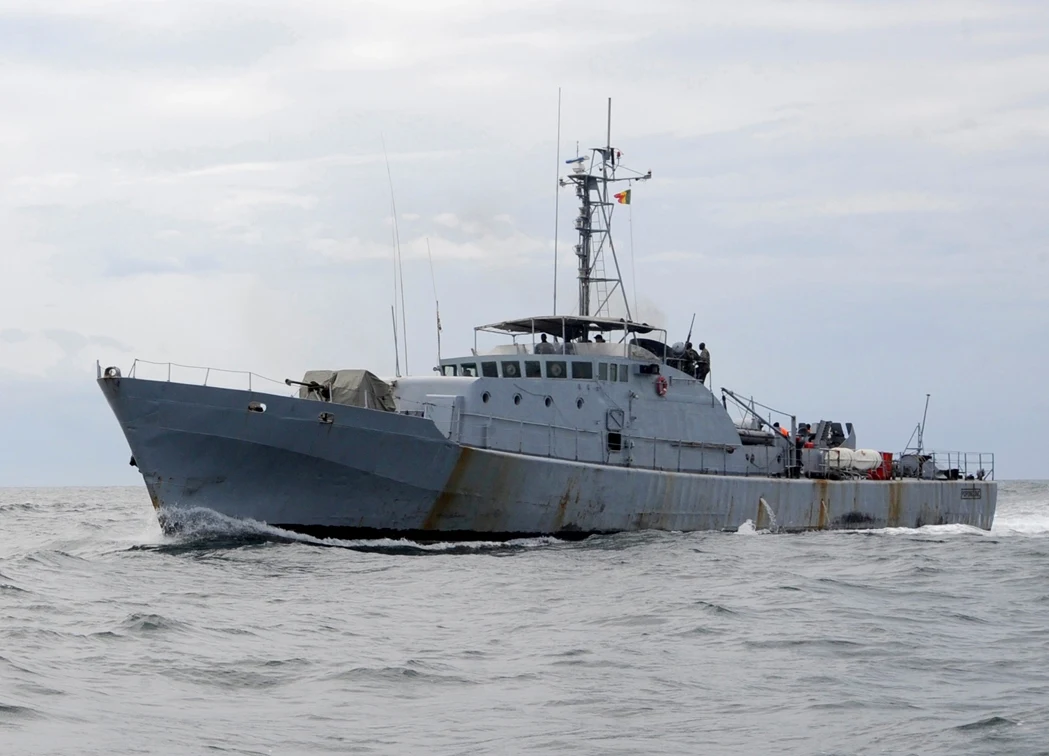
The photograph accompanying this essay records a separate partnership. On 8 August 2009, the US Coast Guard photographed Senegal’s Poponquine during a joint operation in the Atlantic. The official caption says Senegalese boarding teams trained alongside US Coast Guard personnel. The image is evidence of a particular exercise and of Senegal’s ability to work with different external partners. It does not show HERA, tell us which units responded in November 2026, or establish what those units did after disembarkation. Its value is to make visible a part of maritime cooperation that agreements can leave abstract: crews learn and practise how to act together. What they are authorised to do still depends on the mission and the applicable rules. [5] [7]
A second Senegal–Spain agreement shows how decisions on shore can matter as much as patrols. Signed in Dakar in December 2006, the agreement on unaccompanied Senegalese children set up cooperation on prevention, protection, return and reintegration. It allocated financing for protection on Spanish territory to Spain and provided for cooperation in financing prevention, return and reintegration with Senegal. It also provided for a joint committee to assess measures. These are provisions about duties, process and finance. They do not tell us how many children received effective support, or establish the age or circumstances of anyone rescued this November. Their significance is that they make an issue visible that a patrol tally cannot answer: who has responsibility for an individual case once the first emergency has passed? [3] [8]
The history of the route also looks different from the shore. Senegalese researchers Serigne Mansour Tall and Aly Tandian examined how young people financed Atlantic crossings in the 2000s. In the cases they studied, some families sold assets to contribute; other travellers saved earnings from precarious urban work or drew on pooled savings. They also described how relatives abroad could help others obtain travel documents or finance a visa. Their evidence comes from a specific period and set of places. It cannot establish who was aboard the Lompoul boat, but it helps explain why two people with similar plans can face different routes and costs. Access to documented travel depends in part on who can afford it and who can find someone to help them meet its conditions. [9]
Not every pirogue journey is an attempt to reach Europe. Thomas Binet, Pierre Failler and Andy Thorpe draw on research conducted in 2007–09 in Senegal and in West African destination countries to describe fishing crews that had long moved along the coast for work. Their study treats fishing mobility as an economic activity in its own right and argues for regional fisheries management that takes those movements into account. This history matters to policy because the same coastline sustains work, trade and longer journeys under different legal conditions. A response based entirely on departure prevention cannot tell an official which protections a person needs, or explain the wider opportunities and constraints households weigh when considering a journey. [9] [10]
Senegal’s national strategy, validated in July 2023, already treats migration as more than a question for patrol crews. It sets out five areas: prevention, border management, law enforcement, support and protection, and return and reintegration. Those headings give ministries a basis for sharing responsibility, but they are a strategy rather than proof that services are available in every coastal district. The November records say who announced the rescues and identify institutions involved in the response to Lompoul. They do not show how the cost of follow-up is divided, whether local services received funds, or whether families in different jurisdictions have a common way to enquire. A published responsibility and a funded service are separate commitments. [1] [2] [3] [11]
The African Commission set out what that follow-up could include in its 2021 resolution on missing migrants and refugees. It called for states to cooperate in searching for missing people, identifying the dead and communicating with families. Its 11 November statement returned to those duties. From a family’s point of view, the distinction between someone who has been rescued, someone who has died and someone whose fate remains unknown is not merely a matter of statistical classification. It determines whether they can find a relative, arrange a burial or keep searching. Sharing records can help establish someone’s fate, but public reporting can describe whether a tracing service exists without circulating survivors’ names or information that might expose them to harm. [1] [4]
There is also an accountability question for destination countries. Spain’s early cooperation illustrates how a destination government can support patrols, help finance certain protection work and still rely on Senegalese institutions to carry out tasks on Senegalese territory. The African Commission’s standard applies across those divisions of labour: sharing the work should make it possible to identify who must act when a boat is in distress and who takes over afterwards. Nothing in the November material shows that a Spanish or Frontex unit participated in the rescues the Senegalese navy described. The historical arrangements help locate responsibility in the right institution; they cannot substitute for a record of the operation itself. [1] [3] [5] [8]
The records also show two different ways to measure the work. The 2007 HERA announcement described interviews intended to identify how journeys were organised and patrols intended to prevent departures. The Commission’s 2021 resolution, by contrast, asks states to build the capacity to account for people who disappear. Those tasks can coexist, but the records produced for one will rarely answer the questions asked by the other. A report on departures does not tell families whether an identification has been made or which authority holds the case. [4] [5]
After Lompoul, the most telling evidence of cooperation would include reports that distinguish people rescued in each operation from those still missing, and show where a family can ask for help across borders. Those are different measures from the number of patrols or boats stopped. The history of the route shows why that distinction has endured: the institutions equipped to patrol the sea are not necessarily the institutions able to identify someone, arrange protection or answer a family. The Commission’s statement puts those later duties back in the same frame as rescue. Whether governments carry them out is a matter for subsequent records, not something the appeal itself can establish. [1] [3] [4] [11]
- [1]African Commission on Human and Peoples’ Rights. Nouveau drame migratoire au large du Sénégal : la Commission africaine appelle au renforcement de la protection des migrants et à la prévention des décès en mer2026-11-11
- [2]Ministère de l’Intérieur et de la Sécurité publique du Sénégal. Drame migratoire sur le littoral de Kébémer2026-11-08
- [3]Radiodiffusion Télévision Sénégalaise / Marine nationale sénégalaise. Émigration irrégulière : 759 personnes secourues par la Marine nationale en mer (includes the Navy’s announcement)2026-11-11
- [4]African Commission on Human and Peoples’ Rights. Resolution on missing migrants and refugees in Africa and the impact on their families (ACHPR/Res. 486)2021
- [5]Frontex. A sequel of operation Hera just starting2007-02-15
- [6]Government of Spain, La Moncloa. Spain and Senegal agree to strengthen bilateral cooperation on fighting terrorism, organised crime and drug trafficking, and to enhance management of migratory flows2017-07-20
- [7]U.S. Coast Guard Atlantic Area / DVIDS. U.S. Coast Guard Cutter Legare Patrols With Senegalese Navy Vessel, Poponquine [Image 2 of 2]2009-08-08 (capture); 2009-08-10 (release)
- [8]Senegal and Spain / Boletín Oficial del Estado. Acuerdo Senegal–España sobre menores senegaleses no acompañados: prevención, protección, repatriación y reinserción (BOE-A-2008-12316)2006-12-05 (signed); 2008-07-18 (gazette)
- [9]Serigne Mansour Tall and Aly Tandian / European University Institute, CARIM. Regards sur la migration irrégulière des Sénégalais : vouloir faire fortune en Europe avec des pirogues de fortune2010
- [10]Thomas Binet, Pierre Failler and Andy Thorpe / Maritime Studies. Migration of Senegalese fishers: a case for regional approach to management2012-06-06 (publication); 2007–2009 (fieldwork)
- [11]République du Sénégal / CILMI. Stratégie nationale de lutte contre la migration irrégulière2023-07-27 (validation)
- [12]European Court of Auditors. Special Report 08/2021: Frontex’s support to external border management: not sufficiently effective to date2021
Did this publication help you understand the topic?
0 voluntary responses. Browser-based participation; responses are not a representative survey.
We welcome suggestions, contributions and recommendations.
Editorial standards ↗