Senegal’s prime minister, Ahmadou Al Aminou Lo, called on 25 October for deputies to submit precise amendments and offered to attend the National Assembly with the ministers concerned. APS reported his remarks at a press conference devoted to the proposed 2026 supplementary budget. His intervention followed the parliamentary finance committee’s rejection of the proposal on 23 October, recorded by RTS the following day. The dispute now turns on how the executive’s financial choices will be justified and considered through the legislative process. [1][11]
Lo said he had proposed technical exchanges with the Assembly after his 8 September policy statement and renewed the offer on 15 October. These are the prime minister’s account of his initiatives. His proposed appearance with ministers would provide a setting for deputies to question the assumptions and allocations in the bill. The 25 October press conference records that offer and his request for amendments; it does not establish a subsequent parliamentary agreement or adoption of the supplementary budget. [11]
The proposal gives the disagreement an immediate social dimension. Its explanatory memorandum puts projected total revenue at CFA 5,848.7 billion and spending at CFA 7,583.9 billion, with the projected deficit rising from 5.4 to 7.6 per cent of GDP. Energy subsidies would increase from CFA 250 billion to CFA 790.3 billion. The government attributes the adjustment to an international energy shock and weaker receipts. These are the proposal’s forecasts and explanations, which frame the choices submitted to legislators; they are not audited year-end results. [2]
The same memorandum proposes reducing investment expenditure by CFA 555 billion, divided between domestically and externally financed investment. It also proposes doubling the family-security-grant envelope from CFA 35 billion to CFA 70 billion. The document therefore links fiscal adjustment with a proposed redistribution between investment and social support. An enlarged grant appropriation would authorise an envelope; whether families receive support depends on subsequent execution. The figures establish the choices the government seeks to make and the resources attached to them, without demonstrating payments or completed services. [2]
The parliamentary disagreement had already become public before the committee vote. In a statement dated 20 October, the PASTEF parliamentary group said discussions with the government had produced compromises but no overall agreement on the supplementary budget. It requested additional material to substantiate the financial choices and described a return to committee. The statement supplies the group’s own account of its position at that stage. It identifies demands for justification within legislative scrutiny and helps explain why the later committee decision cannot be understood simply as a disagreement over a headline total. [3]
The group also connected its position to the documents needed to examine the proposal. Budget figures acquire political meaning through the assumptions, priorities and explanations that accompany them. A request for further material creates a specific point of accountability between representatives and the executive: the government must set out the grounds on which it asks for authority to raise or spend public resources. The 20 October statement records an intervention in that process. It does not by itself establish what additional documents were subsequently supplied or settle the merits of every disputed allocation. [3]
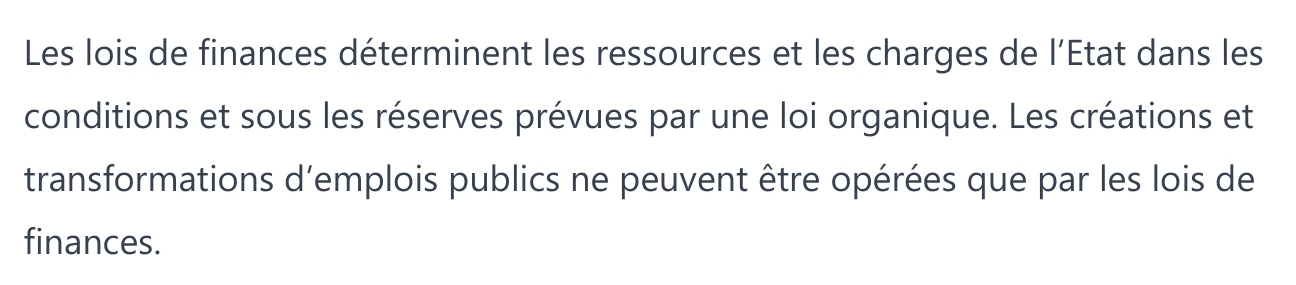
Senegal’s constitutional framework makes financial authorisation a central relationship between the Assembly and government. Article 67 provides for finance laws to determine the state’s resources and charges within the conditions established by an organic law. The historical constitutional text reproduced with this essay also places the creation and transformation of public employment within finance legislation. These provisions connect the legislative process with the organisation of the state itself. Decisions about revenue and expenditure structure the institutions through which public commitments can become salaries, programmes and services. [4]
Article 68 assigns the Assembly the vote on finance bills and provides for the Court of Accounts to assist in scrutiny of their execution. Authorisation and scrutiny thus occupy different moments in the constitutional design. A parliamentary vote establishes a legal framework for the use of resources; examination of execution concerns what followed. The distinction explains why public accountability continues after a budget is adopted. The provisions cited here belong to the 2001 constitutional framework as amended in the reproduced text, rather than a claim that every later legal change is captured by that historical edition. [4]
Senegalese public-law scholar Ibrahima Diallo approaches this relationship through the concrete powers of Parliament in budgetary matters. His study distinguishes the formal authority to consent to resources and expenditure from the practical conditions under which representatives exercise it. Financial authorisation gives the executive permission to implement a programme; control concerns the use made of that permission. His framing directs attention to the distribution of powers across the budget cycle. It makes the quality of legislative scrutiny a question of institutions, information and usable authority. [5]
Diallo’s approach is useful for reading the present dispute because it follows public power beyond the existence of a parliamentary vote. The executive’s role in preparing and implementing a budget and the legislature’s role in authorising and controlling it operate within a particular constitutional arrangement. His historical legal discussion supplies a way to examine those relationships. It does not establish that a current minister has acted unlawfully or that a committee’s position necessarily resolves the underlying financial choices. Its contribution is to locate budgetary authority within the functioning relationship between public institutions. [5]
A separate constitutional decision earlier this month shows the importance of that arrangement. On 15 October, the Constitutional Council declared organic law No. 38/2026 unconstitutional because of the procedure followed in its adoption on 1 October. The judgment records that the government had requested a single vote under Article 82, retaining amendments it proposed or accepted. The Assembly instead voted separately on government amendments, rejected them and adopted the text. The Council held that this breached a substantial procedural requirement and affected the validity of the law. [6]
The ruling concerns that organic-law amendment, a different legislative text from the supplementary budget rejected in committee on 23 October. Its reasoning addresses the constitutional procedure for adoption. It does not decide that parliamentary financial oversight is inherently unconstitutional. Keeping the subject and effect of the judgment precise makes the institutional stakes visible: legislative authority operates through rules that also confer procedural powers on the government. A court can invalidate the route by which a law was adopted while leaving the wider political debate about the desired form of oversight open. [6]
The public purpose advanced for the organic-law amendment was reported by Senegal’s news agency APS on 1 October. The proposal sought tighter supervision of special credits through changes to the organic law governing finance legislation. APS recorded 127 votes in favour and five abstentions among the 132 deputies voting, alongside the disagreement over government amendments. This contemporary account identifies what the sponsors sought to regulate. The later constitutional decision means that the recorded parliamentary adoption cannot be presented as proof that the proposed new controls became operative law. [7]
The sequence matters for understanding political accountability. The Assembly considered a change to the rules governing sensitive categories of expenditure; government representatives proposed amendments and invoked a voting procedure. APS’s account shows those positions meeting inside the legislative institution. It provides evidence of a contest over the design of financial control without establishing misappropriation by any individual. The political question concerns how authority over public money is organised and supervised. The evidence supports examination of the proposed rules and their legislative treatment, with the legal fate of the text kept in view. [7]
Regional rules provide another part of this institutional history. UEMOA’s 27 March 2009 directive on transparency in public-finance management sets standards for parliamentary authorisation, explanations of financial forecasts and public reporting during execution. Its annex requires revised financial projections to be justified and identifies independent external audit as part of accountability. This West African framework places national budget procedures within a regional effort to make public finance more legible and answerable. It supplies standards against which documents and institutional practices can be examined, without itself proving compliance in the present dispute. [8]
The directive also gives citizens and the media a place in public-finance debate. It provides for accessible information, a public budget calendar and a simpler guide to the budget, alongside the opportunity for discussion. These requirements concern the relationship between state institutions and the people who finance and use public services. A budget becomes politically intelligible when citizens can connect proposed resources with the services and obligations concerned. The regional framework consequently links institutional supervision with the public’s ability to follow choices through preparation, adoption, execution and subsequent accounting. [8]
Published research documents gaps in that relationship, with an important date boundary. The International Budget Partnership’s 2025 Open Budget Survey gives Senegal scores of 42 for transparency, six for public participation and 31 for oversight, each out of 100. The assessment considers documents and events through 31 December 2024. It is an expert assessment of institutions and practices, rather than a poll of public opinion or a measure of the proportion of money properly spent. Its findings describe the assessed period and cannot be treated as a verdict on the October 2026 committee proceedings. [9]
The assessment separates access to information from opportunities to influence decisions. Its transparency component examines eight key budget documents through 109 indicators; participation examines formal channels across institutions and stages of the budget cycle. Cheikh Tidiane Cissé of Senegalese civil-society organisation ONG 3D conducted the country research, with review involving the finance ministry and UNICEF. The results identify a basis for discussing institutional reform: timely reporting can improve public knowledge, while participation also requires mechanisms through which people can make submissions and receive a response. [9]
That discussion continued in Senegal in September. In its 28 September account of the survey presentation, ONG 3D reported calls to improve budget transparency and participation. Its account included the budget administration’s acknowledgement that further work on information and public engagement was needed. This brings civil-society research and the administration into a shared public discussion, while preserving their different responsibilities. Civil organisations can analyse and challenge the available material; public institutions retain responsibility for publishing financial information and organising the procedures through which budget decisions are made. [10]
Read alongside the current dispute, that discussion identifies the public significance of parliamentary scrutiny. Revenue assumptions, subsidy envelopes and investment choices affect the services and costs people encounter, while the authority to decide remains distributed across elected representatives, the executive and oversight institutions. ONG 3D’s account locates participation within that continuing relationship. The immediate question in Senegal is how the proposed financial choices will be justified and dealt with through the legislative process. The longer task is to make the resulting decisions, their execution and their consequences available for sustained public examination. [10]
- [1]RTS. Projet de LFR 2026 : le Premier ministre face à la presse ce dimanche après le rejet du texte en commission24 October 2026; committee decision 23 October
- [2]Republic of Senegal / Ministry of Finance and Budget. Projet de loi de finances rectificative pour l’année 2026 — exposé général des motifs2026 proposal; archive record 19 September 2026
- [3]PASTEF parliamentary group. Communiqué sur les désaccords avec le gouvernement concernant le projet de loi de finances rectificative20 October 2026
- [4]Republic of Senegal. Constitution du 22 janvier 2001, modifiée — articles 67 et 682001, as amended; reproduced edition 18 February 2025
- [5]Ibrahima Diallo / Afrilex. Pour une appréciation concrète des pouvoirs du parlement sénégalais en matière budgétaireUndated; accessed 25 October 2026
- [6]Constitutional Council of Senegal. Décision n° 10/C/2026 — séance du 15 octobre 202615 October 2026; original judgment reproduced by Lexenegal
- [7]Agence de Presse Sénégalaise. L’Assemblée nationale adopte la proposition de loi organique visant à renforcer l’encadrement des crédits spéciaux1 October 2026
- [8]UEMOA Council of Ministers. Directive n° 01/2009/CM/UEMOA portant Code de transparence dans la gestion des finances publiques27 March 2009; effective 1 January 2012
- [9]International Budget Partnership. Open Budget Survey 2025 — Senegal2025 edition; assessment cut-off 31 December 2024
- [10]ONG 3D. Enquête sur le budget ouvert : le Sénégal appelé à renforcer la transparence budgétaire28 September 2026
- [11]Agence de Presse Sénégalaise. LFR 2026 : le Premier ministre appelle les députés à privilégier le dialogue et les amendements25 October 2026, 19:18 Dakar
Did this publication help you understand the topic?
0 voluntary responses. Browser-based participation; responses are not a representative survey.
We welcome suggestions, contributions and recommendations.
Editorial standards ↗