Sierra Leone’s effort to rebuild political trust has returned to the centre of public debate this week. In a statement published on 29 October 2026 for the National Unity and Social Cohesion Conference in Freetown, UN regional envoy Leonardo Santos Simão urged the government and the All People’s Congress to carry their national-unity commitments into everyday institutional practice. The live issue reaches beyond the willingness of political leaders to meet. It concerns citizens’ influence over electoral rules, the institutions administering them and the decisions that follow the next election. [1]
The process has a specific origin. Following disagreements over the June 2023 elections, the government and the APC signed an agreement after mediated talks held from 16 to 18 October 2023. ECOWAS’s contemporary account describes two connected mechanisms: the opposition’s return to Parliament and local government, and a cross-party committee reviewing constitutional and electoral arrangements. Chief Minister David Moinina Sengeh led the government delegation; Samura Kamara led the APC delegation. These were negotiated choices by Sierra Leonean political actors, supported by African Union, ECOWAS and Commonwealth mediation. [2]
That settlement made participation in public institutions part of the response to political disagreement. Returning representatives could again speak and vote within governance bodies while proposed changes moved through a committee process. The agreement therefore created an institutional route through which conflict over an election could become debate over the rules governing subsequent elections. Its democratic significance rests on how that route connects party negotiations to the people represented by those parties. The commitments also carried a timetable, giving the public a basis for evaluating the pace of implementation. [2]
The electoral debate continued into 2026. In January, the Tripartite Steering Committee Secretariat briefed ECOWAS on implementation of the June 2024 report’s 80 recommendations. The account identifies consultations on proportional representation, first-past-the-post and hybrid systems, alongside reviews of election-related institutions. These systems distribute representation through different procedures. Choices about them shape the relationship between a ballot, a constituency and a parliamentary seat. Consultation consequently concerns the organisation of political voice as well as the administration of an election. ECOWAS reported an implementation-tracking mechanism, but its meeting account supplied no recommendation-by-recommendation completion table. [3]
The international guarantors’ April assessment makes the distribution of authority more concrete. Their joint communiqué called for a Parliamentary Standing Committee on Electoral Matters, referring to Recommendation 20 of the Tripartite Report. Its proposed work included reviewing the electoral cycle, examining preparedness and guiding legislative reform towards the 2028 elections. Parliamentary scrutiny could give electoral preparation a continuing public institutional home. The communiqué expressed a requirement for further action at that point; it does not establish the committee’s subsequent performance. Its significance for the current unity process is the responsibility it assigns to elected institutions. [4]
The same April communiqué called for completing the restructuring of the Electoral Commission by 31 December 2026 and reaffirmed the importance of inclusive consultation on electoral legislation. The deadline places appointments and institutional design within an identifiable political calendar. For voters, these arrangements affect confidence in who administers competition and how competing parties can challenge decisions. For officeholders, they concern the allocation and supervision of public authority. The communiqué provides a dated account of commitments by the parties and guarantors. Assessing fulfilment requires the later appointment decisions, laws and parliamentary record. [4]
Citizen evidence gives this institutional timetable social meaning. Afrobarometer’s December 2025 dispatch reported that 34% of respondents trusted the electoral commission somewhat or a lot, compared with 64% in 2018. Trust also varied by party affiliation. These are reported public attitudes, distinct from a judicial determination about an election. The Institute for Governance Reform interviewed 1,200 adults in March–April 2025; the stated national margin of error was approximately three percentage points at a 95% confidence level. Those fieldwork dates place the findings before the April 2026 assessment and this week’s conference. [7]
The same survey found strong support for political pluralism: 85% rejected one-party rule, while 61% supported having many parties to provide meaningful choices. Eighty per cent preferred losing parties to cooperate with the government in developing the country over monitoring and criticising it. Read together, these responses disclose a demanding political relationship. People can value competitive choice while wanting cooperation after an election. The practical task for political institutions is to sustain scrutiny and representation within that expectation of cooperation. The survey measures preferences; it cannot establish how respondents would judge any particular reform now before decision-makers. [7]
Another dispatch from the same 2025 fieldwork found that only 26% had heard of the electoral-system review. Awareness was especially limited among women and rural respondents. This locates a concrete distributional problem within the reform process: information about institutional choices reached different social groups unevenly. A national consultation gains democratic substance through people’s ability to understand what is being proposed, formulate a response and learn how that response was considered. The finding gives civic communication a specific constituency and purpose, particularly where travel, language or access to information can shape participation. [8]
The respondents also expressed considerable willingness to share political space. Ninety-three per cent supported regional and ethnic balance in public appointments, and majorities said they would support their party appointing people from other parties, regions or ethnic groups. The results show the presence of inclusive preferences within Sierra Leonean society. They caution against portraying political division as an inherent property of any population. The authors, Fredline M’Cormack-Hale and Andrew Lavali, present these attitudes alongside lower interpersonal trust. Political belonging and trust therefore require attention to the particular institution and relationship being discussed. [8]
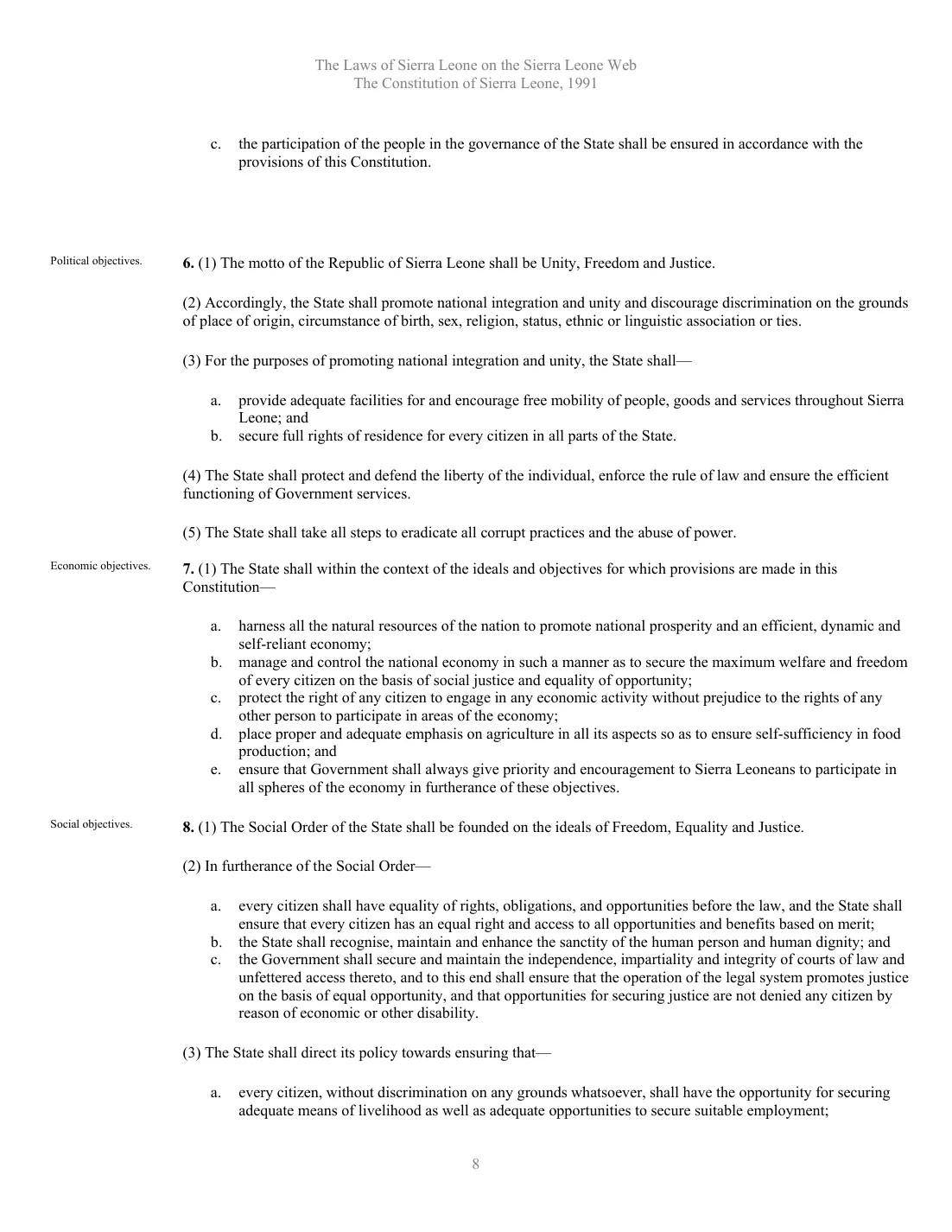
Sierra Leone’s constitutional history supplies a language for interpreting those preferences. Section 5 of the 1991 Constitution locates government’s authority and legitimacy in the people. Section 6 links national unity with freedom, justice, non-discrimination and public services. The reproduced document accompanying this essay shows that historical formulation. Chapter II has an important legal qualification: section 14 makes its principles fundamental to governance while specifying that they do not themselves confer court-enforceable rights. The principles establish a political standard for lawmakers; a particular legal remedy depends on the relevant enforceable provisions and legislation. [5]
This constitutional understanding of unity places obligations on institutions as well as citizens. Its public significance becomes visible when appointment procedures, electoral administration and access to debate are assessed against the stated source of public authority. Sovereignty here begins with the relationship between people and government. National cohesion acquires substance through the terms on which different people can participate in that relationship. The historical text helps explain why a unity initiative can be evaluated through representation and accountability, with careful attention to the difference between constitutional objectives and the legal mechanisms that implement them. [5]
Published scholarship shows how these relationships have worked through concrete institutions. David Leonard and Titi Pitso’s EISA study, with contributions from Anna Schmidt, examined the 2007 and 2008 elections and the surrounding architecture of government. Their account connected electoral administration to parliamentary capacity, constituency demands, media and international assistance. It described the successful 2007 transfer of power as an achievement requiring institutional explanation. For the present debate, its enduring contribution is to locate an election inside the wider relationships through which officeholders obtain authority and citizens seek benefits and accountability. [6]
The study’s discussion of constituency service is particularly useful. It distinguishes benefits available to a community from benefits distributed in exchange for political backing. That distinction identifies a mechanism through which political dependence can develop: access to a resource may become tied to support for an officeholder. These are findings and concepts developed around earlier elections, whose present relevance must be examined case by case. They illuminate why electoral reform can have consequences beyond polling day, reaching into the everyday distribution of jobs, infrastructure and assistance that makes representation meaningful to constituents. [6]
More recent locally grounded research broadens the public perspective. The National Commission for Democracy’s assessment with International IDEA drew on community discussions, expert interviews and documentary evidence in 2025. Its framework included citizenship, social rights, Parliament, political participation and the media, alongside elections. Community fieldwork took place in April and May 2025 across the country. The assessment records democratic experience through several social settings and institutions. Its findings connect participation with people’s ability to reach institutions and obtain information, giving the current unity debate a wider public agenda than negotiation between party leaderships alone. [9]
Such qualitative evidence offers detail about how people encounter government, while the survey supplies estimates of how particular attitudes are distributed. The democracy assessment’s community discussions can reveal experiences and meanings without establishing national prevalence for every view expressed. This distinction matters for the argument about inclusion. A reform process can examine both the breadth of public confidence and the reasons people give for feeling represented or excluded. The assessment’s scope makes public services, civic communication and accessible institutions part of democratic quality, helping explain why changes to electoral procedures need continuing engagement with lived experience. [9]
There is already a domestic institution with a statutory mandate to connect peacebuilding and public concerns. The commission’s founding Act, published in February 2021 after signature in December 2020, provides for dialogue, conflict prevention and complaints concerning violence, inequality or injustice. It also directs attention to local stakeholders and diversity. The Act specifies independence in the discharge of the commission’s functions. These provisions give the conference’s convenor responsibilities extending into community relationships. They establish an institutional channel through which grievances can be heard and addressed; their effectiveness depends on how that channel functions in practice. [10]
The legislation also connects institutional independence to public accountability. It requires financial records and audit, an annual performance report, presentation of that report to Parliament and availability to stakeholders after tabling. These are concrete mechanisms through which people can examine what a peace institution does with its mandate and resources. For the current unity initiative, they make follow-through visible through ordinary public records. A conference can initiate commitments; reporting and legislative scrutiny can carry those commitments into a continuing relationship between the institution and the people whose peace it is charged with supporting. [10]
Public debate has its own institutional history. The Public Order Amendment Act signed in August 2020 repealed Part V of the 1965 Act, which concerned defamatory and seditious libel. That was a specific legislative change to the legal environment for expression. It gives the history of reform a tangible example of a rule being altered through Parliament. The repeal’s scope should be understood precisely: it removed that part of the statute. The wider conditions under which journalists and citizens question power depend on other laws, institutional practice and the resources available for public communication. [11]
The political value of Sierra Leone’s current unity process will emerge through those relationships: electoral institutions that can explain decisions, representatives who scrutinise implementation, and citizens able to participate with informed confidence. Simão’s latest statement places practical implementation and trusted institutions at the centre of the task. The evidence assembled across the unity process supports a coherent public standard: commitments acquire democratic force through the opportunities people have to understand, influence and hold accountable the authority exercised in their name. That is the present significance of carrying unity into institutional practice. [1]
- [1]United Nations in Sierra Leone / UNOWAS. Statement by SRSG Leonardo Santos Simão at the National Unity and Social Cohesion Conference in Freetown2026-10-29 (publication; conference 26–27 October 2026)
- [2]ECOWAS. Press Statement On The Outcome Of The Dialogue Between The Government Of Sierra Leone And The All Peoples Congress Party2023-10-20; dialogue 16–18 October 2023
- [3]ECOWAS. ECOWAS Engages Tripartite Steering Committee on Implementation of National Unity Reforms2026-01-22; meeting 21 January 2026
- [4]ECOWAS, UNOWAS and Commonwealth. Press Statement: International Moral Guarantors — Third Joint Assessment Mission to Sierra Leone2026-04-20; mission 13–20 April 2026
- [5]Republic of Sierra Leone / Sierra Leone Web. The Constitution of Sierra Leone, 1991 (Act No. 6 of 1991), sections 5–6, 11 and 141991-09-24 (signed); 1991-10-01 (commencement)
- [6]EISA, Journal of African Elections; David K. Leonard and Titi Pitso, with Anna Schmidt. The Political Economy of Democratisation in Sierra Leone: Reflections on the Elections of 2007 and 20082009; Volume 8(1), pp. 49–70
- [7]Afrobarometer; Fredline A. O. M’Cormack-Hale and Andrew Lavali. AD1092: Sierra Leoneans urge political cooperation as trust in electoral commission falls to new low2025-12-15; fieldwork March–April 2025
- [8]Afrobarometer; Fredline A. O. M’Cormack-Hale and Andrew Lavali. AD1029: Large majorities of Sierra Leoneans favour cross-party collaboration over divisive politics2025-08-11; fieldwork March–April 2025
- [9]International IDEA and National Commission for Democracy, Sierra Leone. State of Democracy in Sierra Leone Assessment 2025 Report2025-12-11; community fieldwork April–May 2025
- [10]Republic of Sierra Leone, Government Printing Department. Independent Commission for Peace and National Cohesion Act, No. 3 of 20212020-12-18 (signed); Gazette 2021-02-04
- [11]Republic of Sierra Leone, Government Printing Department. The Public Order (Amendment) Act, 2020, No. 42020-08-14 (signed); Gazette 2020-08-18
Did this publication help you understand the topic?
0 voluntary responses. Browser-based participation; responses are not a representative survey.
We welcome suggestions, contributions and recommendations.
Editorial standards ↗