South Africa’s budget debate entered a new stage on 21 October 2026 when Finance Minister Enoch Godongwana presented the Medium-Term Budget Policy Statement and announced draft changes to the rules governing public finances. He described a proposed fiscal anchor under which each administration would set objectives, report against them and explain material deviations to Parliament. The legislation is expected to be tabled in 2027. The immediate political issue concerns how those future rules would shape the choices through which hospitals, schools, water systems and other public services receive resources. [1]
Godongwana presented fiscal sustainability as a foundation for constitutional commitments. His account of the proposed anchor gives the Financial and Fiscal Commission a role in reporting independently on the relationship between the fiscal framework and an administration’s fiscal plan. That is a proposed allocation of oversight responsibility. It would connect an elected government’s objectives, Treasury’s financial framework and a further institutional assessment. The draft’s eventual parliamentary treatment will determine its legal form; the minister’s announcement identifies the direction government is pursuing while consultation remains open. [1]
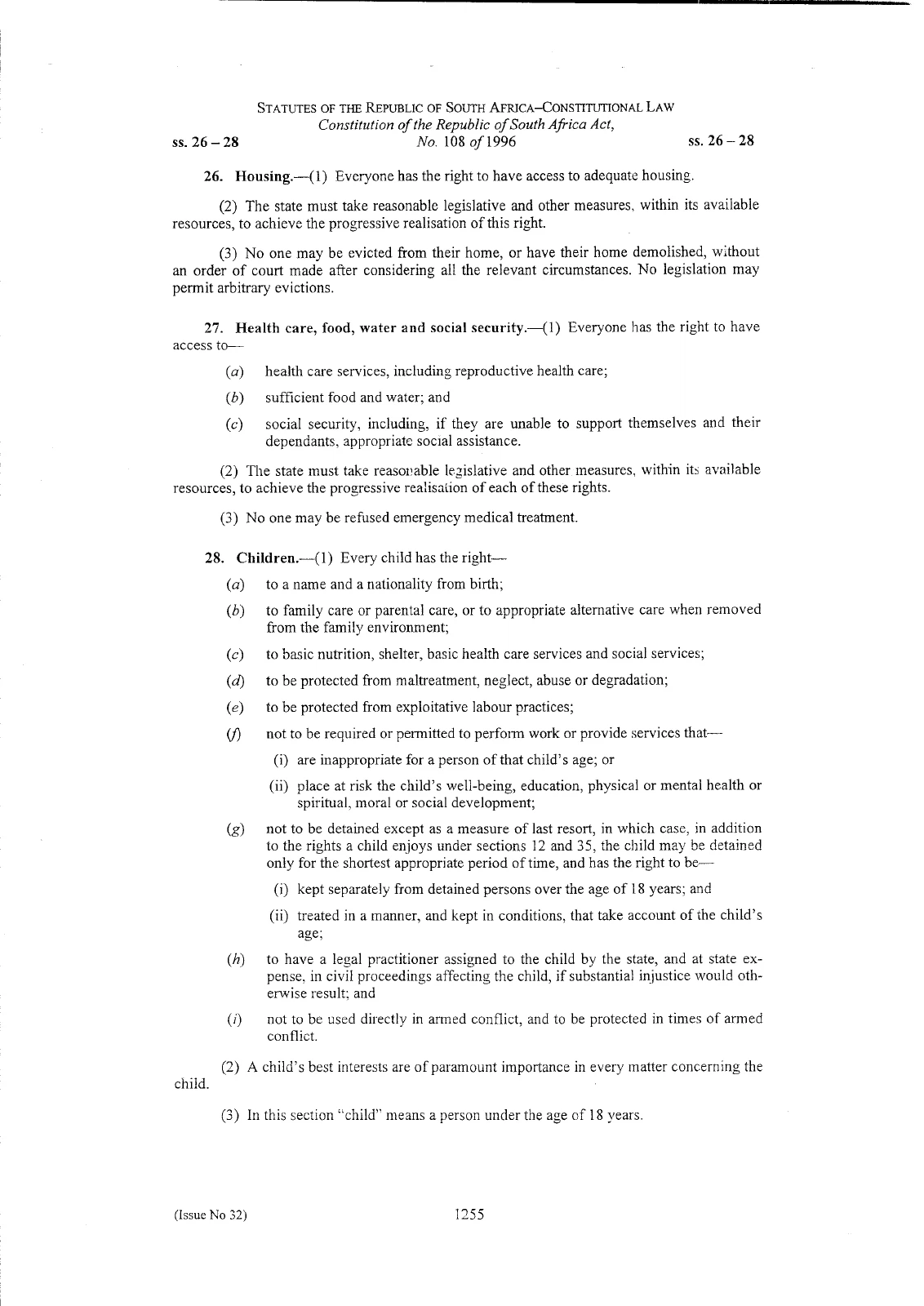
The constitutional setting gives these choices their public significance. Sections 26 and 27 establish rights concerning housing, healthcare, food, water and social security, with duties of progressive realisation through reasonable measures within available resources. Section 214 connects the division of revenue to debt obligations, basic services, provincial and municipal needs, and economic disparities. Section 215 requires transparent and accountable budget processes. The constitutional text places resources and rights within the same framework, making the allocation of public money part of the organisation of the state’s responsibilities towards people. [2]
The Public Finance Management Act of 1999 gives that relationship an administrative structure. Section 28 requires annual multi-year projections of revenue and expenditure, with capital and current spending distinguished, together with the minister’s key macroeconomic projections. This requirement makes assumptions about future resources part of a public statement to the National Assembly. The distinction matters for services: building infrastructure and keeping it operating involve different spending commitments. A multi-year view brings those commitments into the same account of what government expects to raise and spend. [3]
The original Act also requires measurable objectives alongside departmental budget votes and provides a framework for adjustments during the financial year. These provisions connect financial authorisation to a stated purpose and provide a means of revising plans when circumstances change. The history is specific: after the adoption of the Constitution, the 1999 legislation established an institutional approach to managing revenue, expenditure, assets and liabilities. The current reform discussion returns to the organisation of those responsibilities after more than two decades of implementation. [3]
Parliament’s role developed further through the Money Bills legislation enacted in 2009 and amended in 2018. Its stated purposes include representing people’s interests in public finances and ensuring participation in the budget process. Section 6 requires the medium-term statement to include the fiscal outlook, spending priorities, the proposed division of revenue among spheres of government and substantial changes to conditional grants. That places national aggregates alongside allocations that affect provinces and municipalities. The statutory structure gives committees material through which to examine the assumptions and distribution underlying the executive’s proposals. [4]
Section 12 of the amended legislation provides for consideration of a revised fiscal framework and allows committee reports to propose amendments, with the minister given an opportunity to respond. This establishes a relationship between executive initiative and legislative scrutiny. The implications reach the distribution of resources among governments responsible for services. The public importance of a budget debate lies partly in how those powers are exercised: a published proposal enters a process in which representatives can examine its effects and consider changes before the relevant instruments are adopted. [4]
The economic argument over the direction of spending remains active. In an October briefing note prepared before the statement, Liso Mdutyana and Mzwanele Ntshwanti of the Institute for Economic Justice argued for stronger coordination of fiscal, monetary and industrial policies. Their criticism concerns the expectation that debt stabilisation through spending restraint will generate sufficient investment and employment. They propose a developmental strategy involving productive capacity, public services and a wider revenue base. This is an interpretation advanced by the authors, setting out the mechanisms through which they expect public expenditure to support development. [5]
Their argument gives the composition and effects of expenditure a central role. The briefing calls for evaluating the different impacts of spending, improving its quality and supporting state capacity. Its relevance to the current debate is the connection between fiscal decisions and the ability to sustain production and public provision. That creates a substantive question for scrutiny of any fiscal anchor: how its objectives would interact with expenditure needed for services and development. The authors’ case identifies an economic debate that remains open as the proposed rules move through consultation. [5]
Provincial government supplies another view of the distributional problem. Before the 21 October statement, Western Cape Premier Alan Winde and finance minister Deidré Baartman called for household cost-of-living relief and support for frontline services. Their statement described pressure on provincial budgets from the rising cost of healthcare, transport and infrastructure. It located national decisions within the operating responsibilities of another sphere of government. These are the province’s stated concerns and priorities, through which its leaders sought to influence the national allocation of resources. [6]
The Western Cape statement also proposed expanding the package of basic services available to qualifying low-income households. It suggested larger water and electricity allocations and recognition of internet access in a proposed dignity basket. These were suggestions under development. They make the distributional issue concrete by identifying what a household should be able to obtain through public provision. The financial question then includes the cost of the package, the institutions responsible for delivering it and the relationship between national support and the obligations borne by municipalities and provinces. [6]
Municipal accounts show why the connection between allocation and functioning services needs attention. In its report on 2024–25 local-government audits, the Auditor-General recorded metropolitan capital expenditure of R34.41 billion, with R12.11 billion used to replace or renew existing assets. The report found signs of underinvestment in maintenance and renewal across all eight metros. Those findings concern the earlier audit period, with audit outcomes included through 30 April 2026. They provide a documented context for the present budget debate about the resources required to sustain roads, water networks, electricity grids and sewerage systems. [7]
The Auditor-General reported repairs and maintenance spending at approximately four per cent of metropolitan asset value, against the Treasury norm of eight per cent. It linked inadequate renewal to risks of deterioration, service disruption and higher future costs. That account identifies a continuing financial commitment embedded in infrastructure: an asset requires maintenance after its initial construction. The relationship between capital budgets, operating expenditure and the condition of existing networks therefore belongs within the assessment of public-service funding. A new allocation’s practical significance depends on how it supports that chain of provision. [7]
Public investment also shapes which firms and workers participate in building infrastructure. A renewable-energy study by Rachel Alexander, published by the IEJ on 23 October, examines production networks for solar, wind and battery systems. It draws on sector studies involving 59 interviews, a survey with nine manufacturer responses and observations and validation workshops. The report identifies inconsistent demand, international competition and coordination problems as constraints on local production. Its evidence concerns the relationships through which procurement and other policies influence domestic capabilities and the distribution of economic value. [8]
Alexander’s report recommends predictable public procurement, stronger productive capabilities and links between industrial support, decent work and gender equity. These are policy proposals based on the research. They connect expenditure to the organisation of demand: government decisions can influence firms’ ability to plan production and employment. The study also identifies differences in job quality and access to opportunities, giving the employment consequences of investment a place in assessing its developmental value. The political choices around infrastructure extend into the conditions under which goods are produced and work is organised. [8]
The South African Communist Party’s response on 23 October placed public ownership and employment at the centre of its criticism of the medium-term statement. The party rejected the direction of spending restraint and argued for an expanded role for the state in industrialisation and service provision. Its statement presents a political programme and a contested interpretation of government strategy. It adds an organised constituency’s view of the purposes public finances should serve, including the relationship between the organisation of infrastructure and the distribution of benefits from it. [9]
The SACP’s position also brings the history of South Africa’s post-apartheid economic choices into the current argument. Its response situates the debate within a longer dispute over the state’s developmental role and the organisation of core infrastructure. The relevant political distinction concerns where responsibility and control sit, and how investment serves employment and public needs. Presenting the party’s programme as its position keeps that debate visible while leaving the claims about future economic effects open to examination through subsequent policy decisions and evidence. [9]
There is an immediate public route into scrutiny of the current framework. Parliament’s finance committees have scheduled virtual hearings for 28 October and set noon on 26 October as the deadline for written submissions. Their notice concerns the revised fiscal framework and revenue proposals tabled with the medium-term statement. The invitation identifies the part of the decision process in which interested people and organisations can place evidence before legislators. The hearings are scheduled events as of 24 October; their contributions and effects on the committees’ eventual recommendations are still to come. [10]
That timetable makes the next stage of the debate specific. Executive proposals will be considered through committee work in which participants can address their assumptions and consequences. The notice links the current process to duties under the finance-management and Money Bills legislation. Its public significance lies in the opportunity for household, worker, provincial and municipal concerns to enter the assessment of the fiscal framework. How those contributions shape recommendations will become visible in the hearing records and reports through which Parliament develops its position. [10]
South Africa’s constitutional framework requires public finances to address both national obligations and the capacity of provinces and municipalities to provide basic services. It also ties budgeting to transparency and accountability. Those commitments give the current reform debate a concrete public test: how decisions about resources support the institutions, workers and infrastructure through which people obtain care, water, shelter and other services. The distribution of financial authority matters because it shapes the means available for carrying out those responsibilities over time. [2]
- [1]South African Government / Minister of Finance. Minister Enoch Godongwana: Medium-Term Budget Policy Statement 202621 October 2026
- [2]Republic of South Africa. Constitution of the Republic of South Africa, 1996: official text, sections 26–28 and 213–2161996; consolidated reprint, consulted 24 October 2026
- [3]Republic of South Africa, Government Gazette. Public Finance Management Act 1 of 1999: original enacted text, sections 27–302 March 1999
- [4]Parliament of South Africa. Money Bills and Related Matters Act 9 of 2009, as amended16 April 2009; consolidated through 17 January 2019
- [5]Institute for Economic Justice; Liso Mdutyana and Mzwanele Ntshwanti. Coordinated macroeconomic policy for an uncertain world: A preview of the 2026 MTBPS15 October 2026
- [6]Western Cape Government. 2026 MTBPS: Western Cape Government urges cost-of-living relief and frontline services support21 October 2026; pre-tabling statement
- [7]Auditor-General of South Africa. Consolidated General Report on Local Government Audit Outcomes 2024–25, metropolitan financial management, pp. 174–1772024–25 audit; cut-off 30 April 2026; accessed 24 October 2026
- [8]Institute for Economic Justice; Rachel Alexander. Using Policy to Build South Africa’s Renewable Energy Industry and Create Decent, Equitable JobsOctober 2026; published online 23 October 2026
- [9]South African Communist Party. Response to the Medium-Term Budget Policy Statement23 October 2026
- [10]Parliament of South Africa, finance committees. Have Your Say: 2026 Revised Fiscal Framework and Revenue Proposals (MTBPS)October 2026; deadline 26 Oct; hearing 28 Oct; accessed 24 Oct 2026
Did this publication help you understand the topic?
0 voluntary responses. Browser-based participation; responses are not a representative survey.
We welcome suggestions, contributions and recommendations.
Editorial standards ↗