On 11 November 2026, UNESCO reported that thirty University of Juba students had finished training to operate a campus radio station. In October they had practised gathering and checking news, writing scripts, presenting and putting programmes together. They were already debating what to call their morning and evening shows. The university’s journalism school is preparing to host the station, with support from UNESCO and the Japan International Cooperation Agency. The date marks a report on completed training, while the broadcasts themselves are still to come. What the students will be able to do depends on who controls the frequency, the running costs and the editorial decisions. [1] [2] [3]
At the University of Juba, the work did not begin with the November announcement. In January the journalism school and the National Press Club formed a student press club. Radio Tamazuj reported from its launch that the students would help with the planned renovation of the university radio station. In February the school’s deputy dean described the prospective station to the South Sudan Media Authority as a place to practise broadcasting and tell the public about university activities. Those accounts place the initiative within work the school and students were already doing. The public purpose they describe is wider than training for employment: a station run from a university can make the work of that institution more visible to the people around it. [1] [2] [3]
The first programmes also give the students decisions that cannot be made by a supplier of broadcasting equipment. Choosing a morning schedule means deciding whose day it fits. A bulletin about the university can start with an official announcement and then ask what it means for students; a discussion about a public service may need time for the people who use it and for officials to respond. These are examples of what editorial responsibility entails, not descriptions of shows that have aired. The November account describes students preparing for that work. The earlier press-club record helps explain why it matters that they take part in shaping what goes out rather than only learning to use the studio. [1] [2] [3]
Japan’s support is part of a wider media project launched publicly in February 2025 by South Sudan’s information ministry, Japan and UNESCO. Radio Tamazuj reported a project value of US$2.5 million and a programme that combined facilities, training and civic information ahead of and after elections. That figure describes the overall project; it gives no separate allocation for campus radio and no amount paid to a supplier. A UNESCO tender published in April 2026 sought broadcast equipment for five sites: the university, Terekeka, Wau, Yambio and Malakal. The procurement notice shows how those places entered a shared equipment process. It provides no record of the resulting contract or of a working service at any one of them. [1] [4] [5]
The November account shows why a common equipment purchase can serve different purposes. At Juba, the journalism school provides a place for students to practise and work with teachers. In Terekeka County, UNESCO describes a separate community station preparing volunteers for production, a listeners’ club for feedback and a board for management. The board proposed ways to raise funds locally and support volunteers. In those discussions, club members identified barriers to girls attending school and the importance of hearing women with disabilities. Those concerns came from the discussions reported in Terekeka; they are neither the campus station’s programme nor evidence that they have already reached listeners. They show what a local feedback structure can bring to a broadcasting project that a national equipment plan cannot specify. [1] [5]
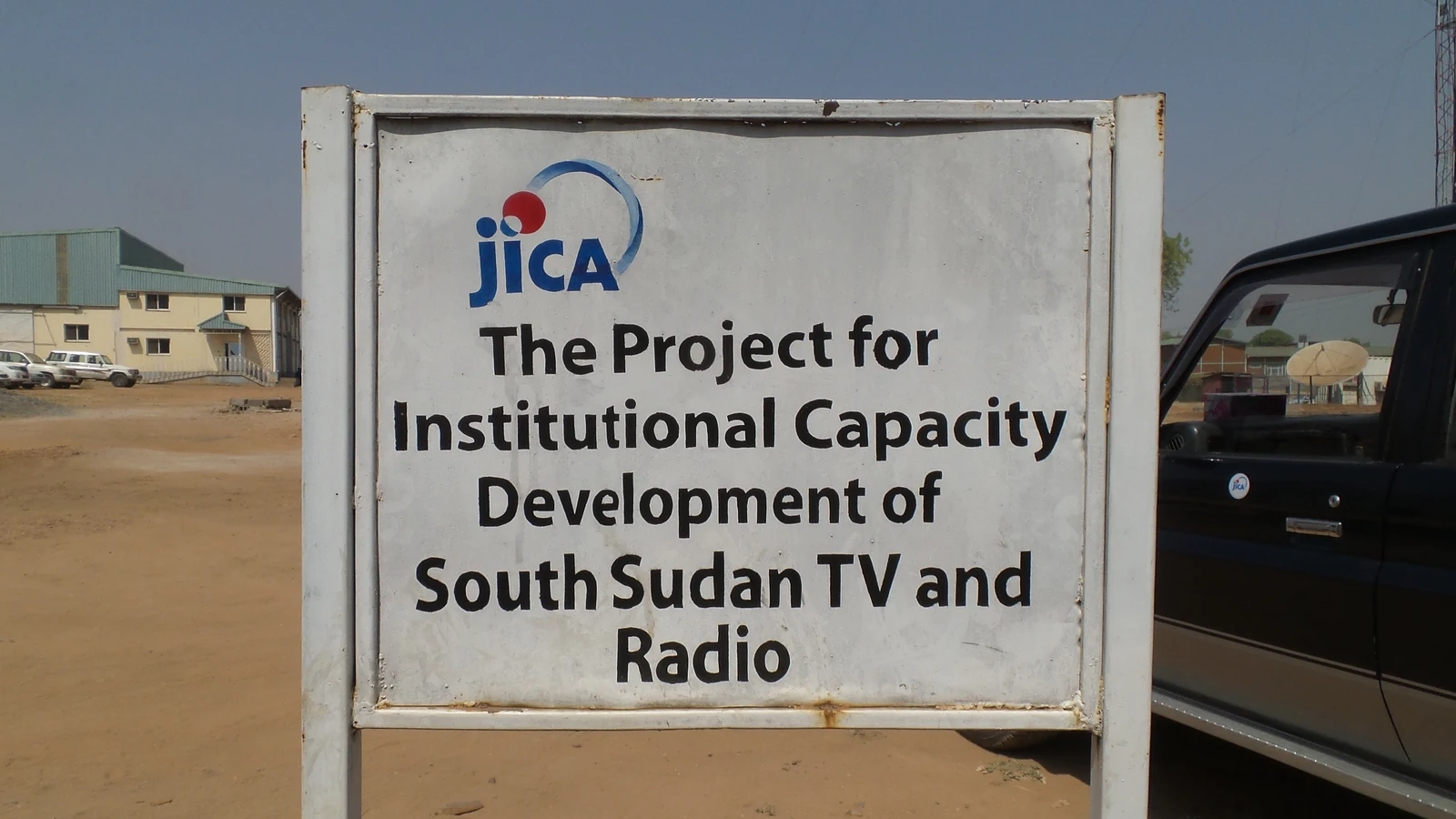
The sign in the photograph belongs to an earlier project. It stood in Juba in February 2016 and names Japan’s institutional capacity project for South Sudan TV and Radio. JICA’s evaluation dates that cooperation to 2012, the year after independence. The national broadcaster was expected to provide accurate and fair news, but the evaluation describes a need for training in production and equipment maintenance, and for practical plans to turn a state broadcaster into a public service. It records generators, equipment and training as separate parts of the support. The photograph gives that institutional history a place and date. It shows neither the later campus studio nor a sign that the older reform achieved all its aims. [6] [7]
The evaluation gives a concrete example of what happens between training and an enduring service. The corporation’s board approved a short-term plan for public service broadcasting in 2016 and a longer one in 2018. Staff introduced maintenance logs and manuals, but the evaluators noted uncertainty about the funds to keep improving maintenance. A manual helps pass knowledge from one operator to the next. Paying for repairs and training requires a decision by the institution that will run the station after the technical project ends. For the university, that question will recur as successive groups of student volunteers graduate. [1] [6]
The distinction between a national public broadcaster and campus or community radio matters for both power and finance. A national corporation can build the staff and transmission capacity needed to cover more places. A university or county station can give people who are rarely heard on a national programme a more direct part in making it. Those roles can coexist. They also have different needs: a campus station must be able to train successive groups of students and keep technicians and equipment available, while a community station may depend on a board, volunteers and recurring local support. JICA’s evaluation of the older national project records delays and extensions amid crises in 2013 and 2016. In the newer project, Terekeka’s proposals to support volunteers show that local organisers are already considering who will sustain the work once the equipment is installed. [1] [6] [7]
Radio had carried public information in the region before independence. Radio Miraya, then operated by the United Nations Mission in Sudan with Fondation Hirondelle, first broadcast from Juba in June 2006. Its 2011 announcement, issued shortly before independence, described bulletins in English and Simple Arabic, listener calls and programmes dealing with services and reconciliation. It was a mission station with a particular public mandate. Its record illustrates why the languages and formats of a broadcast matter: being able to receive a signal is one condition of access; being able to understand and respond to what is said is another. [8]
Research from that transition also cautions against reading broadcasting as an automatic route to political participation. Sonya De Masi’s Internews evaluation studied community stations in what is now South Sudan and adjacent areas. Its fieldwork, reported as December 2010 to March 2011, drew on interviews, focus groups and surveys around particular stations. The report describes listeners valuing the ability to hear local concerns and take part in discussion. It also explains why the research could not demonstrate that radio caused changes such as higher voter participation. Travel and translation affected what could be observed. The study is evidence of how people in those settings experienced radio around the independence referendum, with no basis for projecting the same results onto future campus listeners. [9]
The South Sudan Media Authority Act of 2013 provides another piece of the institutional history. It treats frequencies as public resources, distinguishes public, commercial and community broadcasting, and requires a broadcast operator to obtain a licence. It also distinguishes that licence from permission to practise journalism as an individual. Those distinctions matter in Juba: a student can have the skills to report while the institution still needs the authority and means to transmit. The public records on the campus project establish the training and preparations; they do not confirm the station’s assigned frequency or the date it begins regular broadcasting. The media regulator, the university and the project partners have different roles in getting a programme from a classroom to an audience. [1] [3] [5] [10]
Editorial authority continues after the licence is granted. Zachary Mondesire’s study of South Sudanese journalists draws on interviews and ethnographic work between 2013 and 2020. He examines how writers decided which information they could publish and how some outlets used anonymity. The study concerns particular journalists and media organisations, including online ones; it does not describe the campus station. It helps explain why the students’ training in verification is only one part of being able to report. An editorial structure also needs to give reporters somewhere to bring uncertainties, ways to protect contributors and a way to correct an account when better evidence arrives. The difference between what circulates informally and what can be substantiated for broadcast matters especially during an election period. [1] [10] [11]
The election timetable gives the project urgency without defining its whole purpose. On 10 November the head of the UN mission told the Security Council that the planned December vote faced unresolved questions about preparedness and the timetable. She also said elections should form part of a longer transition. A campus station could explain how an election is organised if it is operating in time. Yet it would still have a job after polling day: listeners need information about institutions and services, and students need opportunities to learn how to test official claims. The same reporting standards apply to university announcements, donor descriptions and election information. [1] [4] [8] [12]
The comparison across the 2006 mission broadcaster, the national corporation and the two newer stations shows why public voice depends on more than the presence of a transmitter. Each project gives different people the ability to commission, produce or question a programme. The University of Juba’s completed training is a step towards giving students some of that authority. The next practical evidence will be a service that people can tune in to, with a schedule they can understand and a means to give feedback. A station’s contribution to public life will become visible in who gets to speak and who gets a useful answer, including after the founding project ends. [1] [3] [7] [9] [10]
- [1]UNESCO. University of Juba students prepare to take first campus community radio station on air11 November 2026; describes training completed in October
- [2]Radio Tamazuj. University of Juba forms student press club with media group9 January 2026
- [3]South Sudan Media Authority. The Media Authority hosts University of Juba Journalism, Media and Communication Student20 February 2026
- [4]Radio Tamazuj. South Sudan, Japan launch $2.5M media development project12 February 2025; launch 11 February
- [5]UNESCO / United Nations Global Marketplace. Supply of Radio Broadcast Equipment to Five(5) radio community stations in South Sudan20 April 2026
- [6]Japan International Cooperation Agency. Summary of Terminal Evaluation Results: The Project for Institutional Capacity Development of South Sudan Broadcasting CorporationUndated; data through Nov 2018; accessed 12 November 2026
- [7]RomanDeckert / Wikimedia Commons. SouthSudanTV-JICA RomanDeckertFeb2016.jpg10 February 2016 (capture)
- [8]United Nations Mission in Sudan / Radio Miraya. Radio Miraya launches revamped and new programmes26 June 2011
- [9]Sonya De Masi / Internews. When Does Information Change Lives? An evaluation of community radio development in South Sudan and the Three AreasFieldwork December 2010 to March 2011
- [10]Republic of South Sudan; copy hosted by South Sudan NGO Forum. Media Authority Act, 20132013 (act)
- [11]Zachary Mondesire / Media, War & Conflict. Journalism without signature: News and rumor from South Sudan2025; fieldwork 2013–2020
- [12]United Nations Mission in South Sudan. Remarks by SRSG Anita Kiki Gbeho to the United Nations Security Council10 November 2026
Did this publication help you understand the topic?
0 voluntary responses. Browser-based participation; responses are not a representative survey.
We welcome suggestions, contributions and recommendations.
Editorial standards ↗