On 10 November 2026, the Judicial Committee of the Privy Council ruled that two provisions of Trinidad and Tobago’s Sexual Offences Act cannot be used to criminalise private, consensual sexual relations between adults of the same sex. The board, which hears final appeals from Trinidad and Tobago, allowed the appeal and dismissed the Attorney General’s cross-appeal. The decision changes how the two provisions apply; it does not strike out the whole Act. It also answers a question that has occupied the country’s courts since 2018: when does a law passed after independence retain the constitutional protection given to older laws, and when must it stand or fall on its own justification? [1] [2]
The answer starts in Trinidad and Tobago’s 1976 republican Constitution. Sections 4 and 5 protect rights including respect for private and family life. Section 6, often called the savings clause, shields existing laws from challenge on specified grounds. Its purpose is easier to understand if one thinks of a constitution coming into force while an entire body of law remains on the books: the country’s institutions need rules they can continue to apply. But continuity can also keep older restrictions in place. The question in this appeal was whether the particular restrictions could claim that protection after Parliament enacted a new statute, not whether every law with colonial origins must now be treated alike. [1] [3]
The legislation had changed in important ways. The 1925 Offences Against the Person Act contained the earlier offences. The 1986 Sexual Offences Act repealed that framework and adopted new provisions; in the sections challenged, it increased penalties and broadened the reach of the law. The Privy Council looked at more than whether both statutes used some of the same terms. It examined the legislative exercise and the differences in who and what the law covered. It concluded that the later provisions replaced the earlier ones rather than re-enacting them with modifications in the sense required by section 6. The legal turning point was a choice made by an independent Parliament as well as a legacy inherited from colonial law. [1] [3] [4]
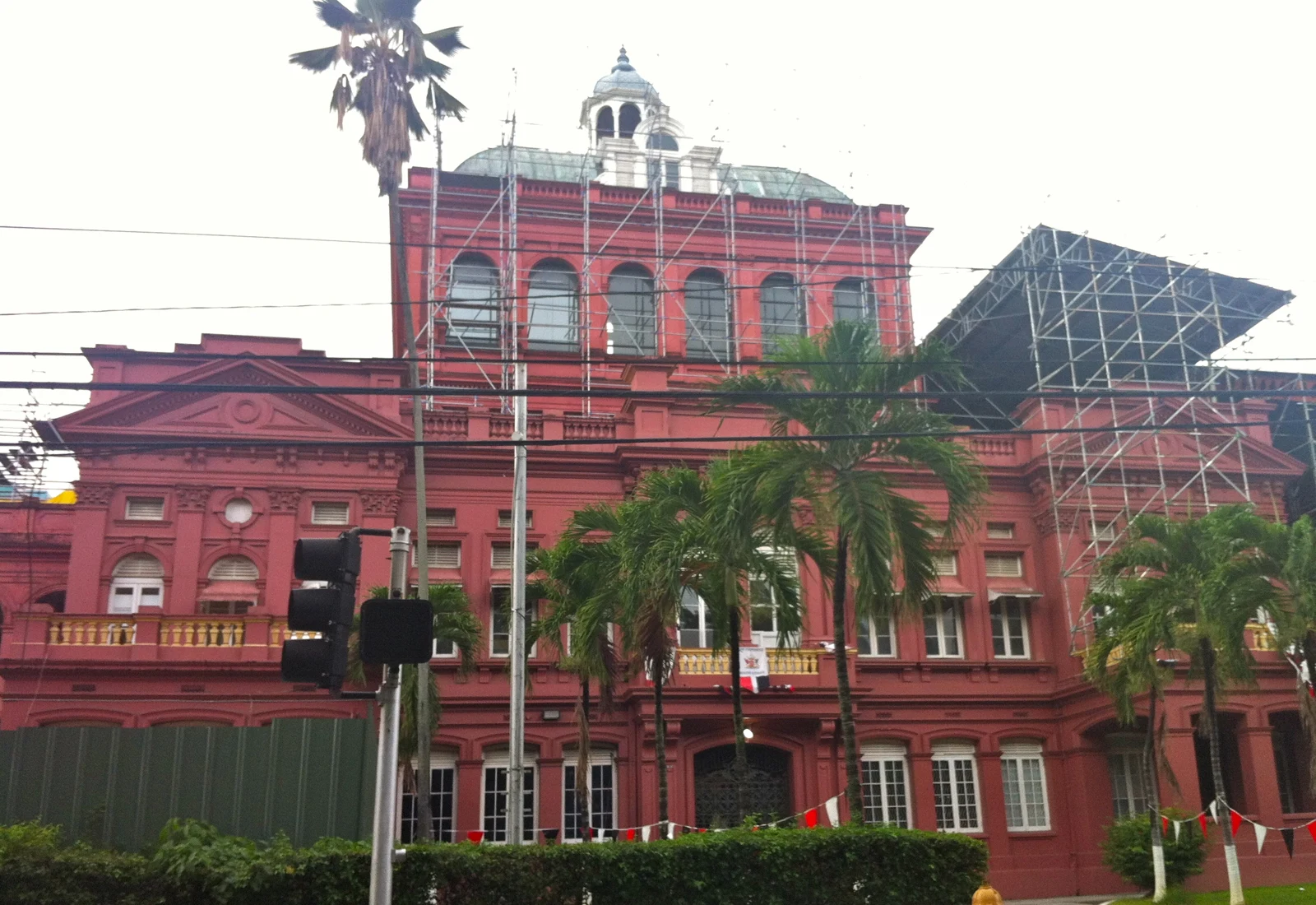
The photograph of the Red House in Port of Spain gives that distinction a place. It shows the historic seat of Trinidad and Tobago’s Parliament in October 2011, with scaffolding around the building. Parliament’s account records that the legislature moved to temporary premises in 2011 and returned to the restored building in 2020. The photograph does not show the 1986 debates or the appeal in London. It depicts the home of the legislature whose decisions are central to the case. Reading the statute alongside the history of that institution makes clear why the story cannot be reduced to a British rule imported intact and later removed by a British court. [1] [4] [5] [6]
That conclusion was contested in Trinidad and Tobago’s own courts. In April 2018 the High Court held that the challenged provisions were not saved by the Constitution and that criminalising the conduct at issue infringed protected rights. In 2025 the majority of the Court of Appeal took a different view of how the newer Act related to the older law. Its approach would preserve a narrower version of the previous prohibitions rather than accept the full reach of the 1986 provisions. The November judgment rejected that approach. The sequence matters because the people making and contesting these interpretations include Caribbean judges, legislators and advocates. The final decision came from London, but the constitutional dispute was developed in Trinidad and Tobago. [1] [2] [7]
The board’s reasoning also drew on a wider legal tradition. In explaining why exceptions to protected rights should be read narrowly, it cited Justice Aguda’s opinion in a Botswana Court of Appeal case, which in turn referred to an earlier Trinidad and Tobago decision. That is a limited point about how courts interpret constitutions, not a claim that the Botswana case concerned the same conduct or produced the same remedy. It does show that a court in London was drawing on reasoning that had travelled between postcolonial jurisdictions. The route of the appeal and the sources of its constitutional argument are two different things. [1]
The judges then considered a second constitutional mechanism. Section 13 allows Parliament, through an express declaration and a three-fifths majority in each House, to pass a law that conflicts with specified rights, subject to a test of whether the restriction can be justified in a society that respects those rights. The 1986 Parliament used that procedure. The November decision held that it did not justify criminalising the private conduct at issue. A vote meeting the threshold and a restriction that meets the justification test are therefore distinct. The case gives a concrete example of why a constitutional voting rule does not end the inquiry into what the law does to people. [1] [3]
The Attorney General argued that the provisions could be justified as laws with a long history. The board held that their age did not supply a legitimate objective for restricting protected private life. It also concluded that even if a legitimate objective had been established, the restriction did not fairly balance public interests against the intrusion into private life. That reasoning matters because it separates evidence about the existence of a tradition from an explanation of why the state needs a criminal penalty. An old rule can tell a court how a legal system developed; its persistence alone cannot establish that the interference is justified now. [1] [3]
The scope of the remedy is equally important. The court required that the two provisions be read subject to the Constitution so they do not criminalise the private, consensual relations specified in the judgment. It did not turn the rest of the Sexual Offences Act into a nullity, decide every question about discrimination, or make a finding about the experience of any community as a whole. Human Rights Watch welcomed the decision as a protection for LGBT people and argued that the offences had contributed to stigma even when rarely enforced. That is an advocacy organisation’s assessment of the wider effects. The court’s order establishes the legal change; later evidence is needed to establish how institutions respond to it. [1] [2] [8]
For Black Trinidadians, one way to understand those wider stakes is through local scholarship rather than an assumption that everyone experiences law in the same way. Leniqueca A. Welcome’s work on criminalisation and Black womanhood in Trinidad examines how class, gender and ideas about respectability have shaped the treatment of poor Black women. It is not a study of the enforcement of sections 13 and 16. Its relevance is more specific: it shows why the written terms of an offence cannot by themselves explain who is regarded as credible, respectable or entitled to protection when dealing with public institutions. This distinction leaves room for the particular experiences of Black queer people without treating them as uniform or using one population’s experience as a proxy for another’s. [8] [9]
Local organising also gives the judgment a frame beyond the courtroom. CAISO: Sex and Gender Justice developed its 2025 policy agenda through discussions with community partners and people using or engaging with its services. Its agenda and its earlier programme report describe work on access to services, responses to discrimination and support in navigating institutions. Those records are evidence of what the organisation and its participants brought to the policy discussion. They are not a population survey. What they make visible is that decriminalisation and getting help with a problem at work, in a service or in a legal process require different institutional responses. Removing a criminal prohibition can matter immediately even where those other responses still need to change. [8] [10] [11]
CAISO’s agenda separates legislative change from social services and training. That structure is useful when assessing what the judgment may mean in practice. A new statement of the law may prevent an agency from relying on a provision, while staff still need to know what the decision means for the way they receive a complaint. A person may also need help finding a service in the first place. These are distinct ways of making a right usable; counting a law reform as proof of all three would obscure the work local organisations have identified. [1] [10] [11]
There is a practical distribution of work after the ruling. Courts can state the constitutional meaning of the provisions; Parliament can amend the text that appears in the statute book; agencies can clarify how they apply it. Community organisations can help people understand their rights and bring concerns to institutions, but the service records do not show that those organisations have been given public funds to carry out the government’s responsibilities. Nor does the judgment make an appropriation or promise service delivery. The difference matters to people deciding whether they can safely seek help: the removal of a criminal sanction is a legal result, while the availability of confidential, accessible assistance depends on what other institutions do. [1] [3] [10] [11]
The court’s decision brings together two histories that are often told separately. Colonial law supplied the earlier offences; an independent legislature chose how to replace them. Trinidad and Tobago’s Constitution both preserved some older rules and provided the rights through which the later provisions were challenged. The November decision sets the limit for the two sections before the court. The next public evidence will come from how the statute is presented and applied, and from whether people can seek protection and redress without being exposed to new burdens. Those are the places to look for the difference between a judgment handed down and a right people can exercise. [1] [3] [4] [10]
- [1]Judicial Committee of the Privy Council. The Attorney General of Trinidad and Tobago and others v Jason Jones, [2026] UKPC 38 — judgment2026-11-10
- [2]Judicial Committee of the Privy Council. The Attorney General of Trinidad and Tobago and others v Jason Jones — press summary2026-11-10
- [3]Republic of Trinidad and Tobago / Digital Legislative Library. Constitution of the Republic of Trinidad and Tobago, sections 4–6 and 131976 (Constitution; revised compilation)
- [4]Parliament of Trinidad and Tobago / ILO NATLEX. Sexual Offences Act, Chapter 11:281986 (enactment); 2012-12-31 (consolidation date)
- [5]Parliament of Trinidad and Tobago. The Red HouseUndated; accessed 2026-11-12
- [6]James Roberts / Panoramio, archived by Wikimedia Commons. The Red House2011-10-26 (capture)
- [7]High Court of Justice of Trinidad and Tobago / Human Dignity Trust archive. Jason Jones v Attorney General of Trinidad and Tobago, CV2017-00720 — judgment2018-04-12
- [8]Human Rights Watch. Trinidad and Tobago: UK Court Overturns Same-Sex Conduct Laws2026-11-10
- [9]Leniqueca A. Welcome / Cultural Anthropology. On and In Their Bodies: Masculinist Violence, Criminalization, and Black Womanhood in Trinidad2024-03-19
- [10]CAISO: Sex and Gender Justice. 2025 LGBTQI+ Policy Agenda2025 (agenda); 2024 (consultations)
- [11]CAISO: Sex and Gender Justice. Wholeness and Justice Insights Report 20232024-05 (published); 2023 (programme data)
Did this publication help you understand the topic?
0 voluntary responses. Browser-based participation; responses are not a representative survey.
We welcome suggestions, contributions and recommendations.
Editorial standards ↗