On 9 November 2026, Uganda and the African Union signed an agreement in Entebbe for Uganda to host the African Humanitarian Agency. The AU says the agency will be based in Kampala and coordinate African responses to emergencies including conflict, forced displacement and climate-related disasters. President Yoweri Museveni said Uganda would honour a commitment of US$86 million in three tranches over three years. The signing establishes the host arrangement; the amount is a commitment reported by the AU, and the announcement does not document a transfer. The distinction matters to the people whose protection is at stake. Giving an agency a home and giving it the resources and authority to coordinate an emergency response are different decisions. [1] [2]
The AU Assembly selected Uganda as host in February 2025 and asked its Commission and Uganda to put in place the measures needed to make the agency operational, including the host agreement. The Assembly also called on member states and partners to support the institution and encouraged them to honour earlier humanitarian pledges made in Malabo. November’s signing fulfils one of the steps named in that decision. The other work, including turning commitments into operating resources, remains a separate matter. Uganda is both the state offering to host a continental body and a country with decades of experience organising protection with districts, international agencies and affected communities. [1] [2] [5]
The proposal for a continental agency predates the choice of host. The AU’s operationalisation study traces it to the Assembly’s January 2016 decision on humanitarian effectiveness. That decision envisaged a body based on national and regional mechanisms and funded with African resources. The institutional aim was to give African actors more authority over how crises are assessed and responses coordinated. It did not require every service to be provided directly from a continental headquarters. National and local institutions already take decisions about land, public services and access to assistance; the practical question is how a continental agency can support them and where responsibility lies when a response falls short. [2] [3] [5]
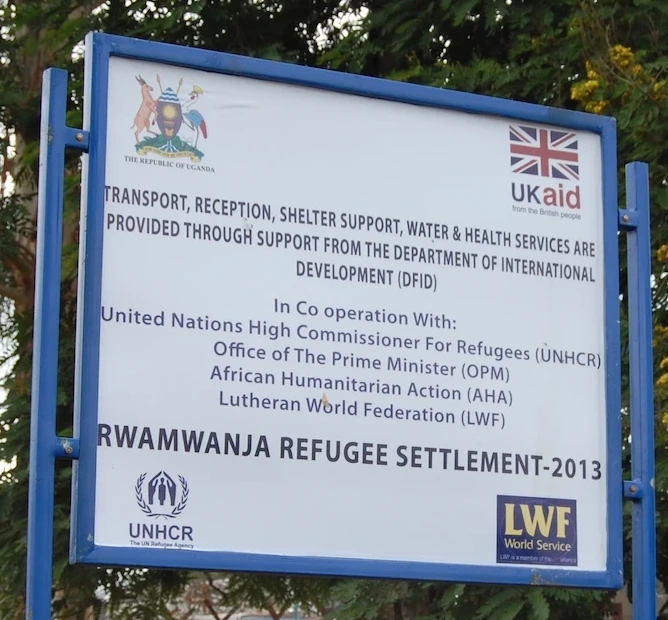
A photograph of a sign at Rwamwanja refugee settlement in western Uganda, taken on 13 April 2013, captures an earlier arrangement for providing relief. The sign lists transport, reception, shelter support, water and health services and credits British development assistance. It names Uganda’s Office of the Prime Minister, UNHCR, the Lutheran World Federation and African Humanitarian Action as cooperating institutions. African Humanitarian Action, named on that sign, is distinct from the new AU agency. The sign records how the institutions publicly described their roles, not whether households received each listed service. It makes visible how many authorities stood behind assistance at one place, even before a continental coordinating agency was established. [1] [4] [5]
Rwamwanja’s history also shows why decisions about refugee protection cannot be read as a single continuous policy. A UNHCR monitoring report dates the settlement’s establishment to 1964, when it received refugees from Rwanda, and its closure to 1995 after many repatriated. It reopened in 2012 to receive people fleeing insecurity in the Democratic Republic of Congo. The 2013 photograph documents the site after that reopening. Reusing an established settlement made it possible to organise reception in a known location, but a settlement’s designation does not supply water, land or classrooms by itself. Those resources have to be organised for the people arriving and for neighbours who may use the same local facilities. [4] [5] [8]
African governments had already negotiated a regional protection rule in the decades between Rwamwanja’s first opening and its reopening. The 1969 Organisation of African Unity refugee convention retained protection based on a well-founded fear of persecution and extended the definition to people compelled to seek refuge outside their country by circumstances including occupation, external aggression or serious disturbances to public order. The convention also contemplated cooperation with UNHCR. That earlier agreement was about who could be recognised and protected across national borders. The current agency project asks how African institutions should organise the response when people need assistance, whether they have crossed a border or remain displaced in their own country. [1] [5] [10]
Uganda’s 2006 Refugees Act gives a separate legal account of who has rights. The Act provides for identity documents and permission to remain for recognised refugees, protects against specified forms of discrimination, and sets out terms for employment, education and movement. Those protections are subject to the Act and the applicable conventions. They concern what the state recognises, beyond what a particular relief project supplies. For someone arriving from Congo, access to emergency shelter and the ability to work after recognition are related but governed by different decisions. The continental host agreement does not itself revise the national law or determine a refugee’s legal status. [1] [5] [6]
Alexander Betts’s political history asks why successive Ugandan governments have maintained versions of a self-reliance policy. Drawing on archival records and interviews, he distinguishes the rights that refugees can gain from the interests of institutions that sustain the policy. His account uses patronage to describe exchanges in which resources or advantages can help secure political support; it is a proposed explanation of particular historical relationships, not a label for every partnership. In his reading of the early 2000s, the Ugandan government and UNHCR brought together changes in refugee policy and efforts to mobilise development assistance for settlements and host communities. Their priorities overlapped without being identical. That history is useful for asking how the AU’s new institution will set priorities, but it supplies no evidence of misconduct in the 2026 agreement. [3] [6] [7]
The research at Rwamwanja adds another perspective on what those choices meant locally. Naohiko Omata described the settlement after the 2012 reopening, using field research that began in late 2013. The study documented people receiving initial supplies and a plot for residence and cultivation, as well as the beginnings of trade with Ugandan businesses. The comparisons with older settlements showed why the length of time a settlement has existed can matter to the development of markets and supply networks. Refugees and residents appear in Omata’s account as people who make economic decisions, not simply as recipients of aid. The emergence of some trade, however, does not establish that every household could earn enough from its plot or could reach a market. [5] [8]
Gemma Ahaibwe and Sheila Depio of Uganda’s Economic Policy Research Centre drew on a 2017 survey covering several rural settlements, including Rwamwanja, and urban refugees in Kampala. They found that access to land was associated with lower dependence on aid and that the size of plots mattered. The results concern relationships in the survey across the settings it included; they do not show that a plot alone caused a household to become self-reliant or describe all households in Rwamwanja today. They also report that a lower reliance on aid can reflect eligibility rules and reductions in support as well as earnings or agricultural output. The distinction matters when self-reliance is treated as a programme objective. Less recorded aid does not by itself show that a family has more resources. [8] [9]
Services pose a related question about what counts as delivery. The 2018 UNHCR monitoring report used focus groups and interviews with partners and sector leads at Rwamwanja. It recorded difficulties for refugees and local residents in accessing water and reported pressure on education and health services. The report is dated evidence of experiences raised in that monitoring exercise; it is not a current assessment of all services. Read alongside the 2013 sign, it helps explain why institutional cooperation must be assessed from more than a list of participating agencies. A water point can be planned or installed while distance and reliability still determine whether families can use it. Coordination records are most useful when they connect an agency’s responsibility to these practical conditions. [4] [5] [9]
The host agreement therefore raises a financing question and an authority question. The US$86 million commitment announced at Entebbe matters because the original AU design envisaged African resources underpinning a continental institution. A budget and a record of payments would show whether the host contribution is available for operations and what it finances. A separate set of arrangements would show when the agency coordinates a response, how it works with the national and regional bodies already responsible, and who can challenge priorities when people are overlooked. The signing announcement sets out the agency’s intended field of work. It does not show how an emergency referral from a district would be handled or how resources would reach that district. [1] [2] [3]
Rwamwanja suggests what an effective division of labour could make visible. An office coordinating humanitarian responses should be able to distinguish who makes an allocation, who receives it and who is responsible for delivery at the point of use. An institution concerned with self-reliance should also be able to see the difference between people getting by with less assistance and people gaining secure access to land, services or markets. Historical research in Uganda shows why donors, central government, districts and residents can have overlapping interests while facing different costs. A continental agency has the opportunity to make those relationships clearer, provided the responsibility to answer for individual decisions remains traceable. [3] [5] [7] [8] [9]
The 9 November agreement is a concrete step because it follows the Assembly’s decision and establishes a home for the agency. The next evidence will be the agency’s operating arrangements, the resources actually received and the processes through which affected people and local authorities can shape a response. At Rwamwanja the old sign tells us who wanted to be visible in the delivery of relief. The stronger public record for a new institution would let residents see which body can act when a service is missing, what it has been given to do the work and how they can contest a decision that affects them. [1] [2] [4] [5] [9]
- [1]African Union Commission. African Union and Uganda Officially Signs the Host Agreement for the African Humanitarian Agency (AfHA)9 November 2026
- [2]Assembly of the African Union. Decision on Operationalization of the African Humanitarian Agency, Assembly/AU/Dec.909(XXXVIII)15–16 February 2025
- [3]African Union Commission. A Study on the Operationalization of the African Humanitarian AgencyUndated working document; accessed 11 November 2026
- [4]Andy Wheatley / UK Department for International Development, via Wikimedia Commons. Rwamwanja refugee settlement, southwest Uganda13 April 2013; historical photograph
- [5]
- [6]Parliament of Uganda / Uganda Legal Information Institute. Refugees Act, 2006 (Act 21 of 2006)4 August 2006 text; 30 June 2025 digital edition
- [7]Alexander Betts / African Affairs, Oxford University Press. Refugees and Patronage: A Political History of Uganda’s “Progressive” Refugee PoliciesApril 2021 journal issue
- [8]Naohiko Omata / Forced Migration Review. Refugees’ engagement with host economies in UgandaJune 2018, issue 58; research 2013–2015
- [9]Gemma Ahaibwe and Sheila Depio / Economic Policy Research Centre, Uganda. How Effective is the Self-Reliance Agenda in Uganda’s Refugee Response?June 2019; household survey 2017
- [10]Organisation of African Unity / African Union treaty collection. OAU Convention Governing the Specific Aspects of Refugee Problems in Africa10 September 1969
Did this publication help you understand the topic?
0 voluntary responses. Browser-based participation; responses are not a representative survey.
We welcome suggestions, contributions and recommendations.
Editorial standards ↗