On 13 November 2026, during the UN climate talks in Antalya, UNDP’s Namibia office put water security at the centre of its account of the country’s new climate commitments. Namibia’s own plan points to an expansion at Goreangab in Windhoek, where the city has been turning treated wastewater into a source of drinking water since 1968. The policy question is what that investment would change for people who draw water from a shared stand instead of a connection at home. An expansion could make the system better able to withstand drought; whether it improves household access depends on what Windhoek and national institutions do with the water once it is available. [1] [2] [3] [6]
The ministry responsible for environment, forestry and tourism led the national plan. It estimates that carrying out the full programme through its 2030 and 2035 milestones would cost about US$14.07 billion, of which about 88 percent is conditional on international support. That estimate covers mitigation and adaptation across the country. It is neither the cost of an expansion in Windhoek nor a financing commitment made in Antalya. For a municipality planning a water system, the distinction matters: equipment, connections and maintenance must each be paid for over different timescales, while international support can arrive on terms that cover only some of those costs. [1] [2] [3]
Namibia has nevertheless spelled out decisions it intends to pursue through domestic institutions. Its plan counts Windhoek’s existing public–private arrangement for advanced wastewater treatment and potable reuse as a starting point. It sets national milestones for putting more treatment and reuse facilities into operation and separately includes distribution works and service upgrades in informal settlements. Those separate commitments recognise something that a single water investment figure cannot capture. Adding plant capacity addresses the available supply. Getting water from a pipe to a home or communal stand requires work in the neighbourhood, along with a continuing arrangement for operating the service. A completed plant would count towards one goal even if those other works were still waiting for finance. [2] [5] [6]
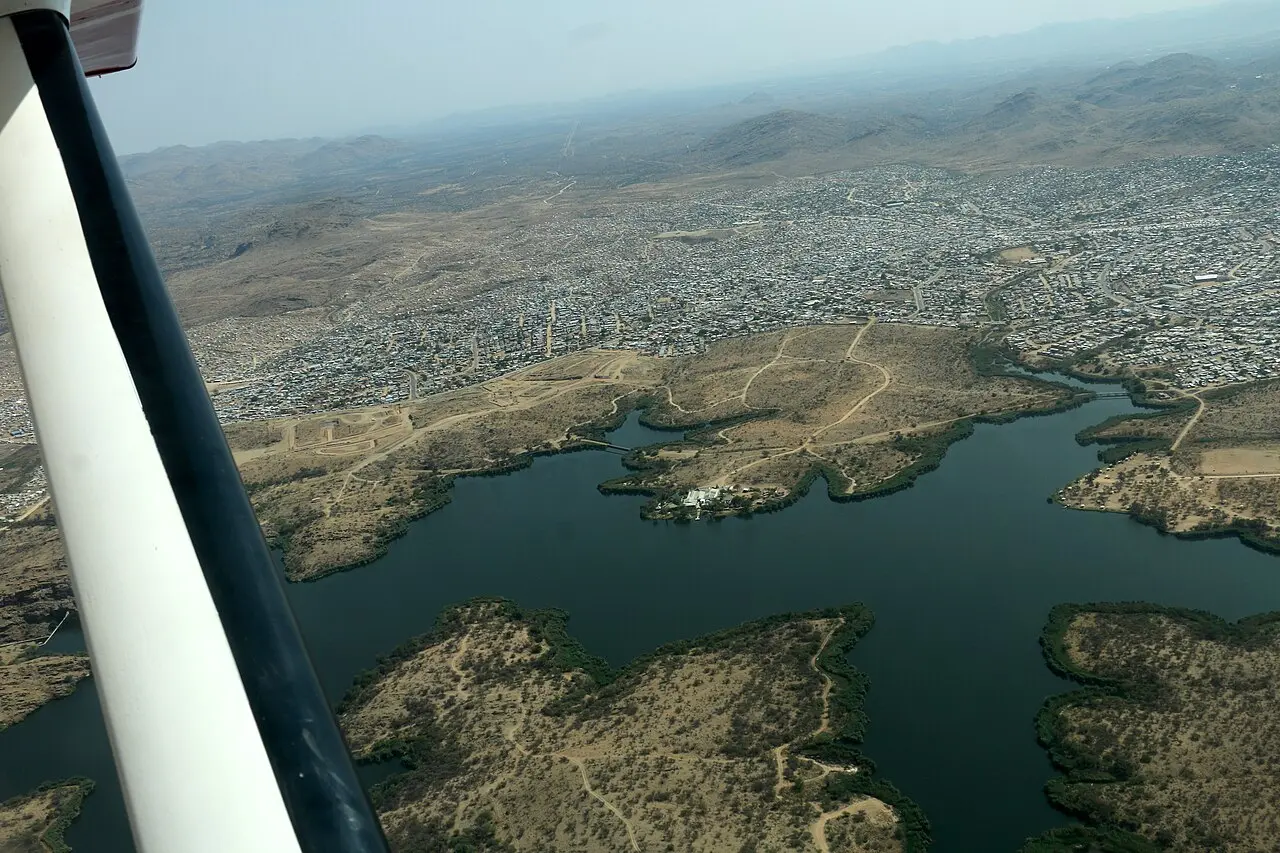
Water reclamation was a municipal answer to a specific problem long before it became a climate policy. Pierre van Rensburg and Cecilia Tortajada trace it to supply constraints in the late 1950s. The facility brought into use in 1968 allowed Windhoek to treat domestic sewage effluent to a standard at which it could be added to the potable supply. The arrangement recovers part of a flow already passing through the city instead of depending on another distant source for every increment of demand. The 2017 photograph shows the Goreangab reservoir, part of that older water landscape. The treatment works and the reservoir have different functions; the photograph helps locate the history without showing how present facilities operate. [3] [7]
The drought of 2015–2017 demonstrates why the city pursued more than one source. NamWater, the national bulk supplier, operates the system that conveys water from three dams outside the city. When those dams were under strain, the drought assessment records that water from farther north was brought into the central system and that the city drew on reclamation and groundwater options closer to hand. This division of responsibilities remains relevant to financing. A decision about national bulk supply can change the quantity that reaches Windhoek, while municipal decisions govern much of what happens after it arrives. Each institution can invest in its part of the network while residents still experience a failure at the point where the two responsibilities meet. [2] [3] [6]
The same drought study traces demand management through changes in tariff structures and efforts to enlist businesses, public institutions and residents in saving water. It also records uneven public communication, including a national awareness campaign that was announced but did not formally launch. The example matters because drought restrictions ask people to act on information issued by several institutions. A household with its own meter can use readings to track changes; a household dependent on a shared stand cannot use the same device to see or control the total used at that stand. The incentives and information designed for one setting need to be considered alongside the way water is supplied in the other. [3] [6]
The drought also showed who could negotiate how much to save. The assessment describes cooperation between the city and large industrial users, some of which invested in equipment to monitor and reduce their use. Construction firms resisted a recommendation to postpone work, citing employment, and the study found that the sector did not effectively implement that recommendation. Saving water was a decision about work and income as well as a target for consumption. It played out differently for a firm that could negotiate a conservation plan and for households using a communal stand. That experience is a reason to examine who has a voice when the city sets priorities in a future shortage. [3] [6]
The network was built in a city where access to urban land was deliberately unequal. S. Roland, Q. Stevens and K. Simon reconstruct Windhoek’s spatial history through maps and planning records. Under South African rule, residential segregation shaped where different populations could live and how neighbourhoods connected to the centre. Forced relocation from the Old Location and the planning of Katutura made that geography concrete. A city able to innovate in water production could also restrict the urban land on which Black residents were allowed to live. The two histories overlap in time. That overlap helps explain why the technical achievement at Goreangab tells us so little by itself about the distribution of services. [3] [4]
Independence in 1990 changed the political authority over the city, but public institutions inherited that physical layout. The mapping study follows the growth of informal settlements around the edge of Windhoek, including around Goreangab Dam. Living near a reservoir or a pipe does not put a household inside the network. An address must be served, the local distribution line must function, and someone must be able to pay or otherwise obtain access under the rules in force. None of those questions can be answered simply by calculating how much water a treatment plant produces. Nor does the historical account imply that all present gaps have a single cause: the speed of settlement growth and the choices made since independence also matter. [3] [4] [5]
The Namibia Statistics Agency’s February 2026 baseline records municipal and settlement conditions rather than following individual households over time. In Windhoek its listings include numerous settlement extensions for which communal taps are recorded. A tap is a real service, and the baseline makes it visible in a way that a figure for national plant capacity cannot. It still leaves open how many people rely on that tap, whether it works consistently, and what alternative residents have when it is unavailable. Measuring those things would show whether improvements recorded for a neighbourhood translate into changes people can count on from day to day. [2] [5] [6]
The city’s own guidance makes a distinction between prepaid meters connected directly to a residential plot and prepaid communal meters serving a group at a shared stand. In both arrangements the meter can register use, but it defines a different relationship between the municipality and its users. A residential connection serves one plot. With a communal meter, water collection and dependence on the equipment are shared. The difference also changes how a performance report should be read. A meter installed at a shared stand can serve several households; a count of meters alone cannot tell residents how far they must travel for water or tell the municipality whether the households that need the stand can keep using it. [5] [6]
The climate plan gives Namibia a way to account for both parts of this story. It tracks operational treatment plants and volumes reused, and elsewhere calls for reporting the people who benefit from distribution improvements. Its settlement measures also envisage better drainage and sanitation alongside water access. In Windhoek those outcomes would be most informative if the bulk supplier and city reported them together, so that readers could see where additional supply became reliable service. A national investment can be valuable even where it primarily reduces the risk of a system-wide shortage. It should be possible to say that plainly while still asking what has changed for people at the far end of the network. [2] [3] [5] [6]
The plan gives local authorities and regional councils roles in reporting water reclamation, while national bodies and NamWater are involved in reporting other infrastructure measures. It also mentions the public–private arrangement already operating in Windhoek. That is reason to look for decisions at several levels as the plan moves into practice. A national commitment can identify an investment; subsequent contracts, budgets and municipal service records will show who undertook which part, how the costs were assigned and whether additional capacity or connections entered service. That distinction is especially important for households already relying on communal provision, for whom an interruption or a long walk can matter as much as the volume produced elsewhere in the system. [2] [3] [5] [6]
Windhoek’s experience gives Namibia an existing institution and decades of practical knowledge to build on. The commitments discussed in November 2026 give that experience a larger role in the country’s response to climate risk. The test in Windhoek will be whether decisions about new capacity and decisions about access can be followed together: how much extra water the system can supply, which neighbourhoods gain dependable service, and who can afford to use it. Those outcomes should be visible in municipal and national records after investment decisions are made. [1] [2] [3] [5] [6]
- [1]UNDP Namibia. When the rains fail: Why climate action matters for Namibia’s future13 November 2026
- [2]Government of Namibia, Ministry of Environment, Forestry and Tourism. Namibia’s Third Nationally Determined Contribution (NDC 3.0)2026
- [3]Frontiers in Climate. An Assessment of the 2015–2017 Drought in Windhoek, by P. van Rensburg and C. Tortajada9 April 2021; case study 2015–2017
- [4]Urban Forum. The Uncanny Capital: Mapping the Historical Spatial Evolution of Windhoek, by S. Roland, Q. Stevens and K. Simon4 February 2023; journal issue 2024
- [5]Namibia Statistics Agency. Namibia Informal Settlements Baseline ReportFebruary 2026
- [6]City of Windhoek. Finance and Customer Services: Prepaid Water Meter FAQsUndated; accessed 13 November 2026
- [7]Hp.Baumeler via Wikimedia Commons. Goreangab Damm.jpg28 September 2017
Did this publication help you understand the topic?
0 voluntary responses. Browser-based participation; responses are not a representative survey.
We welcome suggestions, contributions and recommendations.
Editorial standards ↗