The African Union Commission renewed its demand on 23 October 2026 for the immediate, unconditional lifting of unilateral sanctions against Zimbabwean institutions and individuals. Chairperson Mahmoud Ali Youssouf attributed restrictions on access to finance, investment and development assistance to those measures, and aligned the AU with SADC’s position. That is the Union’s assessment and diplomatic demand. The live political question concerns the powers through which external institutions influence Zimbabwe’s access to resources, and how any change would affect the country’s development choices and the people whose interests are invoked in the debate. [1]
The European Union’s February 2026 review provides one part of the legal setting. The Council extended its arms embargo until 20 February 2027 and lifted the provisions allowing travel bans and asset freezes. Its statement described an intention to deepen relations in areas including trade and investment. These decisions identify the categories retained and removed during that review. They also place continuing diplomatic engagement alongside a restriction concerning arms. The AU’s October demand enters a relationship whose formal measures have already changed over time. [2]
The distinction among categories matters to the distribution of authority. An arms embargo concerns a particular area of exchange, while a travel restriction or asset freeze operates through different controls. In the February statement, the Council said it would continue monitoring the effectiveness of the measures. That places review and renewal within the institution’s own decision process. The current African demand seeks to influence that external exercise of authority, with the nature of each retained measure determining what its removal would change. [2]
The United States took a different institutional step in March 2024. Executive Order 14118 terminated the national emergency on which the Zimbabwe-specific sanctions programme had rested and revoked three earlier executive orders. Its operative provisions preserved the handling of earlier proceedings and obligations. The order records a dated legal change in the exercise of presidential emergency powers. It is part of the chronology needed to understand the setting of the AU’s present call and the different decisions through which restrictions have been altered. [3]
OFAC’s administrative record of 4 March 2024 documents changes to its sanctions list alongside the executive order. It records removals under the Zimbabwe programme and additions or changes under the separate Global Magnitsky framework. The institutional mechanism is designation under a particular legal authority, with effects attached to the listed person or entity. The record shows how termination of a country-specific programme can coincide with the use of another sanctions framework. Those dated administrative actions are relevant to identifying the kinds of measures at issue in current diplomacy. [4]
A further implementation step followed in April 2024. OFAC announced a final rule removing the Zimbabwe Sanctions Regulations from the Code of Federal Regulations, effective upon publication on 17 April. Its notice explicitly linked the removal to the termination of the emergency the previous month. This sequence identifies separate executive, administrative and regulatory actions. It also shows the importance of the institution empowered to make each change: a diplomatic demand, a presidential order and an implementing rule have different roles within the same policy relationship. [5]
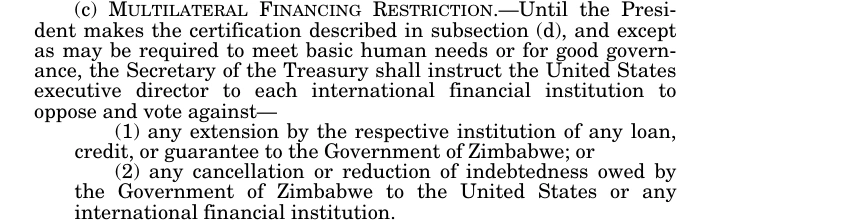
Another strand reaches back to legislation enacted by the US Congress in December 2001. The Zimbabwe Democracy and Economic Recovery Act, commonly called ZDERA, directed the US Treasury secretary to instruct American executive directors at international financial institutions to oppose specified lending and debt-relief decisions until presidential certification of stated conditions, with an exception for basic human needs or good governance. This mechanism acts through the United States’ representatives within multilateral institutions. The text establishes an instruction to those representatives within bodies where decisions involve other members and institutional rules. [6]
The same Act provides for reviews of debt restructuring and financial support after certification. It therefore connects access to a change in the US government’s assessment of specified political conditions. The original provisions concern elections, law, land reform and other commitments. This is a form of external leverage organised through domestic legislation and participation in international institutions. Its historical significance lies in the link it establishes between a foreign government’s political criteria and the positions its representatives are instructed to take on financing for Zimbabwe. [6]
Congress amended the legislation in August 2018. The amendment added detail concerning electoral administration, access to voter rolls, observers, campaigning and the position of security forces in elections. It also addressed consistency between earlier legislation and Zimbabwe’s 2013 Constitution. These are requirements expressed in a US legislative instrument. Their inclusion locates the bilateral dispute within questions that also concern political rights inside Zimbabwe, while assigning an external state a role in judging conditions relevant to its own policies and institutional positions. [7]
The 2018 text also expresses support for a stronger bilateral relationship, including trade and investment, if specified conditions are satisfied. That formulation brings economic cooperation into a conditional political relationship. Understanding the mechanism requires attention to both the proposed benefits and the authority making the assessment. The history of the legislation shows how the conditions themselves have been revised. The current diplomatic debate consequently encompasses decisions made through legislatures and financial institutions as well as the executive sanctions powers exercised by governments. [7]
Financial exclusion has also involved institutions’ own decisions about debt. On 24 September 2001, the IMF Executive Board reviewed Zimbabwe’s overdue obligations and declared it ineligible to use the Fund’s general resources, also removing access to the Poverty Reduction and Growth Facility. The release dated 25 September attributed those actions to arrears. That decision preceded ZDERA’s enactment in December. The chronology identifies a separate institutional process, with overdue financial obligations forming the stated basis of the Fund’s action at that time. [8]
The subsequent history includes change in those obligations. The joint IMF–IDA debt sustainability analysis dated August 2025 records that Zimbabwe cleared its arrears to the IMF’s concessional trust in 2016. It also documents continuing arrears to the World Bank, African Development Bank and European Investment Bank at the end of 2024. These findings distinguish creditors and preserve the dates of their financial relationships. An account of financing constraints in the present therefore has to follow the conditions attached to the relevant institution and the debt owed to it. [9]
The same analysis describes a Structured Dialogue Platform through which Zimbabwe’s authorities engage creditors and donors on re-engagement and debt relief. That places national authorities within an ongoing process of negotiation over financial obligations. The institutional relationship involves the country’s outstanding debts, creditors’ decisions and a proposed route towards resolution. These are part of the setting in which the AU seeks wider economic space for Zimbabwe, with changes to sanctions and progress on debt involving different decisions and participants. [9]
A May 2026 IMF publication on Zimbabwe’s request for a staff-monitored programme continues to place arrears, public financial management, currency policy and financing constraints within its account of the economy. Its published overview describes prolonged exclusion from most official financing alongside recent improvements in stability. The dated publication records continued engagement on economic policy. It gives the current debate another institutional context, in which the relationship between national policy choices and external financing is being addressed through discussion of a programme. [10]
African institutions have also created their own instruments for organising trade finance. The agreement establishing Afreximbank was concluded in Abidjan in May 1993. Its attached Charter gives the bank a purpose of facilitating and expanding intra-African and extra-African trade, with functions including direct credit to eligible exporters and financing through banks and other African institutions. This founding framework identifies an African institutional route for mobilising finance. Its relevance is the capacity it creates for African actors to organise resources and financial relationships through a bank with its own mandate. [11]
The original Charter also defines shareholding categories involving African states, African financial institutions and investors, alongside non-African participants. That design embeds international connections within an institution established to support African trade. African agency in finance can therefore involve the creation and governance of institutions as well as negotiations with existing creditors. The founding document sets out powers and organisational arrangements; the terms, delivery and public consequences of particular financing operations depend on the agreements through which those powers are used. [11]
Zimbabwean citizens’ views give domestic political authority its own place in this discussion. An Afrobarometer release on 12 October reported that 76 per cent of respondents preferred democracy to any other form of government. The Mass Public Opinion Institute interviewed a nationally representative sample of 1,200 adults in May 2026. The release gives a country-level sampling margin of approximately three percentage points at 95 per cent confidence. These are findings about democratic preferences from that fieldwork period, providing evidence of citizens’ expectations of political rule. [12]
The survey also found an evenly divided assessment of the extent of democracy: 45 per cent described Zimbabwe as a full democracy or one with minor problems, and 45 per cent as undemocratic or having major problems. The remaining responses included uncertainty. That distribution makes differing evaluations within the country visible. The public interests invoked in international diplomacy include people with varied experiences and judgements about their own institutions. Their preferences concerning political authority form a relevant part of the wider question of accountability and whose voice enters decisions. [12]
The AU’s own founding commitments connect these levels of politics. Article 3 of its Constitutive Act includes defending sovereignty, promoting common African positions, encouraging democratic participation and protecting human and peoples’ rights. Article 4 recognises sovereign equality and participation by African peoples alongside human rights and the rule of law. Those provisions place collective diplomacy within a framework that also concerns how authority is exercised within member states. The Union’s role includes advancing international positions while maintaining responsibilities towards the people whose rights its institutions are intended to protect. [13]
The Commission’s 23 October statement places its sanctions demand within regional integration and development goals. It attributes a range of economic burdens to unilateral measures and commits the AU to mobilising support for their removal. That position identifies the Union as a political actor seeking a change in external policy. Its claims about economic consequences remain attributed to the Commission. The institutional record gives the demand a precise setting through the different forms of restriction, financing conditions and diplomatic engagement developed over the preceding decades. [1]
The present debate concerns Zimbabwe’s room to make development choices and the responsibilities attached to political power. The AU’s Constitutive Act links common positions and sovereign equality with participation and rights. Those commitments make the public significance of international reform concrete: how changes in financial and diplomatic relationships affect the capacity to provide livelihoods and services, and how the resulting choices remain answerable to people. Following those relationships requires attention to the particular powers exercised by African governments, regional institutions, creditors and external states. [13]
- [1]African Union Commission. AUC Chairperson’s Call for the Unconditional Lifting of Unilateral Sanctions Imposed against Zimbabwe23 October 2026
- [2]Council of the European Union. Zimbabwe: Council renews arms embargo and lifts travel bans and assets freeze17 February 2026; reviewed 19 February
- [3]President of the United States / Federal Register. Executive Order 14118: Termination of Emergency With Respect to the Situation in Zimbabwe4 March 2024; published 5 March 2024
- [4]Office of Foreign Assets Control, US Treasury. Termination of Emergency With Respect to the Situation in Zimbabwe; Global Magnitsky Designations; Issuance of Amended Frequently Asked Question4 March 2024
- [5]Office of Foreign Assets Control, US Treasury. Publication of Final Rule to Remove the Zimbabwe Sanctions Regulations16 April 2024; rule effective 17 April 2024
- [6]United States Congress / Government Publishing Office. Zimbabwe Democracy and Economic Recovery Act of 2001, Public Law 107–9921 December 2001
- [7]United States Congress / Government Publishing Office. Zimbabwe Democracy and Economic Recovery Amendment Act of 2018, Public Law 115–2318 August 2018
- [8]International Monetary Fund. IMF Declares Zimbabwe Ineligible to Use IMF Resources, Press Release 01/4025 September 2001; Board decision 24 September
- [9]IMF and International Development Association. Zimbabwe: 2025 Article IV Consultation, Country Report 25/282 — Debt Sustainability AnalysisDSA dated 11 August 2025; debt data through end-2024
- [10]International Monetary Fund. Zimbabwe: Request for a Staff-Monitored Program — Press Release and Staff Report: published overview20 May 2026
- [11]Parties to the Afreximbank founding agreement / United Nations Treaty Series. Agreement for the establishment of the African Export-Import Bank, with Charter8 May 1993; registered 13 October 1995
- [12]Afrobarometer / Mass Public Opinion Institute. Zimbabweans support democracy but divided over its true extent, new Afrobarometer study shows12 October 2026; fieldwork May 2026
- [13]African Union. Constitutive Act of the African Union, articles 3–411 July 2000
Did this publication help you understand the topic?
0 voluntary responses. Browser-based participation; responses are not a representative survey.
We welcome suggestions, contributions and recommendations.
Editorial standards ↗