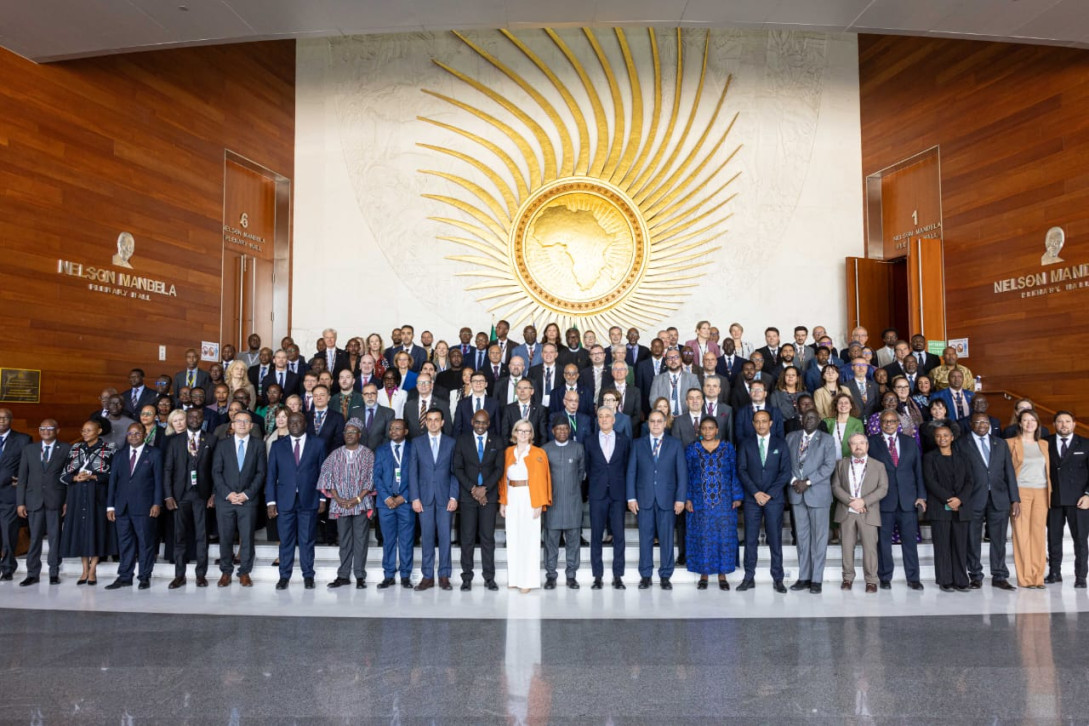
On 4 November 2026, African Union and European Union senior officials meeting in Addis Ababa adopted a plan to implement commitments their leaders made in Luanda a year earlier. They also adopted a mechanism to coordinate follow-up and monitor progress, according to the EU delegation’s account of the meeting. The officials released a separate monitoring report covering 2022–2025. The new decisions give the two organisations a way to track what follows the summit, but the delegation’s public account does not set out project budgets, delivery deadlines or the detailed measures in the new plan. [1][2]
The meeting was co-chaired by Willy Nyamitwe, Burundi’s ambassador to Ethiopia and chair of the AU Permanent Representatives Committee, and Patricia Llombart Cussac, the European External Action Service’s managing director for Africa. Representatives of member states and institutions took part. The four areas named in the EU account—prosperity; peace, security and governance; people; and multilateralism—cover more than any one investment programme. The new follow-up arrangement concerns work across that partnership. It is distinct from a financing agreement between a development bank and a government, or from a decision by a national authority to award a contract. [1][3]
The starting point was the declaration adopted by leaders in Luanda on 25 November 2025. It reaffirmed a joint vision agreed at the Brussels summit in 2022 and welcomed work on a draft monitoring report. The declaration linked cooperation on energy, transport and digital infrastructure to the AU’s Programme for Infrastructure Development in Africa as well as to the EU’s Global Gateway. The documents now mark three separate steps: a political commitment at leaders’ level, a report looking back at earlier activity, and an implementation plan adopted by senior officials. The retrospective report cannot measure the results of a plan adopted after the period it covers. [1][2]
Ethiopia used the meeting to put forward priorities on digital policy. The Ethiopian News Agency reported that Ambassador Lemlem Fiseha presented the AU side’s position in connection with Prime Minister Abiy Ahmed’s role as AU champion for AI and digital health. The priorities she outlined included investment in digital infrastructure, wider digital literacy, support for local technology firms, and inclusion of African languages in AI. In a separate intervention, Ambassador Meles Alem asked the EU to invest in projects in the AU’s infrastructure programme. These were priorities advanced by Ethiopian representatives; the public meeting account does not specify which of their proposals, if any, received project funding. [1][4]
There was already an African policy basis for those proposals. The AU’s July 2024 Continental Artificial Intelligence Strategy treats dependable electricity, broadband, computing capacity, data and skills as conditions for building AI systems. It also discusses the risks of training systems on data that poorly represent the people who will use them. That matters for the language priority raised in Addis Ababa: a network connection can make a service reachable, while the languages and data used in its design affect whether people can use it on fair terms. The two problems require different work. A fibre contract can specify an installation; support for language inclusion would also need decisions about which languages are covered, how data are gathered and how performance is assessed. The meeting account announces no such specifications. [1][4][5]
The European Commission describes Global Gateway’s Africa–Europe investment package as work undertaken by EU institutions, member states and European financial institutions through Team Europe initiatives. Its digital programme includes terrestrial and submarine fibre, cloud and data infrastructure, alongside support for regulation and data protection. The Commission presents €150 billion as the scale of the broader investment package, which also covers areas such as energy, health and education. That figure is not a new appropriation for the Addis Ababa plan or a payment to Ethiopia. The distinction matters because the source of money and the instrument used can determine who signs the contract, who bears the cost, and which institution is answerable for delays. [1][2][6]
The exchange on trade showed where cooperation still involves negotiation. In Luanda the leaders agreed to keep dialogue open on the EU’s deforestation regulation and carbon border adjustment mechanism. ENA reported that Meles raised those measures in Addis Ababa when discussing market access. The delegation’s account records a wider discussion on investment and trade; it does not announce changes to either EU measure. [1][2][4]
The partnership already operates through several channels. The AU traces its institutional development through the joint strategy agreed in Lisbon in 2007, later road maps, meetings between the two commissions and forums involving parliamentarians, civil society and businesses. Senior officials can coordinate among these institutions, but their meeting does not confer the same authority on every participant. For example, a regulator considering data protection requirements has a different role from a development bank deciding whether to finance infrastructure. The public account of the follow-up mechanism establishes its purpose; it does not explain how those responsibilities will be assigned or how people affected by a project will be able to see and challenge reported progress. [1][3][5][6]
That is where the next public records will matter. For a connectivity project, an announced investment can be traced through the financing terms, the award of work, and evidence that a network is operating where users need it. For a programme intended to make AI work in more African languages, the relevant evidence would include the languages selected and what services people can actually use in them. Neither measure follows automatically from the adoption of a partnership plan. What changed on 4 November was the machinery for following up the leaders’ commitments; what it delivers will depend on the decisions and results that the two sides can document through it. [1][2][4][5][6]
- [1]European External Action Service. AU and EU Advance Implementation of their Strategic Partnership at Senior Officials Meeting2026-11-04
- [2]African Union and European Union. Joint Declaration of the 7th African Union–European Union Summit2025-11-25
- [3]African Union. Africa–European Union (EU) PartnershipUndated overview; accessed 2026-11-04
- [4]Ethiopian News Agency. AU-EU Senior Officials Meeting Opens in Addis Ababa2026-11-04
- [5]African Union. Continental Artificial Intelligence Strategy2024-07
- [6]European Commission. EU-Africa: Global Gateway Investment PackageUndated overview; accessed 2026-11-04
Did this publication help you understand the topic?
0 voluntary responses. Browser-based participation; responses are not a representative survey.
We welcome suggestions, contributions and recommendations.
Editorial standards ↗