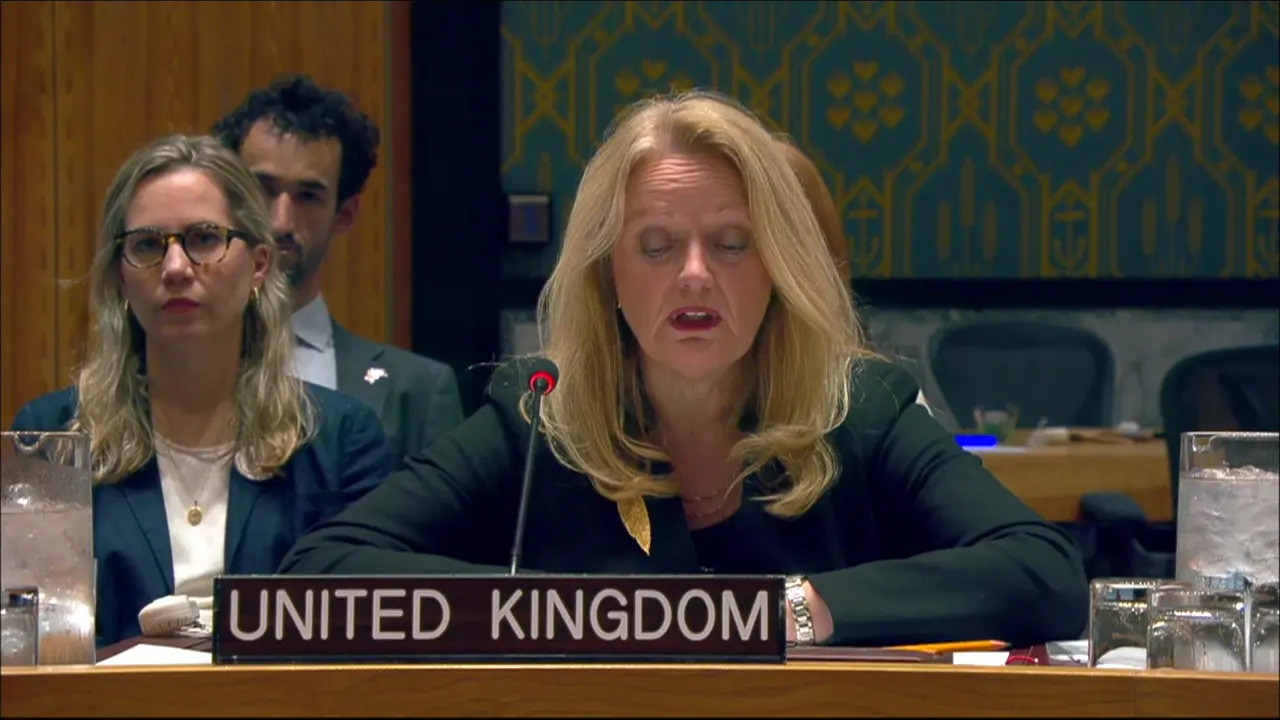
The Security Council renewed the United Nations Support Mission in Libya until 31 October 2027 on 30 October 2026, with 13 votes in favour, none against and abstentions by Russia and Greece. The decision gives the mission another year to facilitate Libya’s political process as Libyan actors negotiate the institutions and rules needed for national elections. The UN’s audiovisual account records a continuing emphasis on presidential and parliamentary elections within 24 months, linked to the agreement reached through the Smaller Convening on 30 August. That remains a political commitment requiring implementation. [1]
The United Kingdom, which drafted the resolution, said it would support Special Representative Hanna Tetteh’s roadmap and efforts to establish a single executive authority. Ambassador Sarah MacIntosh’s explanation of vote identified reunification of judicial, military and security institutions as part of the task. These are questions of who can exercise authority across the country and under which common institutions. The Council’s renewal extends international facilitation; the political arrangements themselves require decisions by Libyan actors. The UK’s statement presents the purpose its delegation assigned to the adopted resolution. [2]
MacIntosh also emphasised human rights, the rule of law and women’s full, equal, meaningful and safe participation. Those commitments place inclusion within the political process the mission is expected to support. For people seeking to influence the transition, participation concerns the terms of negotiation and the institutions through which an eventual election will be administered. The UK called on parties to honour their commitments, connecting the timetable to democratic choice and security. Its statement establishes an expectation of progress while leaving the substantive implementation work ahead. [2]
A domestic response came from Presidential Council head Mohamed al-Menfi. In a statement reported by the Libyan News Agency on 31 October, he welcomed the mandate extension and called for a broad political process led and owned by Libyans. He urged wider agreement and participation by the relevant institutions, including allowing institutions to select their own representatives. His response brings the composition of the negotiating process into focus: the way representatives enter talks affects which institutions can claim a voice in the decisions emerging from them. [3]
Al-Menfi’s statement also argued that a sustainable settlement required national consensus and the reunification of state institutions. These were his stated political requirements for the next stage, reported by LANA. They locate a question of representation inside the larger electoral timetable. A process can produce commitments among participants while other institutions continue to press for broader participation. The Presidential Council’s intervention makes that concern explicit, giving the public a named actor and a concrete position to follow as negotiations and institutional appointments proceed. [3]
The dispute over electoral institutions has a documented chronology. LANA’s account of the Smaller Convening’s first Rome meeting on 29 April reported agreement on the need to restructure the High National Elections Commission’s board. Participants recommended a route involving nomination of a judge for its chairmanship and consideration of nominees from the House of Representatives and High Council of State. That account records proposals made at the time. It does not establish that those appointments were completed. It identifies the institutional choices around election management that preceded the August agreement and the current mandate renewal. [6]
The April report described the Smaller Convening as addressing the first two steps of the UN-facilitated roadmap, including completion of the commission and consensus on viable electoral laws. This gives the current reference to implementation a specific content. Election preparation depends on the body administering the process and the rules that govern competition. The earlier meeting’s recommendations show how negotiations sought to allocate responsibilities among judicial and legislative actors. Their subsequent implementation must be established through the relevant appointment and legislative decisions, rather than inferred from the announcement of agreement. [6]
Technical assistance operates through another institutional channel. UNDP describes its Promoting Elections for the People of Libya project as part of an integrated UN electoral-support team with UNSMIL. The team provides direct advice to HNEC commissioners and staff, including on planning, institutional capacity, participation and public awareness. HNEC remains the national electoral institution receiving that support. The model therefore links Libyan administrative responsibilities with international technical resources, while decisions needed to call and govern national elections remain part of the political process. [4]
The project also identifies outreach to groups prone to exclusion as a priority. Its published activities include staff development, election materials, results-management systems and public communication. Those functions explain how participation depends on administrative capacity alongside political agreement. People need to receive information, register through accessible procedures and encounter institutions capable of processing their votes. UNDP’s project account describes the support mechanism; it should be distinguished from a completed national electoral event. The current mandate renewal provides a continuing international framework in which that assistance can operate. [4]
Reunifying institutions also has immediate economic stakes. At its 28 October meeting in Tripoli, the Central Bank’s board called for continued coordination with executive authorities on public expenditure and efforts to unify the general budget. The bank’s statement tied that work to financial stability, fiscal discipline and management of public resources. These are the bank’s stated priorities. They show that the distribution of public authority is being discussed through fiscal institutions as well as electoral negotiations, with decisions affecting how resources are directed towards goods and services. [5]
The board also resolved to establish committees for monetary policy and risk oversight and discussed financial reporting and electronic payments. These were institutional decisions and directives announced by the bank, with the practical performance of the committees still to follow. Their connection to the political process lies in the governance of shared resources and the institutions expected to exercise it. The bank’s call for budget unification supplies a concrete economic counterpart to the diplomatic emphasis on reunifying the state: public authority includes the power to organise expenditure, oversee risks and account for financial decisions. [5]
The Council debate also revealed disagreement about international influence. Russia’s ambassador, Vassily Nebenzia, argued that Libyans should determine the process’s parameters and cautioned against externally imposed solutions. Russia abstained on the renewal while the resolution nevertheless passed. The recorded vote establishes continued authorisation for UNSMIL, alongside differences over how facilitation should operate. As Libyan institutions negotiate the next steps, the immediate test is the implementation of commitments on electoral rules and institutional arrangements, with participation and decision-making authority remaining central to the process. [1]
- [1]United Nations UNifeed. UN / Libya2026-10-30; meeting and footage 30 October 2026
- [2]United Kingdom, Foreign, Commonwealth & Development Office. This mandate will strengthen UNSMIL’s ability to advance a Libyan-led and Libyan-owned political process2026-10-30
- [3]Libyan News Agency (LANA). Al-Menfi welcomes extension of the UN mission and calls for an inclusive Libyan-led political process2026-10-31
- [4]United Nations Development Programme, Libya. Promoting Elections for the People of LibyaUndated project page; consulted 2026-10-31
- [5]Central Bank of Libya. Statement on the Meeting of the Board of Directors of the Central Bank of Libya2026-10-28; page updated 2026-10-29
- [6]Libyan News Agency (LANA). UN mission: Members of the mini-dialogue agree on restructuring the electoral commission council2026-04-29
Did this publication help you understand the topic?
0 voluntary responses. Browser-based participation; responses are not a representative survey.
We welcome suggestions, contributions and recommendations.
Editorial standards ↗