Frente POLISARIO’s representative at the United Nations, Sidi Mohamed Omar, reaffirmed on 1 November 2026 that the movement would cooperate with UN efforts towards a settlement of Western Sahara’s status. His communiqué, published in full by Sahara Press Service, responded to the UN spokesperson’s announcement concerning the cessation of MINURSO’s operations. The movement maintained its demand for self-determination and independence. This response places the continuing political dispute alongside the mission’s mandate deadline: the end of an operational authorisation does not itself settle the competing positions over the territory’s future. [8]
The communiqué distinguishes the departure of a mission from the question of political rights. POLISARIO reiterated its commitment to cooperation with the Secretary-General and Security Council while rejecting any diminution of Sahrawi self-determination. These are the movement’s stated objectives, rather than an agreement reached with Morocco. Its renewed declaration of UN engagement is a substantive development after the failed renewal votes, because it identifies the international process with which the movement says it will continue working. [8]
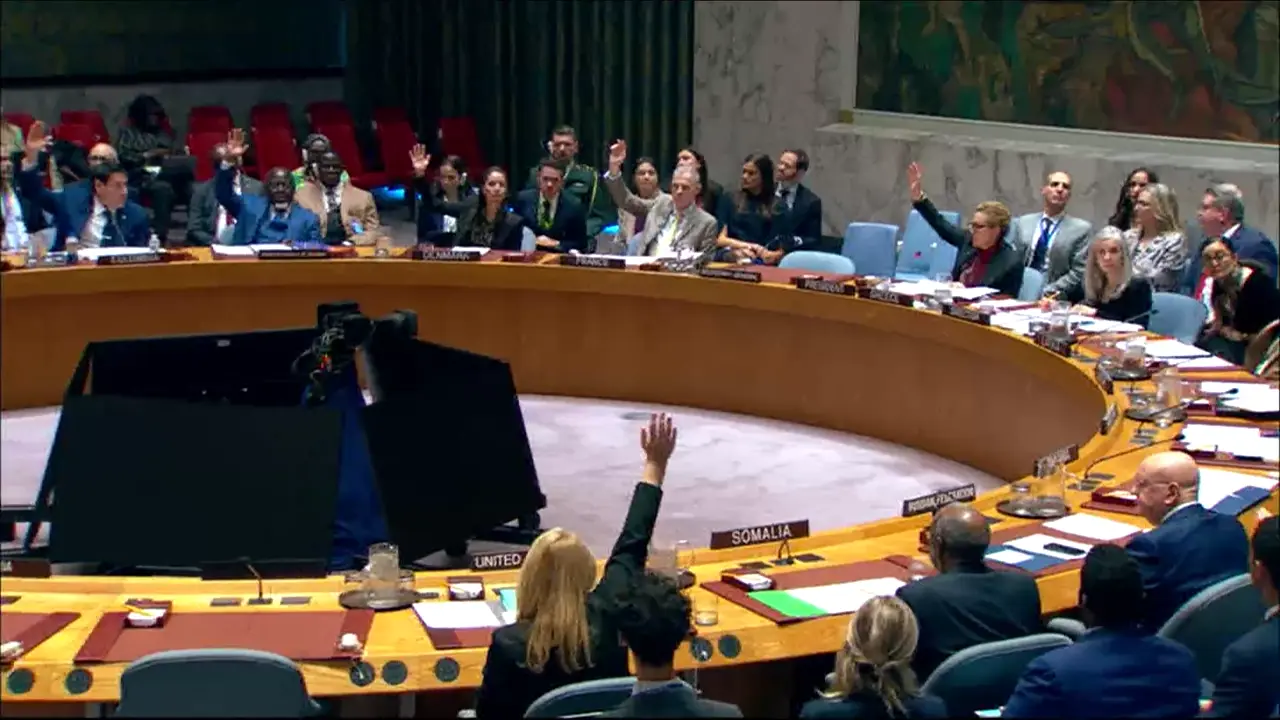
The Security Council failed on 30 October 2026 to renew the UN Mission for the Referendum in Western Sahara. A US draft received 11 votes in favour, one against and three abstentions; Russia’s negative vote prevented adoption. A Russian draft then received three votes in favour, one against and 11 abstentions, falling short of the required support. The US proposal would have extended the mission for a year and changed its name to the UN Mission in Western Sahara. Neither draft was adopted at that meeting. The photograph accompanying this report records that dated Council session. [1]
The two outcomes arose through different procedures. Under the Security Council’s voting rules, substantive decisions require at least nine affirmative votes and must avoid a negative vote by a permanent member. Russia’s vote therefore blocked a US text that had secured the numerical majority. The Russian proposal failed to reach nine affirmative votes. That distinction matters when identifying which diplomatic choices prevented a decision: opposition by a permanent member and insufficient overall support are separate obstacles, each capable of stopping adoption. [2]
The voting system gives five permanent members an authority that the Council’s elected members do not possess. An abstention by a permanent member can allow a substantive proposal to pass when it has sufficient affirmative votes. A negative vote can prevent it. For the people affected by this dispute, the continuation of an international presence consequently depends on decisions made through this unequal distribution of Council authority. The published rule explains the institutional mechanism behind the latest impasse, alongside the differing political positions expressed by governments. [2]
The mandate deadline came from resolution 2797, adopted on 31 October 2025, which extended MINURSO until 31 October 2026. The resolution supported negotiations taking Morocco’s autonomy proposal as their basis and called for a final, mutually acceptable political solution providing for the self-determination of the people of Western Sahara. These formulations appear together in the adopted text. It also requested a strategic review of the mission’s future mandate and decided that the Council remained seized of the matter. They establish the previous negotiating framework and the date of its operational extension, rather than an agreed final settlement of the territory’s status. [3]
Russia framed its alternative as a way to preserve the UN presence and the existing negotiating framework. In his statement, Ambassador Vassily Nebenzia said the text relied on previously agreed language, including resolution 2797, and argued for preserving continuity on the ground. This was Russia’s explanation of its proposal. It identifies a preference for retaining the mission’s existing form while negotiations continue, a position that must be read alongside Russia’s decision to block the US proposal and the limited support its own text subsequently obtained. [4]
Nebenzia also said Russia had dispensed with expert-level consultations on its alternative because of time constraints and its concise use of existing language. That account locates a concrete procedural choice within the last-minute diplomacy. Council members were being asked to accept a text on the basis of continuity with earlier decisions. The outcome demonstrates that a proposal framed as preserving an existing arrangement still required a sufficient coalition of supporting members. Russia’s published statement establishes the rationale it offered, while the recorded tally establishes the result. [4]
The United Kingdom supported further work on the US draft. In a statement after both unsuccessful votes, Ambassador Sarah MacIntosh urged those who had withheld support to seek a solution on that basis, pointing to its 11 affirmative votes. She linked renewal to regional stability and the interests of the affected population, including generations living in refugee camps. The statement records a diplomatic preference for a particular route out of the impasse. It also shows that, immediately after the votes, a Council member was still calling for a further negotiated decision. [5]
Morocco’s Royal Office presented a markedly different political response. In its 30 October statement, it welcomed non-renewal and said MINURSO’s personnel and equipment should leave in the coming days. It also called for the issue to be removed from the Council’s agenda. Those are the Moroccan authorities’ positions and expectations about what should follow. They are consequential because they concern the mission’s future physical presence and the forum in which negotiations are conducted. The statement’s interpretation of the vote does not itself constitute a new Security Council decision on the territory’s final status. [6]
The same statement reaffirmed Morocco’s commitment to the ceasefire and continued diplomatic efforts in support of autonomy under Moroccan sovereignty. It placed the failed renewal within the Kingdom’s broader political strategy. Separating that strategy from the Council’s actual decisions preserves the distinction between a government’s preferred outcome and a settlement accepted through the negotiating process. Morocco’s response shows an African state actively advancing its own objectives within international diplomacy. Those objectives remain part of the dispute over how the people of Western Sahara will exercise political agency. [6]
The UN Secretariat’s January 2026 working paper explains the public significance of the international presence through an earlier reporting period. Summarising the Secretary-General’s account of 2024–2025, it described MINURSO’s monitoring, investigation and liaison with the parties as important to limiting escalation and providing information to UN decision-makers. Those were the functions and assessments recorded before the latest votes. They explain why the question of continued presence reaches beyond a name change: it concerns channels for observing developments and communicating between actors in a disputed territory. [7]
The same working paper connects negotiations to Sahrawi lives across Western Sahara and the refugee camps near Tindouf. It records the prolonged dependence of refugees on humanitarian assistance and the limited opportunities for self-reliance during the period reviewed. These are dated contextual findings, rather than a fresh assessment of conditions on 31 October. They locate the political choices in a lived setting: people’s future participation, family relationships and prospects remain connected to a settlement whose terms they are entitled to understand and influence. [7]
The adopted resolution and the parties’ positions leave different questions to be resolved: the duration of an operational mandate, the framework for negotiation and the terms of a mutually acceptable settlement. Keeping those questions distinct is essential to understanding who can shape the territory’s political future. [3]
- [1]United Nations UNifeed. UN / MINURSO Western Sahara2026-10-30; meeting and footage 30 October 2026
- [2]United Nations Security Council. Voting System — Vote and Majority Required; The Right to VetoUndated; consulted 2026-10-31
- [3]United Nations Security Council. Resolution 2797 (2025), on MINURSO and the Western Sahara political process2025-10-31
- [4]Permanent Mission of the Russian Federation to the United Nations. Statement by Vassily Nebenzia on the Russian-sponsored draft extending MINURSO2026-10-30
- [5]United Kingdom, Foreign, Commonwealth & Development Office. We urge those who did not support the US’ resolution to seek a solution on that draft: UK statement2026-10-30
- [6]Royal Office, Kingdom of Morocco, via Head of Government. Statement by the Royal Office2026-10-30
- [7]United Nations Secretariat, Special Committee on Decolonization. Western Sahara: Working paper prepared by the Secretariat, A/AC.109/2026/172026-01-13; reviews 2024–2025 developments
- [8]Frente POLISARIO Representation at the United Nations, via Sahara Press Service. Communiqué by Sidi Mohamed Omar on MINURSO and continued UN engagement2026-11-01
Did this publication help you understand the topic?
0 voluntary responses. Browser-based participation; responses are not a representative survey.
We welcome suggestions, contributions and recommendations.
Editorial standards ↗