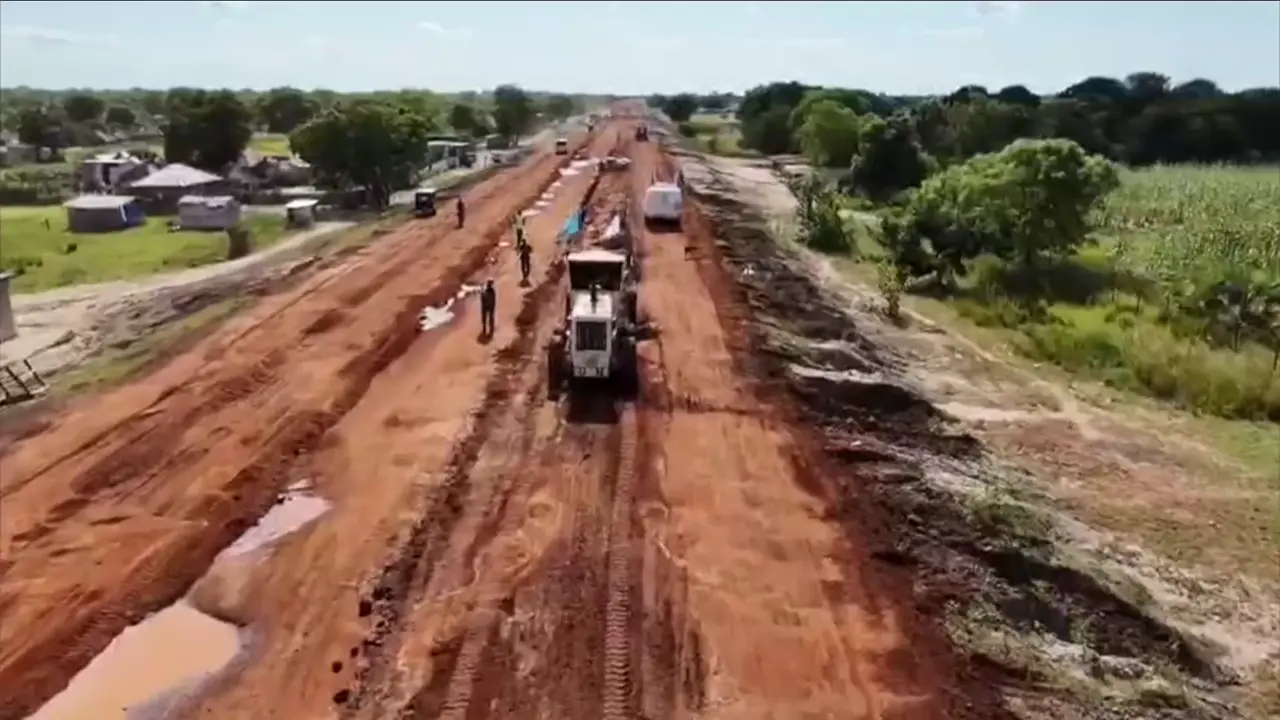
South Korean engineers serving with the United Nations Mission in South Sudan have repaired the road linking Pakwau Junction with Bor town’s main hospital, according to a UNMISS report and footage dated 29 October 2026. The route also serves traders, residents and humanitarian organisations. Residents interviewed by the mission described easier journeys and asked for work to extend towards Langbaar. Their requests place the next choice about engineering capacity before the mission: which routes receive attention as flooding continues to affect movement around the Jonglei State capital. [1]
UNMISS’s acting field-office head in Bor, Khalif Farah, said the work served both the community and mission operations and expressed an intention to continue repairs in subsequent years. That statement is a commitment to further activity; the report gives no funded timetable for extending this particular route. The footage shows rehabilitation and traffic, while residents’ accounts describe the difficulties they experienced. The package supplies no measured before-and-after travel times or accident series. Its documented result is repair of the identified connection, with demand for further maintenance still evident. [1]
The mission operates under authority renewed by the Security Council on 30 April. Resolution 2820 extends UNMISS until 30 April 2027 and places protection of civilians and facilitation of humanitarian assistance at the centre of decisions about available capacity and resources. Road engineering belongs within this wider operational setting. Access influences whether vehicles and personnel can reach communities, while the mission’s choices about deploying equipment take place within an international mandate. The resolution establishes responsibilities and priorities for the mission, rather than a national transport investment programme or an appropriation for every damaged road. [2]
The same resolution requires support to be informed by conflict-sensitive analysis and the UN’s human-rights due-diligence policy. It also calls for engagement with affected communities in identifying threats to civilians. These provisions give community experience an institutional place within the mission’s responsibilities. For Bor, the public requests recorded in the latest package identify routes people want repaired and the services they seek to reach. The mandate supplies a basis for examining how operational priorities take account of that experience, alongside the requirements of civilian protection and humanitarian movement. [2]
Bor’s significance extends across a wider transport network. The Conflict Sensitivity Resource Facility’s county profile describes a southward connection to Juba, eastward links towards Pibor and routes towards Ayod and Akobo. Its road observations refer to the 2024 rainy season and 2025 dry season, when accessibility differed markedly by route. Those dates establish the historical setting for recurrent maintenance needs. A repaired urban connection operates inside a network with changing physical conditions, so journeys involving more than one segment remain dependent on the state of the other links. [5]
The profile also identifies Bor’s role on the Nile, with river transport connecting onward towards Malakal and other destinations. This geography gives the town importance to communities and organisations moving supplies beyond its immediate urban area. Roads, loading points and river services connect different stages of a journey. A change to one part of that system can affect access to the next stage, while the geographical reach of a specific repair remains local. The county account helps explain the town’s transport role without converting its earlier road observations into a current accessibility assessment. [5]
The financial pressures on the broader aid network are explicit in minutes of the Logistics and Telecommunications Cluster’s 8 October meeting, published on 16 October. The meeting recorded approximately US$7 million in new funding for 2026 against US$12 million previously, describing an estimated US$5 million gap. Partners were advised to plan for reduced helicopter support in 2027, with a maximum of three months of wet-season air operations assumed for planning. These are the cluster’s recorded funding outlook and planning assumptions, separate from the budget for UNMISS’s Bor engineering work. [3]
The minutes also set out who would choose priorities for pending air cargo: relevant cluster coordinators were to identify prioritised blocks from commodity lists, with limited operational priority for health items. Requesting organisations would cover related road-transport costs when routes were confirmed open. Such arrangements distribute decision-making and financial responsibility across humanitarian organisations. In practice, physical access and the resources available to use it enter the same allocation process. A road opening can create an option while an organisation still has to finance movement and fit it into operational priorities. [3]
The next published river schedule makes Bor’s continuing logistics role tangible. The document issued on 23 October lists expected departures from Bor on 20 November towards Malakal and Renk, and on a combined route towards Ganyiel, Nyal and Paguer. It sets service-request deadlines of 5 November and separate cargo-delivery deadlines on 8 and 9 November. These are planned movements. Their published dates allow organisations to organise consolidation at the departure point and connect onward transport with their own programme calendars. [4]
The schedule’s distinction between a request deadline, cargo readiness and expected departure shows the sequence through which an announced movement becomes operational. Each stage requires coordination before a boat leaves. For communities awaiting supplies, the timetable links decisions taken by organisations to a physical delivery chain through Bor. The dates provide a concrete near-term planning framework, while delivery at the final destination remains a subsequent event. This connection between local infrastructure and scheduled movements explains why access around a logistics hub has consequences for services over a wider area. [4]
The Logistics Cluster describes its operating model as coordination across hubs in Juba, Bentiu, Bor and Malakal. Road convoys depend on physical accessibility; air services for otherwise inaccessible locations depend on funding and prioritisation through the Inter Cluster Coordination Group. Its river service operates with partner cost sharing through WFP’s on-demand provision. These arrangements make transport a shared institutional task, with different actors controlling information, funding and movement. The Bor repairs therefore enter an existing system of decisions about how public and humanitarian resources reach people. [6]
For readers following the work, the immediate public interest is the connection restored to the hospital and market, together with residents’ stated demand for additional routes. The wider logistics arrangements show why continued access requires financing, coordination and maintenance across successive journeys. As new movements are planned through Bor, the distribution of those responsibilities will remain central to whether improved physical connections translate into reliable access to essential services. The cluster’s published service model identifies the institutions and constraints through which those transport decisions are made. [6]
- [1]UNMISS / United Nations UNifeed. South Sudan / Bor Road Repairs2026-10-29; footage captured 29 October 2026
- [2]United Nations Security Council. Resolution 2820 (2026), paragraphs 1–4, UNMISS mandate2026-04-30
- [3]Logistics and Telecommunications Cluster / WFP. South Sudan — Coordination Meeting Minutes, Juba, 8 October 20262026-10-16 (publication); meeting 8 October 2026
- [4]Logistics and Telecommunications Cluster / WFP. South Sudan: River Departure Schedule, November and December 20262026-10-23
- [5]Conflict Sensitivity Resource Facility, South Sudan. Bor South — County Profile, Administration & LogisticsUndated; consulted 2026-10-30; road observations 2024–2025
- [6]Logistics Cluster / WFP. South Sudan Emergency — Concept of Operations and Service ProvisionUndated operational page; consulted 2026-10-30
Did this publication help you understand the topic?
0 voluntary responses. Browser-based participation; responses are not a representative survey.
We welcome suggestions, contributions and recommendations.
Editorial standards ↗