Brazil’s Ministry of Agrarian Development said on 3 November that it plans to hand over 18 land titles covering ten quilombola territories during November. The programme is intended to benefit 1,119 families in eight states. The announcement creates a dated commitment for communities whose territorial rights depend on decisions by land agencies. The handovers remain planned; the statement does not establish that the families have received those titles. [1]
The proposed titles cover communities from Amapá and Pará to Santa Catarina and Rio Grande do Sul. Several concern portions of the same territory, so the number of titles cannot be read as the number of communities whose entire territory will be secured. The ministry also announced a planned digital land-governance module and a replacement administrative instruction. Neither had been presented as already in force in that account. Their effects will depend on the published rules and on their use in particular land proceedings. [1]
Quilombola communities are contemporary political and social communities, rather than simply a category of historical sites. Incra, the federal land agency, describes them as ethnic groups, predominantly Black, rural or urban, whose self-definition involves kinship, ancestry, cultural practices and particular relationships with territory. That definition matters for the November programme: the right being recognised concerns the land through which a community sustains its collective life. It is not an individual award for a person’s ancestry, nor does it encompass every Black Brazilian. [2]
Incra conducts identification and titling at federal level, while states, municipalities and the Federal District also have responsibilities. A community’s encounter with the state can therefore involve more than a single ministry or office. The agency’s account locates land regularisation within the protection of physical, social, economic and cultural continuity. Its remit connects a property decision to the ability of communities to continue living and producing in a particular place. That makes the territorial extent of each title central to assessing the programme. [2]
Decree 4,887 of 2003 sets out the federal procedure and requires community participation at every stage, directly or through representatives chosen by the community. Identification entails field and land-register work, publication of boundaries, notification of occupants and neighbours, and opportunities to contest the technical report. These requirements give both communities and other affected parties a defined place in the process. They also explain why a technical report, a boundary decision and a property title are different legal steps. An announcement of progress at one stage should not be counted as completion of another. [3]
The decree provides for a collective title, held without division and with restrictions on sale, seizure and acquisition through adverse possession. Legally constituted community associations represent the communities. This arrangement protects a territorial basis for collective life rather than distributing plots for individual sale. It also gives representation practical importance: decisions taken through the association concern a resource held for the community. A title’s significance therefore rests both in the land it covers and in the community institutions through which that land is governed. [3]
The communities’ national coordination organisation, CONAQ, set out its own priorities in a political letter published on 29 October. It called for effective progress in land regularisation and titling, respect for each community’s protocols and forms of organisation, and participation in policies affecting its territory. That position gives a different test of the November programme from a count of documents delivered. Community members are asking to participate in formulation, implementation and evaluation, rather than enter the process only as recipients at a handover ceremony. [4]
CONAQ also connected territory to education, opportunities for young people, local knowledge and economies, climate justice and the rights and participation of quilombola women. Its letter describes these as an agenda for the next period of government. It does not certify the ministry’s November targets or establish that a particular community has approved the programme. The distinction preserves the organisation’s independent political position while showing why a land title can matter across several areas of everyday life. [4]
Census evidence supplies another measure of scale. An IBGE presentation of the 2022 census records about 1.33 million quilombola people across 1,700 municipalities, with 68.1 percent in Brazil’s Northeast. These are census-year figures, rather than a November 2026 population estimate. The distribution shows why a national programme cannot be assessed through one locality or one regional image of Black rural life. The communities covered by a set of title deliveries belong to a much wider and geographically varied population. [5]
The same IBGE material reports that 12.61 percent of quilombola people lived within officially delimited quilombola territories in 2022. Delimitation is not identical to final titling, and residence outside a delimited area does not by itself establish a particular person’s property claim. The figures nevertheless show the importance of separating recognition of people in a census from the administrative status of the territories in which they live. Neither measure can substitute for examining the boundaries and legal status of an individual territory. [5]
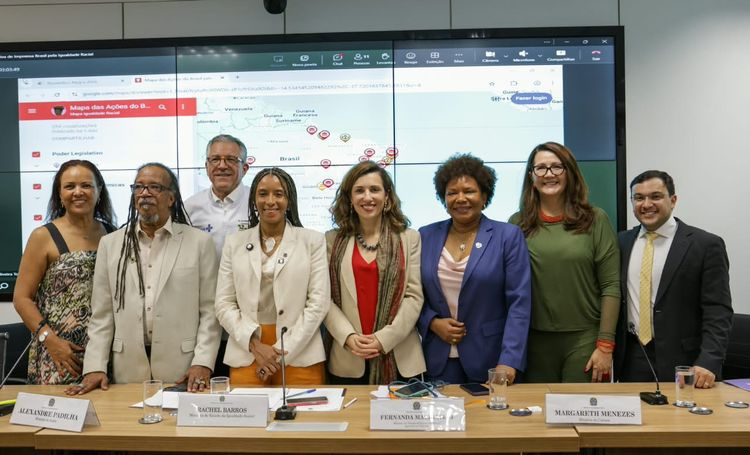
The November announcement was made at the launch of the government’s racial-equality programme in Brasília. Fundação Cultural Palmares’ account of that event records its president, João Jorge Rodrigues, arguing that quilombos need access to internet, roads, computers and universities. This places the land programme within a broader claim to public services and contemporary economic life. Recognition of territory does not remove the state’s responsibilities beyond the land registry; nor does a programme of public services replace territorial rights. [6]
The November programme will therefore be judged beyond the ceremony in Brasília. Fundação Cultural Palmares’ account links racial equality to public services, infrastructure and the ability of communities to take part in contemporary life. Land recognition belongs within that wider relationship with public authorities. Its public significance lies in what it makes possible for particular communities, alongside the services and institutions on which their members continue to rely. [6]
- [1]Ministério do Desenvolvimento Agrário e Agricultura Familiar. Coletiva Novembro Negro 20262026-11-03
- [2]Instituto Nacional de Colonização e Reforma Agrária. Quilombolas2020-01-28; updated 2026-09-21
- [3]Presidência da República, Brazil. Decreto nº 4.887, de 20 de novembro de 20032003-11-20
- [4]CONAQ. Carta política sobre as Eleições de 2026Published 2026-10-29
- [5]Instituto Brasileiro de Geografia e Estatística. Brasil Quilombola: Quantos somos, onde estamos? — Quilombolas e Indígenas, por sexo e idade, segundo recortes territoriais específicos: Resultados do Universo2022 census data; presentation undated, accessed 2026-11-05
- [6]Fundação Cultural Palmares. Novembro Negro reúne ministérios em agenda nacional pela igualdade racial; João Jorge defende mobilização unificada2026-11-03
Did this publication help you understand the topic?
0 voluntary responses. Browser-based participation; responses are not a representative survey.
We welcome suggestions, contributions and recommendations.
Editorial standards ↗