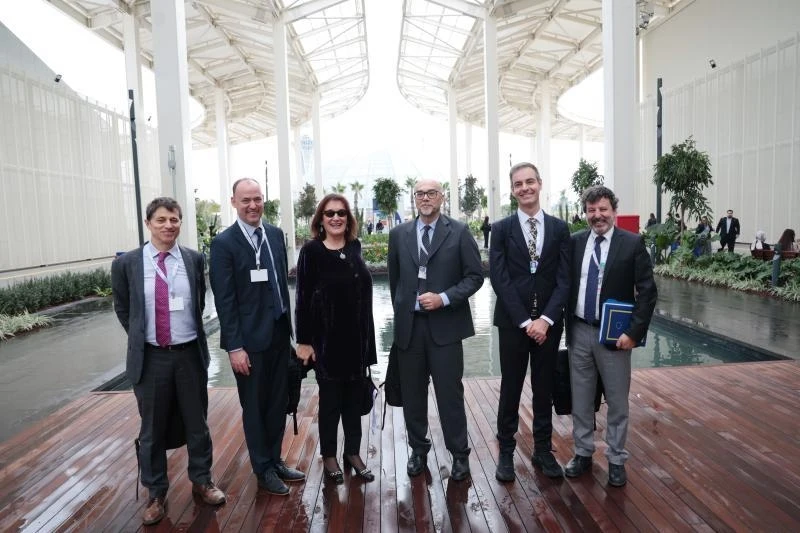
On 13 November 2026, findings from the Union for the Mediterranean’s climate action plan for 2027–28 were presented at COP31 in Antalya, Türkiye. At the conference, the European Commission also set out climate actions under its separate Pact for the Mediterranean, including support for small fisheries and coastal producers. For local governments on the southern shore, the immediate question is how a regional priority becomes something they can put in a budget. Tunisia already has a mechanism designed for that step. Its six pilot communes drew up responses as different as catching rainwater at public buildings and monitoring seawater quality. [1] [2] [4]
The Union for the Mediterranean started consultations on its plan at the Mediterranean Green Week in June and July 2026. It recorded initial input from eight member states and organised the work around four areas: climate commitments and implementation, adaptation and climate risk, finance and project preparation, and the systems that support delivery. In Antalya, the Commission said it had financed the plan and that Commissioner Dubravka Šuica presented the EU pact’s climate actions alongside the regional plan findings and in dialogue with young people, civil society and businesses. The plan presentation established a regional programme of work; the Commission release did not announce transfers to named Tunisian communes. [1] [2]
The distinction matters because the wider COP programme also included activity under existing funding programmes. In the pavilion schedule published on 10 November, the Union for the Mediterranean listed a separate Interreg NEXT MED launch of 49 projects across 15 countries, with a combined value above €120 million. That figure describes that group of projects rather than a budget for the entire 2027–28 climate plan. It also says nothing by itself about when a particular project receives funds, or how much of the overall amount is allocated to a particular municipality. Those details belong in individual grant and programme records. [1] [7]
Tunisia’s municipal pilot predates the Antalya launch. In 2022, the European Commission’s action document on adaptation in the southern Mediterranean set out a route for incorporating climate risk into local budgets. One part of the programme would help national authorities work adaptation into sector plans and policies; another would use the UN Capital Development Fund’s Local Climate Adaptive Living Facility, or LoCAL, to channel support through public budgets. In Tunisia, the mechanism works through a national fund for communal climate action. Tunisian ministries oversee the programme, with technical support from the UN fund. [3] [5]
The design asks the commune to do more than list hazards. The UN fund says each pilot authority had to organise meetings with residents, prepare a plan and pass minimum conditions. A mission from Tunisia’s environment ministry and the UN fund visited pilot communes to check whether proposed measures fitted the funding rules and local plans. The design also links later grant amounts to performance. The national fund’s notice identified €7.12 million from the EU for allocation across four budget cycles; it did not describe that whole sum as money already paid to communes. The steering committee later confirmed that the first six plans met the conditions to proceed to the funding phase, a different step from completing the work. [4] [5] [6]
In Beni Khedache, a mountainous agricultural commune in the south, the plan grouped rainwater harvesting, solar lighting and planting local fig trees at eleven public establishments. The same account describes repairing or improving four watercourses as a further proposal, with agriculture among the intended uses. On the north coast, Bizerte proposed a quite different kind of work: young volunteers would help monitor seawater quality, while the commune considered green spaces near its hospital and separate collection points for organic and plastic waste. The June 2024 record describes proposals. It does not show whether the rainwater systems were installed or whether volunteers subsequently began taking samples. [4] [6]
The two proposals illustrate what local discretion changes. Rainwater harvesting requires decisions about where to collect water and which public buildings can maintain equipment. A monitoring proposal calls for a sampling routine and a way to use the readings. Those are different demands on a commune, even if the same national fund can consider them. In 2024, the UN fund said Tunisia was preparing a competitive process to select another nine communes, asking applicants to describe locally planned responses and how residents would participate. Selection, approval of the proposed work and verification of spending are successive steps in the system, each with a different kind of evidence. [3] [4] [6]
The parallel strand that works with national authorities has a different job. In a current description of its North Africa work, Expertise France lists assistance on Tunisia’s climate governance and on accreditation processes that can help institutions gain access to climate finance. The description also puts adaptation of Egypt’s social protection sector and studies on treated wastewater reuse in the wider programme. The work listed there helps prepare institutions or projects to act. It is distinct from the municipal grants in Tunisia, even though both strands describe their work as adaptation. [3] [8]
At Antalya, the presentation advanced a regional plan and gave EU officials a place to describe the programmes they intend to use. Tunisia’s earlier work shows where the evidence becomes specific enough for people to judge: in a commune’s choice of infrastructure, in the amount approved or transferred for that work, and in records showing what residents can actually use. Beni Khedache and Bizerte began with different priorities. Whether the regional programme helps other local governments address similarly particular needs will turn on how those choices carry through to financing and delivery. [1] [2] [4] [5]
- [1]European Commission, Directorate-General for the Middle East, North Africa and the Gulf. At COP31, the Commission launches climate-related actions under the Pact for the Mediterranean2026-11-13
- [2]Union for the Mediterranean. On the road to COP31: UfM launches process for a regional climate action plan at the 3rd Mediterranean Green Week2026-07-06
- [3]
- [4]United Nations Capital Development Fund. LoCAL Tunisia: Six communities identify adaptation and mitigation priorities2024-06-12
- [5]United Nations Capital Development Fund. A new national fund paves the way for local action against climate change in Tunisia2024; accessed 2026-11-15
- [6]United Nations Capital Development Fund. Tunisia to launch a competitive selection process for local governments seeking to act on climate change2024; steering committee meeting 2024-06-25
- [7]Union for the Mediterranean. UfM-organised Mediterranean Pavilion brings regional climate solutions to COP31 in Antalya2026-11-10
- [8]Expertise France. Un(e) Coordinateur(trice) Régional Afrique du Nord du programme AdaptAction de l’AFD (H/F)Undated notice; accessed 2026-11-15
Did this publication help you understand the topic?
0 voluntary responses. Browser-based participation; responses are not a representative survey.
We welcome suggestions, contributions and recommendations.
Editorial standards ↗