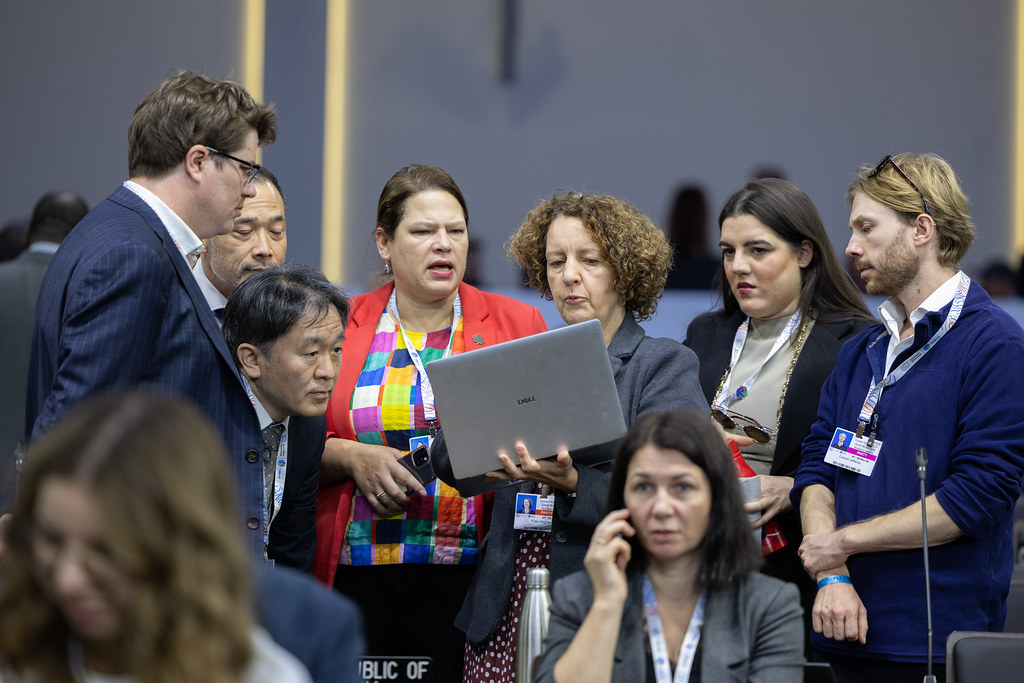
In Antalya this week, a COP31 draft gave a number to a question African negotiators brought to the summit: what would it mean to triple adaptation finance by 2035? One provision in the 11 November text proposes using $40 billion a year as the starting point and setting a benchmark of at least $120 billion a year by 2035. An alternative would gather views on the baseline and the finance to count before settling the figure. The UN climate forum for young people on 13 November also put the $120 billion proposal up for discussion. The previous summit called for efforts to triple adaptation finance; the figures and procedures in the Antalya draft remain negotiating options. [1] [4] [17] [18]
On 13 November 2026 in Antalya, the African Group told consultations on a possible COP31 cover decision that exceeding 1.5°C would increase adaptation costs. It opposed setting electrification targets without specifying the means to implement them. The European Union said proposals that stressed developed countries’ finance obligations under Article 9.1 of the Paris Agreement should be handled under the relevant negotiating item. The presidency invited written submissions by 22:00 Antalya time on 14 November. That invitation gives parties another way to put their positions on record; it does not establish an adaptation finance baseline or a new funding commitment. [11] [14] [15]
On 13 November 2026 in Antalya, the African Group proposed giving the Adaptation Fund Board authority to finalise the legal and institutional arrangements with the fund’s trustee as the fund moves to serve the Paris Agreement alone. Delegates asked for time to consider the proposal. It addresses who can complete the transfer of authority over the fund; it does not set a new contribution level or release money for projects. [11] [12] [13]
On 12 November 2026 in Antalya, delegates discussing the Paris Agreement’s climate finance work programme showed broad support for taking up the goal of tripling adaptation finance and improving access to it. South Africa and several developing-country groups pressed to focus on finance that developed countries are obliged to provide under Article 9.1. Other delegations argued for considering the whole article, including ways to mobilise finance from additional sources. The co-facilitators said they would prepare a first draft. The discussion did not set a baseline or decide which flows should count towards the goal. [3] [4] [10]
On 11 November 2026 in Antalya, Türkiye, COP31 negotiators discussed how to assess the Green Climate Fund’s funding needs. The African Group said it wanted a process to guide efforts to raise money, rather than a specific sum agreed in Antalya. Co-chairs David Kaluba of Zambia and Simon Stumpf of Germany said they would prepare a streamlined text. An agreed process could help developing countries judge whether the resources available to the fund match what they need to put climate plans into practice. The discussion did not produce a funding decision. [1] [8] [9]
African climate negotiators asked for a dedicated agenda item on tripling adaptation finance when COP31 opened in Antalya, Türkiye, on 9 November. Parties adopted their agendas without that separate item. The presidency said the subject could still be raised under existing items, and the following day negotiators discussed it under adaptation and finance. The procedural outcome matters because the previous summit called for efforts to at least triple adaptation finance by 2035. The question in Antalya is how that call will be turned into commitments that can be tracked and used. [1] [2] [3] [4]
The draft gives governments three choices: leave finance language out of this decision, consider progress in a separate finance work programme, or address finance in the adaptation decision itself. Within the last option, the alternative to setting a figure now would seek views on whether to count public and private finance, how to value concessional instruments, and how to avoid counting the same multilateral funding twice. Those choices affect what a headline total tells a recipient government. A grant can be spent without repayment; a loan may finance the same work but leaves a debt. In the separate finance talks, South Africa joined the Arab Group and the Philippines in seeking a method for sharing the cost of provision among developed countries. [4] [10] [17]
The African Group of Negotiators also proposed assessing how much money the Green Climate Fund needs before its third replenishment. The group said governments cannot plan adequately for adaptation without knowing whether international support will be available. The COP31 presidency directed the funding-needs discussion to existing Green Climate Fund agenda items. This is a different result from creating a new negotiating item, and neither procedure puts money into the fund. The official supplementary provisional agenda helps locate the existing routes; the opening-day account records how parties dealt with proposals and adopted the agendas with oral amendments. [1] [2] [5]
At the 11 November meeting, the European Union said it was willing to discuss what the proposal would add to existing work, including the Standing Committee on Finance’s report on developing countries’ needs. South Africa pointed to a timing problem: the cycle for assessing needs does not line up with the cycle for replenishing funds. A needs report can describe what countries require, but when it arrives determines whether it can inform the next round of contributions. The Green Climate Fund’s third replenishment covers 2028 through 2031. [8] [9]
The fund’s board had already approved rules in October for what it can accept in that round. Its report to the conference says the policy encourages grants while allowing more flexibility for contributions in other forms, including guarantees from national and subnational governments. The board asked staff to develop arrangements for handling those guarantees and bring them back for consideration. The policy governs what contributors can offer; it sets neither an overall amount for the replenishment nor what individual projects will receive. That leaves room for the separate assessment the African Group is seeking. [1] [8] [9]
The difference between the two subjects matters. One is a target for scaling up adaptation finance across sources. The other is a discussion about the resources needed by a particular institution that finances climate projects in developing countries. The decision adopted in Belém in 2025 called for efforts to at least triple adaptation finance by 2035 and urged developed countries to increase provision. It also recalled a separate effort to triple annual outflows from specified multilateral climate funds by 2030 from the 2022 level. The year, reference level and money being measured are different. An increase under one measure cannot be taken as proof that the other has been met. [1] [4]
The opening-day decision did not end negotiations on how to measure adaptation finance. At the 10 November discussions on the global goal on adaptation, the Group of 77 and China urged further work on the baseline, tracking and monitoring. The United Kingdom, European Union and Norway supported pursuing discussion in the climate finance work programme in the context of the broader climate finance goal. In a separate finance contact group, the African Group and the Independent Association of Latin America and the Caribbean put forward work on how to put Article 9.1 of the Paris Agreement into effect. The EU favoured a broader scope across Article 9. Those were negotiating positions; the meeting report records that draft text was still to be prepared. [3] [4]
The COP31 presidency’s 13 November summary brings the accounting question into a second forum: informal discussions on a possible conference-wide decision. It records proposals to identify a baseline and milestones and to track delivery of the tripling goal. It also records different views on which sources should contribute to climate finance. The presidency says its note draws on consultations on 10 and 11 November and does not indicate how widely particular views were shared. A baseline in such a decision could give countries a common point from which to judge progress. The note itself selects no baseline, establishes no reporting obligation and leaves the separate talks on the finance work programme open. [1] [4] [10] [14]
A baseline is the amount from which an increase would be counted. The difference is practical: a tripling target cannot be tracked clearly if countries and institutions start from different totals or count different instruments. A grant that a government can spend and a loan it must repay can both support adaptation, but they impose different costs on the recipient. The Belém decision emphasises public, grant-based and highly concessional resources, particularly for vulnerable developing countries. The Antalya discussions on the baseline and on access are therefore about more than the headline number. They concern the kind of finance a government or implementing organisation can actually use. [3] [4]
A programme in Zambia shows what adaptation finance looks like after it moves past the international negotiating stage. A project brief published by the United Nations Development Programme describes Green Climate Fund support for Zambia’s Ministry of Agriculture to help farmers in two agro-ecological regions plan for climate risks, change production practices and reach markets. It identifies 16 districts targeted by the programme. Those are the project’s scope and objectives. They provide a more concrete account of intended beneficiaries than a global finance target, but they do not show what every participating household received. [6]
In May 2026, UNDP reported that President Hakainde Hichilema had launched the Malombe irrigation scheme under that programme in Sioma District. The agency described a 25-hectare system using water from the Zambezi and said it was designed to serve 73 households. The launch identifies a particular piece of infrastructure and its intended users. It does not establish how much each household has been able to irrigate over a growing season or what happened to farm income. A global target, a funded project and a reported installation answer different questions about whether a farmer will be able to grow a crop through a dry period. [4] [6] [7]
That distinction explains why the African Group raised the Green Climate Fund’s needs alongside the proposed adaptation agenda item. Negotiators are asking how to measure changes in adaptation finance overall and how much a particular fund needs to support proposals. A farmer’s access to irrigation depends on later decisions about who can obtain funds, how a project is run and who can use it. The latest talks moved the fund’s needs into a discussion that will generate proposed text; they did not approve new resources for the fund or announce a payment to Zambia. [1] [3] [6] [7] [8]
The Adaptation Fund already serves the Paris Agreement alongside the Kyoto Protocol. Its secretariat explained in 2025 that a move to Paris-only oversight would require trustee arrangements reflecting the new authority and the way proceeds from Paris Agreement carbon crediting are handled. The World Bank serves as trustee. The African Group’s proposal is to let the board finalise arrangements with the trustee. The 13 November consultations also exposed a separate difference: the Like-Minded Developing Countries wanted to retain the board’s composition, while Japan questioned using categories from the original climate convention under the Paris Agreement. The co-facilitators were to prepare updated draft conclusions; neither issue was settled in the discussion. [11] [12] [13]
In separate talks on national adaptation plans the same day, the African Group backed a request to revise a report on the financial support available for those plans, arguing through a joint position with other groups that the overview should match the mandate agreed in Belém. The UK and EU opposed that request and sought greater recognition in the draft text of the broader finance landscape, including private finance. That dispute concerns what is measured; the Adaptation Fund proposal concerns who has authority to finish an institutional transition. Neither is evidence of a new project approval. The Zambia example in this report concerns the Green Climate Fund, a different institution. [6] [7] [11] [12]
The report at issue in the adaptation-plan talks includes a separate look at the Green Climate Fund’s readiness window, covering November 2015 to September 2026. That window is one route through which countries can seek support for preparing plans. Counting it helps identify a source of support, but does not by itself show how much governments can draw on to put plans into practice. That is why the scope of the overview matters alongside the argument over what any conference-wide text should say: a shared headline can coexist with disagreement about which flows belong in a report and what stage of delivery they represent. [11] [15] [16]
The work programme could give countries a way to scrutinise who provides adaptation finance and what counts towards the 2035 goal. The Green Climate Fund discussions address a separate question: how an assessment of needs might guide contributions to that fund. Neither discussion changes what has been approved for a project. For communities such as those served by Zambia’s Malombe scheme, the practical test remains whether support can be accessed and whether the financed work delivers services people can use. [4] [6] [7] [8] [9] [10]
- [1]African Group of Negotiators on Climate Change. AGN pushes for adaptation finance, GCF funding assessment at COP319 November 2026
- [2]IISD Earth Negotiations Bulletin. Daily report for 9 November 2026: UN Climate Change Conference, Antalya9 November 2026
- [3]IISD Earth Negotiations Bulletin. Daily report for 10 November 2026: UN Climate Change Conference, Antalya10 November 2026
- [4]UNFCCC / Conference of the Parties serving as the meeting of the Parties to the Paris Agreement. Report of the Paris Agreement Parties on their seventh session: Decisions adopted in BelémBelém session, November 2025; report issued 2026, Decision 1/CMA.7
- [5]UNFCCC secretariat. Supplementary provisional agenda of CMA 8, FCCC/PA/CMA/2026/1/Add.128 October 2026; agenda as proposed before oral amendments
- [6]United Nations Development Programme Zambia. SCRALA Project Brief: Strengthening Climate Resilience of Agricultural Livelihoods in Agro-Ecological Regions I & II in Zambia7 August 2025 publication page
- [7]United Nations Development Programme Zambia. President Hichilema Launches Malombe Irrigation Under the Green Climate Fund Supported SCRALA Project6 May 2026
- [8]IISD Earth Negotiations Bulletin. Daily report for 11 November 2026: UN Climate Change Conference, Antalya11 November 2026
- [9]Green Climate Fund secretariat / UNFCCC. Addendum to the Fifteenth Report of the Green Climate Fund to the Conference of the Parties (FCCC/CP/2026/9/Add.1)5 November 2026; submitted 6 November and circulated 9 November 2026
- [10]IISD Earth Negotiations Bulletin. Daily report for 12 November 2026: UN Climate Change Conference, Antalya12 November 2026; discussions of 12 November
- [11]IISD Earth Negotiations Bulletin. Daily report for 13 November 2026: UN Climate Change Conference, Antalya13 November 2026
- [12]Adaptation Fund Board secretariat. Arrangements for the Transition of the Adaptation Fund to Exclusively Serve the Paris Agreement (AFB/B.44/5)March 2025
- [13]UNFCCC / Adaptation Fund Board. Report of the Adaptation Fund Board (FCCC/KP/CMP/2026/3–FCCC/PA/CMA/2026/13)22 October 2026
- [14]COP31 Presidency, published by UNFCCC. Summary of Reflections Expressed by Parties During Consultations on the Proposed Cover Decision13 November 2026; consultations 10–11 November 2026
- [15]UNFCCC / COP31 Presidency. COP 31/CMP 21/CMA 8 Presidency ConsultationsUndated; accessed 14 November 2026
- [16]UNFCCC / Least Developed Countries Expert Group. Overview of climate finance for national adaptation plans (FCCC/SBI/2026/23/Add.1)2 November 2026
- [17]UNFCCC in-session document service. Draft text: Global goal on adaptation (SBI 65 item 10(a), SBSTA 65 item 4(a))11 November 2026, version 23:00
- [18]UNFCCC. Youth-led Climate Forum Thematic Part III: Delivering on Adaptation and Loss and Damage13 November 2026 (event date)
Did this publication help you understand the topic?
0 voluntary responses. Browser-based participation; responses are not a representative survey.
We welcome suggestions, contributions and recommendations.
Editorial standards ↗