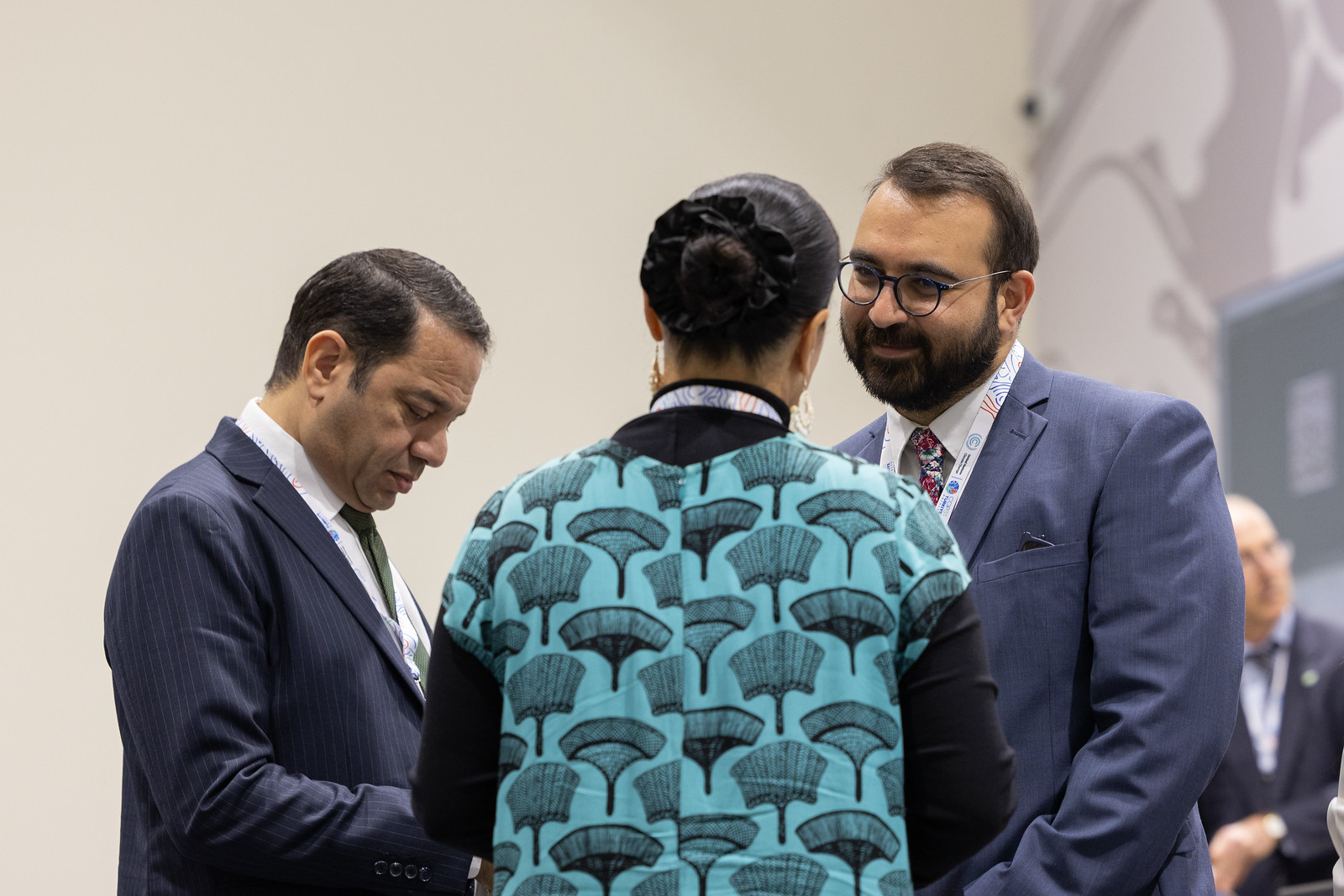
Protecting an income while learning new skills, retaining support near retirement and having a voice before a workplace changes are practical concerns behind COP31’s unfinished just-transition talks. On 18 November, African negotiators called for an outcome encompassing social protection, economic opportunities and adaptation, supported by finance and technology. The following day, the conference presidencies in Antalya, Türkiye, listed the Just Transition Work Programme among the matters still requiring agreement and announced further officials-level consultations. Those documents establish an active negotiation over support for changing livelihoods; they do not announce a completed settlement. [1][2]
The programme’s name can obscure the distinction between discussion and delivery. Established under the Paris Agreement process, it provides a forum for countries and other participants to exchange experience about transitions towards lower emissions and climate resilience. Its existing scope includes employment, social protection, adaptation and participation. At the previous annual climate conference, parties also decided to develop a separate mechanism to strengthen cooperation, technical assistance, capacity-building and knowledge-sharing. The present task concerns how that mechanism would operate alongside the dialogue programme, whose effectiveness and continuation are also under review. [3]
A secretariat synthesis published on 9 November gives a useful account of what participants want changed. It draws on 16 submissions received by 4 November, including positions from Ghana on behalf of the African Group, Tanzania, other negotiating groups and non-state contributors. Its main messages reflect views appearing in more than one submission. Most contributors valued the exchange of experience but considered that the resulting knowledge had not sufficiently entered national planning or practical guidance. This is a synthesis of submitted assessments, rather than an independent evaluation of employment outcomes. [4]
The same review records concerns about who can contribute. Some submissions described developing-country expertise as underrepresented, while proposals included financial and logistical support for community representatives and broader participation by workers, employers, Indigenous Peoples and people with disabilities. Contributors also differed over the programme’s future relationship with the proposed mechanism. These differences matter: creating another platform does not itself settle how experience reaches decisions or how countries obtain usable assistance. The review documents the design problem without demonstrating that any particular reform will resolve it. [4]
Workers’ and employers’ international organisations have made their own joint intervention. In a November statement, the International Trade Union Confederation and International Organisation of Employers call for climate strategies that connect employment, industrial policy, skills, investment and social protection. They want the negotiations to draw explicitly on the International Labour Organization’s just-transition guidelines and labour-rights framework. Their shared position is a proposal from organised labour and business, not an adopted COP31 rule or proof that individual companies and unions agree on every transition measure. [5]
The statement places training within a larger system. Governments, employers, unions and education providers would anticipate changing skill requirements together, with apprenticeships and workplace learning linked to labour-market demand. That formulation addresses both people seeking new qualifications and enterprises needing the capacity to employ them. The organisations argue that technical assistance and institutional support should connect climate commitments to implementation. They provide a negotiating position on how that connection should work; the statement does not report a new training entitlement, a funded national scheme or verified jobs created. [5]
The annual report on the programme’s 2026 dialogues helps explain why the distinction is consequential. In the September industry discussions, participants described workers’ hesitation to retrain when alternative employment was not yet available. They emphasised wages, safe conditions, collective bargaining and protection during restructuring, rather than assuming that a job in a new industry would automatically be decent work. The report records those exchanges and suggested responses. It is evidence of the issues raised in the dialogue, rather than a survey establishing their prevalence across African workplaces. [6]
Participants also discussed people whom a training programme designed around an average worker could miss. Transport, connectivity, disability and care responsibilities can affect access; older workers may need recognition of existing skills, redeployment or income security. Informal workers were discussed as people entitled to decent work, alongside the more readily mapped formal workforce. These considerations broaden the practical meaning of transition support. They also show why counts of courses or attendees alone cannot establish whether assistance reaches people with different circumstances or leads to secure employment. [6]
South African policy research gives this discussion a more specific setting. In a September brief for JUST SA, economist Simbarashe Mhaka examines support options for older coal workers. He proposes voluntary early-retirement arrangements with payments bridging the period before pension access, alongside longer-term social and adjustment services. Workers wishing to remain economically active would retain access to other transition support. These are policy recommendations informed by international experience, rather than newly enacted benefits. Their emphasis on choice is particularly relevant where support for retirement could otherwise be confused with a requirement to leave work. [7]
Mhaka’s recommendations also concern timing and design. He argues for preparation before closures and for workers and unions to help shape eligibility and compensation. The brief treats a payment as one component of support, alongside services addressing life after employment. Its contribution is to identify a package for a particular group, not to establish a universal solution for every coal worker or community. Applying such options would require decisions on financing and eligibility; the publication does not show that a COP31 decision has already paid for them. [7]
The accompanying working paper makes its scope explicit. Mhaka reviews government documents, international cases and the International Energy Agency’s policy database to consider instruments relevant to South Africa. It concentrates on assistance enabling workers to adjust, while leaving evaluation of policies generating labour demand outside its scope. That boundary is important when reading its recommendations: training, employment services and compensation describe support instruments, but this review alone cannot establish how many suitable vacancies will emerge. South African research is contributing policy knowledge to the transition debate, with identifiable limits to what its evidence answers. [8]
The African Group’s current position extends beyond coal employment. Its 18 November statement calls for pathways reflecting countries’ different development priorities and capacities, with adaptation, social protection and economic opportunity considered together. Finance, technology transfer and capacity-building are presented as enabling conditions. That wider scope is compatible with treating workers’ needs concretely without making one country’s coal economy a model for an entire continent. The Group is articulating negotiating priorities; its statement does not establish agreement by other parties or a transfer of resources to affected communities. [1]
The immediate documentary test remains the outcome of the unfinished talks. The 19 November work update envisaged further consultations and draft texts to find agreement, while the existing programme describes cooperation and knowledge-sharing rather than an automatic benefit paid to workers. A negotiated mechanism’s design, any subsequent financing and the assistance actually received are therefore separate stages. For now, the record shows proposals for making transition support more practical and inclusive, with delivery still to be established. [2][3]
- [1]African Group of Negotiators on Climate Change. Africa pushes for substantive outcomes on climate finance, just transition and adaptation as COP31 negotiations intensify2026-11-18
- [2]COP31 Presidency and Presidency of Negotiations. Thursday Update on Organization of Work: Revised2026-11-19
- [3]UNFCCC. United Arab Emirates Just Transition Work ProgrammeUndated; accessed 2026-11-20
- [4]
- [5]International Organisation of Employers and International Trade Union Confederation. COP31 Joint StatementNovember 2026; exact day not stated
- [6]UNFCCC subsidiary body Chairs. Dialogues under the United Arab Emirates just transition work programme: annual summary report — FCCC/SB/2026/72026-11-08; dialogues April and September 2026
- [7]Simbarashe Mhaka / Trade & Industrial Policy Strategies, JUST SA. Ensuring a Just Transition: Rethinking retirement and support mechanisms for South Africa’s older coal workersSeptember 2026
- [8]Simbarashe Mhaka / Trade & Industrial Policy Strategies, JUST SA. Building a Just Future: Policy Solutions for South Africa’s Coal Workforce Transition — Insights from Global ExperienceSeptember 2026
Did this publication help you understand the topic?
0 voluntary responses. Browser-based participation; responses are not a representative survey.
We welcome suggestions, contributions and recommendations.
Editorial standards ↗