Kenya’s Ebola response is concentrating on a known cluster while sustaining surveillance at borders and in health services. In its 23 October bulletin, the World Health Organization reported nine confirmed Bundibugyo virus disease cases, including one death, in Kenya as of 20 October. All eight additional cases were linked to the initial imported case, with no evidence of transmission outside that cluster at the reporting cut-off. The finding places public-health capacity at the centre of the response: identifying contacts, making care accessible and maintaining the institutions able to detect a change in the situation. [1]
WHO reported that all 135 identified contacts had been traced and quarantined by 20 October. It also recorded 709,093 travellers screened and 461 samples tested across five laboratories by 22 October. These figures describe different activities, not interchangeable measures of safety: screening concerns travellers, laboratory testing concerns samples, and follow-up concerns identified contacts. WHO advised against restrictions on travel or trade with affected countries. Its bulletin therefore combines cross-border vigilance with a position against general restrictions, while the response remains directed at a documented chain of exposure. [1]
The Kenyan Ministry of Health and national public-health institutions lead the response, supported by African and international partners. Africa CDC’s 17 October statement identified surveillance, technical coordination, risk communication and community engagement as areas of support. It placed Kenya’s work within regional preparedness and information sharing. This arrangement gives national authorities responsibility for the response inside the country while connecting their decisions with institutions working across borders. The division of work matters because a traveller’s route, a laboratory result and a contact investigation can involve several administrations. [2]
Africa CDC also drew attention to the protection of health workers. Its 17 October statement described cases among workers who had cared for the first patient and stressed protective equipment, training and infection prevention. These are workplace conditions as well as outbreak-control measures. Frontline staff carry responsibilities that depend on resources being available where care is delivered. The regional organisation’s intervention identifies protection of personnel as a public responsibility within the nationally led response, alongside the detection and care of people who become ill. [2]
An earlier material contribution was documented on 12 October. WHO reported handing over medical supplies worth about US$70,000 to support Kenya’s response. The consignment included protective clothing, testing materials, biohazard containers and infection-prevention supplies, with distribution to facilities and teams assigned to the Ministry of Health. This records a handover and a stated distribution responsibility. The supplies were mobilised through the regional emergency-preparedness and response hub in Nairobi, showing how an existing regional facility can support a national response when an emergency creates additional demand. [3]
WHO’s account also identified five laboratories designated for testing, including mobile laboratories at the Busia and Bungoma borders. The location of capacity is part of the political organisation of protection: national coordination has to reach the points at which travellers, health workers and communities encounter the response. The 12 October account described training, laboratory coordination and community communication alongside equipment. These activities locate preparedness within institutions and people who must remain able to work together, with the national ministry retaining responsibility for directing the response. [3]
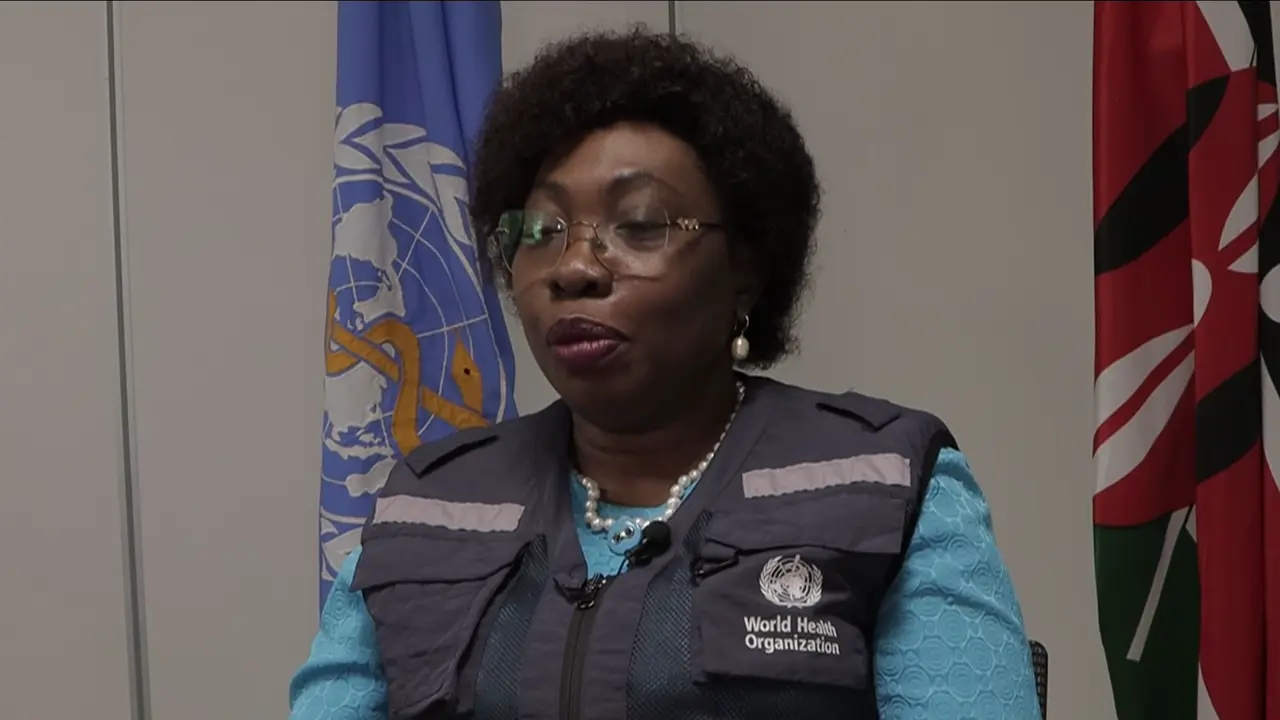
The accompanying image shows WHO representative Neema Rusibamayila Kimambo in Nairobi on 15 October, during an interview released by UNifeed on 23 October. Speaking at that earlier stage of the response, she described daily monitoring of contacts and the deployment of technical expertise to support the ministry. Her account identified surveillance, contact tracing and risk classification as connected tasks. The interview’s case references belong to 15 October; the more recent totals reported above come from WHO’s later bulletin and retain their own data cut-off. [4]
Kimambo also described the deployment of a senior incident manager to work with government counterparts and training for health workers and entry-point teams. Her account places international assistance within a national institutional process. Partners can supply expertise and support training while public authorities remain responsible for organising the response. This is a practical relationship between resources, professional knowledge and decision-making. Its significance lies in whether the supported institutions can detect cases, coordinate care and communicate with the people asked to cooperate with public-health measures. [4]
WHO’s 16 October account described how the second and third cases were identified among people already in quarantine. It explained that health teams were monitoring listed contacts daily and supporting care in designated units. This earlier account documents part of the route through which the later cluster was being followed. It also gives quarantine a specific administrative meaning: identified people are monitored after an exposure, with health teams responsible for recognising illness and arranging the next stage of care. The public task continues throughout that period of monitoring. [5]
The same account emphasised the role of early identification and communication about the response. People asked to cooperate with monitoring need to understand what it involves and which institution is responsible. WHO’s account links community protection with the work of health teams and designated facilities. This relationship depends on confidence as well as instructions: people encounter the response through explanations, follow-up and access to services. Those are concrete parts of the public provision required to sustain cooperation, rather than an assumption that an official announcement is sufficient on its own. [5]
The International Health Regulations place rights within the management of cross-border health risks. Article 3 requires respect for dignity, human rights and fundamental freedoms. Article 32 addresses the treatment of travellers, including appropriate assistance for those quarantined or isolated under the regulations: food, water, accommodation, medical care and communication, taking account of social and cultural concerns. These provisions connect the authority to apply health measures with responsibilities towards the people affected. WHO’s consolidated text records the 2024 amendments as in force for Kenya from 19 September 2025. [6]
Article 43 also requires additional measures to be grounded in scientific principles and available evidence, with restrictions limited in relation to reasonably available alternatives that achieve the appropriate protection. The framework gives public-health authority a defined purpose and conditions for its exercise. In Kenya’s response, the continuing public interest concerns capable services, protection of workers, communication with communities and proportionate action across borders. Maintaining those responsibilities together makes health protection part of an accountable relationship between institutions and the people whose movement and daily lives their decisions affect. [6]
- [1]World Health Organization. Ebola disease caused by Bundibugyo virus — Democratic Republic of the Congo, Kenya and Nigeria23 October 2026; Kenya case data to 20 October
- [2]Africa Centres for Disease Control and Prevention. Africa CDC Reaffirms Support to Kenya Following Confirmation of Four Additional Ebola Cases17 October 2026
- [3]WHO Regional Office for Africa. WHO supports Kenya’s Ebola response with essential medical supplies12 October 2026
- [4]United Nations / UNifeed Nairobi. Nairobi / WHO Ebola updateReleased 23 October 2026; interview filmed 15 October
- [5]WHO Regional Office for Africa. WHO supports Kenya’s Ebola response as third case is found early in quarantine16 October 2026
- [6]World Health Organization. International Health Regulations (2005), as amended in 2014, 2022 and 2024 — articles 3, 32, 43 and Appendix 1Consolidated edition updated 19 June 2026
Did this publication help you understand the topic?
0 voluntary responses. Browser-based participation; responses are not a representative survey.
We welcome suggestions, contributions and recommendations.
Editorial standards ↗