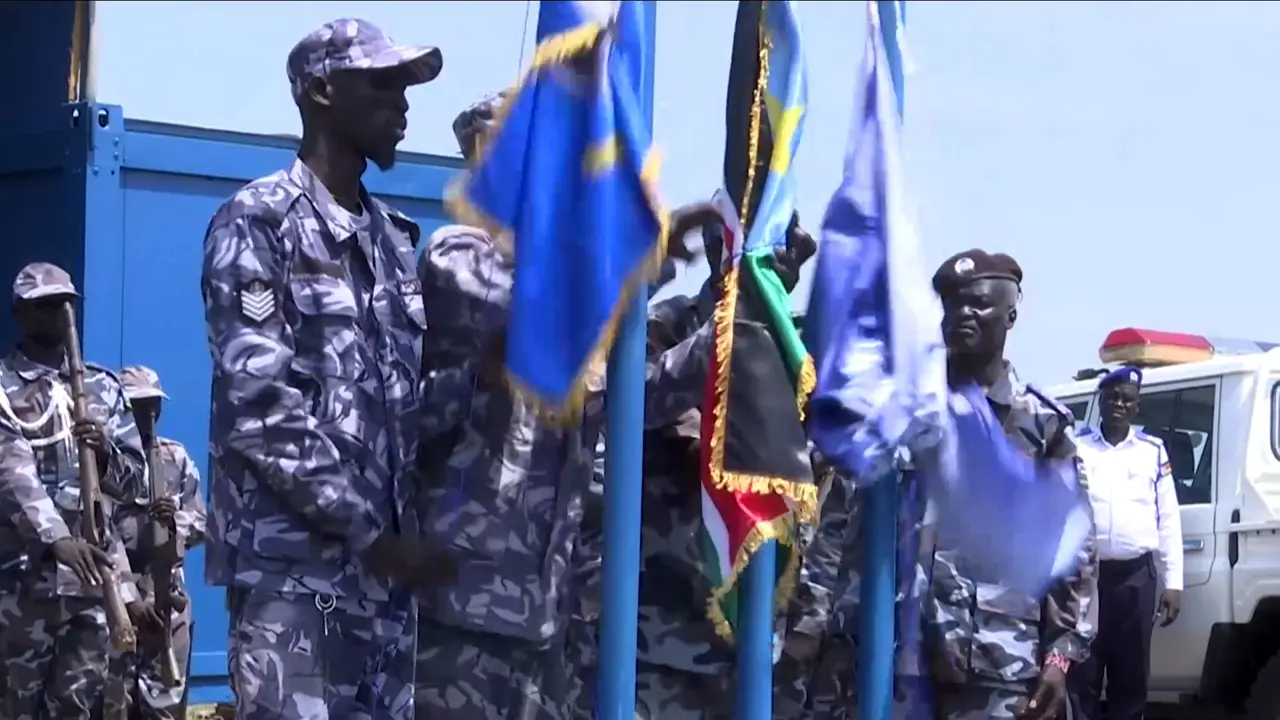
A new police station was handed to Upper Nile’s state authorities in Malakal on 21 October, placing the everyday protection of residents at the centre of a visit by Anita Kiki Gbeho, head of the United Nations Mission in South Sudan. UNMISS footage released on 24 October records the visit of 21–22 October, including the inauguration and meetings with state officials. The handover adds a public security facility in a city where displaced families are rebuilding their lives. Its operation will fall within South Sudan’s institutions and their responsibilities to the people they serve. [1][2]
South Sudan’s public broadcaster identifies the facility as Al-Wakat Police Station and reports that UNMISS constructed it. Caretaker Governor James Koang Chuol welcomed the support, while the state’s senior police representative pledged protection of lives and property. These are commitments by the authorities receiving the facility. The broadcaster’s account records a completed construction and handover, without giving a construction cost, a staffing allocation or operating expenditure. Responsibility now extends to the recurring work of policing: receiving complaints, protecting people and maintaining a service residents can reach. [2]
The constitutional foundation of that responsibility dates to independence. Article 155 of the 2011 Transitional Constitution defines the police as a decentralised professional service organised nationally and at state level. Its assigned functions include crime prevention and investigation, public order and protection of people and property. The same article requires respect for civilian authority, democracy, human rights and judicial orders. A local station therefore sits within a national and state chain of public responsibility, with professional standards, deployment and training assigned to the national service. [3]
Public scrutiny also has constitutional foundations. Article 24 protects expression and the media, while Article 32 establishes access to official information, subject to the qualifications in that provision. Article 146 assigns the Human Rights Commission functions that include investigating complaints and visiting police detention facilities. These provisions identify the relationship between security powers and institutions able to examine their exercise. They give the Malakal handover a significance that reaches from the presence of officers to the ability of residents and journalists to raise concerns about how public authority is used. [3]
A local civil-society initiative had addressed that relationship earlier this month. The National Press Club–South Sudan reports that its Malakal workshop on 7–8 October brought together 30 security personnel, two information-ministry representatives and eight journalists. Participants came from police departments, the National Security Service and the armed forces. Sessions concerned expression, access to information, media laws, communication during tense situations and journalists’ safety at public-order events. This brought people who report on security and people who exercise security powers into a common discussion about their responsibilities. [4]
The press club’s account, published on 12 October, describes support from JICA and a connection to UNESCO-led training in Juba in June. It records participants’ favourable assessments and requests for further training. Those statements establish what participants said about the encounter; they provide no measured evidence of subsequent changes in police conduct or journalists’ freedom to work. The concrete contribution documented here is a local channel for discussing information and security, alongside the new physical facility. Journalists’ access to official information remains relevant to public knowledge of how such services function. [4]
Gbeho’s visit also included Hai Matar, a settlement where people have moved from the former protection-of-civilians site. UNMISS’s video account places the settlement’s population at around 130 households and describes a process beginning in 2024. Its presentation emphasises families’ rebuilding efforts and cooperation with authorities and international partners. That figure concerns this settlement, rather than all displaced people in Malakal or Upper Nile. The account joins two practical aspects of recovery: a place in which households can establish themselves and a public security institution responsible for protection. [1]
People who resettle retain rights that extend through that process. The UN’s 1998 Guiding Principles on Internal Displacement place primary responsibility on competent authorities to establish conditions for voluntary return or settlement elsewhere in safety and dignity. Principle 28 calls for displaced people’s participation in planning and managing the process. Principle 29 addresses equal participation in public affairs and access to public services after return or resettlement. These principles frame settlement as a relationship involving residents’ choices, public provision and the obligations of authorities. [5]
The principles also recognise practical barriers to exercising rights. Principle 20 calls for necessary personal documents to be issued or replaced without unreasonable conditions, including a requirement to return to a former home to obtain them. Principle 18 addresses safe access to essential food, water, shelter, healthcare and sanitation. For households establishing themselves in a different neighbourhood, documentation and services help make residence workable. The principles are an international protection framework; this week’s handover does not establish that all those conditions have been secured for Hai Matar’s residents. [5]
The IASC’s 2010 framework develops the meaning of a durable solution: people should be able to exercise rights without discrimination related to their displacement, with displacement-specific protection and assistance needs addressed. Its criteria include long-term safety, access to livelihoods and basic services, housing and property remedies, documentation and participation in public affairs. The framework gives national authorities the primary role, supported by humanitarian and development actors. It treats recovery as a process requiring cooperation across those responsibilities, including the interests of communities receiving displaced families. [6]
Applied to the public decisions now visible in Malakal, that framework connects security infrastructure with the wider conditions of settlement. A household’s ability to obtain documents, earn a living, use services and participate in local affairs affects whether rebuilding can endure. The police station’s handover is a concrete institutional step within this wider process. The public significance lies in how the receiving authorities sustain protection and how residents take part in the decisions affecting their lives, under standards that recognise them as people with rights throughout recovery. [6]
- [1]UNMISS / United Nations UNifeed. South Sudan / Malakal SRSG Gbeho visit24 October 2026; footage 21–22 October 2026
- [2]South Sudan Broadcasting Corporation. Upper Nile Governor Commends UNMISS for Supporting Security21 October 2026
- [3]Republic of South Sudan; original constitutional text hosted by ConstitutionNet. The Transitional Constitution of the Republic of South Sudan, 2011, Articles 24, 32, 146 and 1552011 text; accessed 25 October 2026
- [4]National Press Club–South Sudan. NPC–SS Strengthens Media–Security Relations in Malakal12 October 2026; workshop 7–8 October 2026
- [5]United Nations; text reproduced in the University of Minnesota Human Rights Library. Guiding Principles on Internal Displacement, Principles 18, 20, 28–301998 principles; accessed 25 October 2026
- [6]Inter-Agency Standing Committee / Brookings–Bern Project on Internal Displacement. IASC Framework on Durable Solutions for Internally Displaced PersonsApril 2010; endorsed December 2009
Did this publication help you understand the topic?
0 voluntary responses. Browser-based participation; responses are not a representative survey.
We welcome suggestions, contributions and recommendations.
Editorial standards ↗