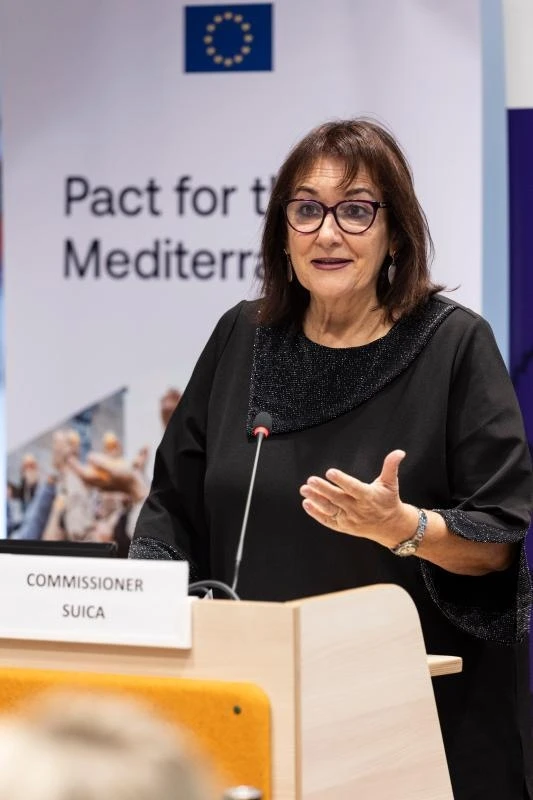
On 10 November, the European Commission and European External Action Service presented an updated Mediterranean action plan to representatives of EU member states and southern Mediterranean partners in Brussels. Its energy section lists the regional investment platform as established and sets out the work still to be done on financing, technical assistance and regulation. Egypt’s electricity grid is an early example of what those commitments look like in practice. The European Investment Bank (EIB) records a signed €600 million loan for the grid, while the November plan still describes the region-wide €25 billion figure as an investment target for 2035. [1] [2] [4]
The plan adds nine initiatives to the broader pact, taking the total to 30. The renewable energy and clean technology initiative, known as T-MED, predates this update: the Commission launched it in June and announced its investment platform on 26 October. The platform brings potential projects together with lenders and investors. It is intended to cover renewable generation, transmission, storage, interconnection and manufacturing, as well as regulatory support. The November document identifies a technical support facility and a study on commercial electricity interconnectors as later steps, with indicative dates in late 2026 and early 2027 respectively. [1] [2] [3]
When the platform opened in October, the Commission described up to €4.5 billion in EU guarantee capacity. The November plan puts total capacity at approximately €5 billion, including top-ups, and lists blended finance separately. The two documents use different descriptions of the available capacity; the later figure is presented as a total that includes top-ups. A guarantee backs specified risks for qualifying finance. It is neither a payment of that amount to partner governments nor a measure of renewable electricity installed. The €25 billion ambition combines anticipated contributions from sources including banks and the private sector. The records do not establish that this capital has been secured for particular projects. [2] [3]
The Egyptian programme has its own financing record. The package presented on 15 June combined a €600 million EIB loan and up to €90 million in Commission grants. The bank’s project register separately shows that €600 million was signed on 24 June and gives an approximate total project cost of €1.567 billion. The Commission said the state-owned Egyptian Electricity Transmission Company would provide the remaining financing and lead implementation, with the Egyptian government acting as borrower through the Central Bank of Egypt. These are different roles: the borrower takes on the loan, the transmission company implements the work, and the Commission’s grant ceiling describes a separate contribution. The signature alone does not establish a disbursement or a construction milestone. [2] [4] [5]
The work concerns the network that carries electricity from where it is generated to where it is used. New substations and transmission lines are intended to bring more renewable generation into Egypt’s national system, including wind and solar power from the Red Sea and Gulf of Suez areas. The EIB describes the project as a second phase of a wider Egyptian programme designed to accommodate the government’s 22-gigawatt renewable capacity ambition by 2030. That figure is a goal for the wider network. The loan does not represent the purchase of 22 gigawatts of generation, and the official programme anticipates work on the EIB-supported phase from 2027 to 2030. [4] [5] [6]
The network also makes energy policy a local question. Where a substation sits and how a transmission line is routed matter to the people using the affected land. The EIB describes the operation as a framework loan, under which individual investments are selected and appraised within a wider programme. Its environmental and social assessment sets out requirements for screening those investments and addressing their effects. The programme-level document therefore establishes how risks should be examined; site-specific records are needed to establish which land and communities are affected, what consultation has taken place and what measures were agreed. [4] [6]
The bank’s assessment puts some of that work before the first disbursement. It calls for the transmission company to finalise frameworks on environmental and social management, resettlement and stakeholder engagement. It also says the bank will check that information has been disclosed and that people affected by individual investments have been consulted. For residents, those provisions matter when the route is still open to change. An agreed framework and a site-level consultation are separate steps. [4] [6]
The regional plan also lists the proposed Greece–Egypt electricity interconnector among related actions. It is a separate project from the Egyptian domestic grid loan. Its promoter, Elica, describes a route for transmitting electricity generated from renewable sources in Egypt to Greece and onwards. That commercial proposal shows how the regional agenda extends beyond strengthening a domestic grid. The November plan lists cross-border infrastructure and regulation as workstreams, but its inclusion of an interconnector does not establish that the cable is operating, that electricity has been sold or that the domestic grid package finances it. [2] [4] [7]
There are two practical ways to follow the November update. At regional level, published guarantee agreements and project lists can show which investments the platform actually backs. In Egypt, the useful records are the individual projects selected under the framework loan, their tenders and environmental assessments, and evidence that completed works are carrying power. The pact provides a place to track proposals across countries and sectors. The bank’s signed loan provides a firmer reference point for one national programme. Whether it improves the reliability of electricity for households and businesses will depend on where the work is done and how the network performs once it is in service. [1] [2] [4] [6]
- [1]European Commission, Directorate-General for the Middle East, North Africa and the Gulf. Updated Action Plan brings a total of 30 actions in one year under the Pact for the Mediterranean10 November 2026
- [2]European Commission, Directorate-General for the Middle East, North Africa and the Gulf. Pact for the Mediterranean: Action Plan – Autumn 202610 November 2026
- [3]European Commission, Directorate-General for the Middle East, North Africa and the Gulf. Commission launches T-MED Investment Platform with up to €4.5 billion in EU guarantees26 October 2026
- [4]European Investment Bank. Egypt Grid Modernization and Expansion, project 202502651 July 2026 project summary; signature recorded 24 June 2026
- [5]European Commission, Directorate-General for the Middle East, North Africa and the Gulf. Egypt and EU join forces on €690 million clean-energy grid investment15 June 2026
- [6]European Investment Bank. Egypt Grid Modernization and Expansion: Environmental and Social Data Sheet19 November 2025 document; published 6 August 2026
- [7]Elica Interconnector. GREGY Interconnector: Electrical Interconnection of the Greek & Egyptian Power SystemsUndated; accessed 11 November 2026
Did this publication help you understand the topic?
0 voluntary responses. Browser-based participation; responses are not a representative survey.
We welcome suggestions, contributions and recommendations.
Editorial standards ↗