A carved mask has a different presence when a person puts it on, moves with it and joins musicians and spectators. That relationship is the starting point of When Masks Dance, an exhibition scheduled to open at Belgrade’s Museum of African Art on 19 November 2026. Curated by Aleksandra Gačić, it places objects from the museum’s collections alongside recordings and accounts of masquerade in Burkina Faso. The question is how masks work through bodies, materials and the knowledge of their makers and users. The opening is scheduled for 6 p.m. local time. [1]
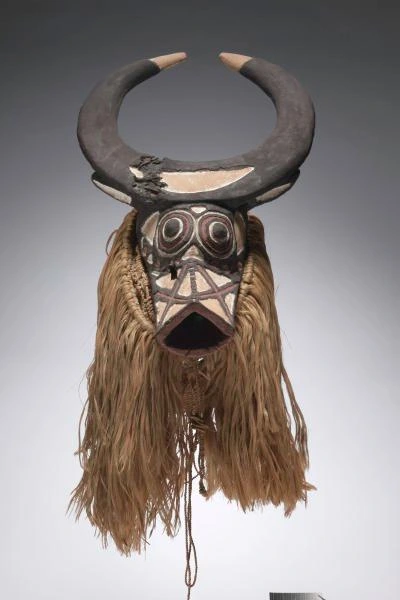
One historical object makes the connection between sculpture and use tangible. The Cleveland Museum of Art’s Buffalo Mask, dated to the early to mid-1900s, combines wood, plant fibres, paint and iron. Its horns rise above a long muzzle; fibres hang below the face. The museum identifies a repaired right horn, interpreting the repair as evidence that the object was valued. Its attribution remains qualified: Burkina Faso, possibly a Bwa-style maker. That uncertainty belongs beside the object, rather than disappearing when its photograph travels. The image accompanying this essay shows this Cleveland object, not an installation in Belgrade. Its exact making date and the name of its maker are unknown. [2]
Repair is an especially useful place to begin looking. It draws attention to an object’s duration and material vulnerability, rather than only to the moment when it was carved. A preserved mask offers evidence of work on wood, surfaces and attachments, but a still photograph cannot establish the sequence of every intervention. Nor does it reproduce the experience of carrying or wearing the object. Seeing a face and horns is one encounter; understanding how the thing could be held, moved and maintained is another. The distinction makes the museum object a starting point for inquiry rather than a complete record of the performance from which it has become separated. [2][3]
A Bwa plank mask described in Penn State’s African Brilliance catalogue reveals a specific way of joining face and sculpture. The catalogue explains that a fibre hood covers the head and that the performer holds a thick rope between the teeth to secure the mask. The opening of the mouth provides a line of sight. These details turn an apparently flat composition into equipment for a moving person. The catalogue situates such masks in initiations, memorial events, renewal ceremonies and market-day performances. Those occasions differ in purpose and audience; the existence of a shared object type does not make them interchangeable. [3]
Another entry in the same catalogue concerns a Nuna koan mask representing a female koba antelope. It describes a performer using two sticks as forelegs and looking through the animal’s mouth. The movement helps make the animal form legible. The entry also records the circulation of masks between neighbouring peoples, including purchases from Nuna makers by Bwa users. Similar circles, colours or shapes therefore do not identify a single homogeneous culture. Making, acquiring and performing a mask can involve different relationships. The catalogue’s account is a documented interpretation of a particular type, not a rule for every community in Burkina Faso, and certainly not for every mask on the African continent. [4]
These two descriptions also change what a viewer can reasonably ask of the carved surface. A mouth opening may serve vision as well as representation; an attachment can matter as much as an outline. Comparing the entries is consequently more informative than treating visual resemblance as a finished explanation. It allows form to be examined together with the practices that make it usable. At the same time, the comparison should preserve the names Bwa and Nuna and the differences between the documented performances. Exchange does not erase those distinctions. It provides a reason to investigate them more carefully. [3][4]
The colours themselves are evidence of skilled material work. In November 2023, Clara Granzotto and Ken Sutherland published an analysis of paint on four Bwa masks in Chicago. They used microscopic samples, infrared spectroscopy, electron microscopy and mass spectrometry, including analysis of proteins. These methods distinguish chemical constituents and, in some cases, biological sources. Their interpretation also drew on published field accounts and exchanges with Abdoulaye Ouédraogo, an artist from Boni. His experience was part of the knowledge needed to interpret the samples, rather than an ornamental addition to a laboratory result. [5]
The study found plant-derived materials, minerals and animal products in the paints, and evidence consistent with different painting campaigns. No modern enamel was identified in the four objects examined. That finding is bounded by the sample: it cannot establish what all Bwa makers used, either historically or today. The paper’s published account by Ouédraogo describes choices and substitutions in materials, helping explain why a familiar colour need not always have the same composition. Analysis can identify what survives on a sampled surface. It cannot, by itself, recover the complete meaning of a ceremony or the circumstances of each repainting. [5]
A museum can also make bodily questions accessible without pretending to recreate a ceremony. An Art Institute of Chicago activity sheet introduces a Bwa butterfly-shaped plank mask from Dossi, dated to the early or middle twentieth century. It asks visitors to think about balance in relation to an object more than seven feet wide. This is an educational exercise, not a substitute for the community’s own interpretation. Its value is more modest and concrete: it makes scale a practical problem. The mask has dimensions that a wearer must negotiate. Reading the measurements alongside an invitation to consider balance gives a viewer something that a small reproduction on a screen can easily conceal. [6]
What museums collected is itself part of the evidence. The University of Iowa’s Stanley Museum describes the core of its African collection as predominantly wooden masks and figures representing a canon sought by European and American collectors through much of the twentieth century. It explains how Christopher Roy advised the collectors and used the holdings for teaching. That institutional account identifies a specific filter through which African arts became visible: the preferences of collecting and the organisation of art-history instruction. It does not make the objects uninformative. It does mean that a strong collection of carved wood should not be mistaken for an exhaustive account of the arts people produced or the forms through which they performed them. [7]
Iowa’s account also describes later growth into textiles, pottery, dress and contemporary work by African and diaspora artists. The collection has changed as its questions and acquisitions have changed. That is a useful counterpoint to the impression that a museum can preserve a culture once and for all through a fixed set of representative things. A collection can support comparison and close study while remaining selective. Reading the museum’s own description makes that selectivity visible, without assuming that every selection has the same history or that all museums have followed an identical course. [7]
Even a short object record can make a consequential distinction. The Metropolitan Museum of Art lists a Bwa Plank Mask from Burkina Faso’s Black Volta River region as wood and pigment, dates it broadly to the nineteenth–twentieth century and identifies the maker as a Bwa blacksmith. Its accession record gives a 1991 gift date. The gift date is not the date of production, just as a photograph’s date is not necessarily the age of the object photographed. These separate chronologies matter when historical artworks circulate online. The record preserves a broad period and an occupational attribution; it does not supply an individual name or a precise year that a writer is entitled to invent. [8]
The story also continues in Burkina Faso. The Agence d’Information du Burkina reported the opening of FESTIMA’s seventeenth edition in Dédougou on 14 May 2026, marking thirty years of the festival. Its account names performances from Zéoulé, Paradé, Mamou and Dédougou, and describes leaf, fibre and cloth masquerades as well as an arts market and a scholarly colloquium. ASAMA’s executive secretary, Léonce Ki, presented the anniversary as an occasion to reflect on preservation and future practice. These were the organisers’ purposes and the reporter’s account of the event, not measurements of long-term social effects. They nevertheless locate the work of presenting and discussing masks within Burkina Faso itself. [9]
A festival is a particular setting, with an announced programme, invited participants and spectators. Its performances provide evidence of public cultural activity at a dated event; they need not stand in for every ritual context in which a mask appears. Keeping that distinction makes it possible to recognise contemporary presentation without deciding that either the festival or the village ceremony is the sole authentic form. The AIB report’s named places are valuable precisely because they allow the account to remain specific. The event happened in May; it should not be presented as newly taking place in November. [9]
For the Belgrade exhibition, the museum names three contributors from Burkina Faso: Léonce Ki on FESTIMA, curator Mickaël Boundjoa Lompo on the National Museum, and choreographer Aguibou Bougobali Sanou on changes from ritual performance to the contemporary stage. Its programme also brings historical recordings together with contemporary festival footage. These are different perspectives and kinds of documentation. Their combination can help audiences follow change rather than imagine that a carved object has one meaning outside time. The announced exhibition runs until the end of February 2027; its programme offers a documented proposal for bringing those perspectives together. [1]
Taken together, the sources suggest a way to look more closely without demanding that any one kind of evidence answer every question. The buffalo mask retains material traces; descriptions of wearing and movement explain practical arrangements; chemical analysis examines selected surfaces; festival reporting locates contemporary participants. None removes the need for the others. A photographed object can be carefully described while its attribution remains uncertain, and a laboratory finding can be precise while its scope remains small. This is what the historical comparison adds to the current exhibition’s question: a mask’s life is neither exhausted by its appearance nor made unknowable by its separation from a performance. It becomes more intelligible when the surviving object is read alongside the skills, interpretations and changing settings that make it work. [2][3][5][9]
- [1]Museum of African Art, Belgrade. When Masks Dance: Objects from the MAU Collection in Light of the Living Heritage of Burkina FasoUndated announcement; opening scheduled 2026-11-19; accessed 2026-11-19
- [2]Cleveland Museum of Art. Buffalo Mask, accession 1969.2Object: early to mid-1900s; record undated, accessed 2026-11-19
- [3]Penn State University, African Brilliance. Catalogue 16: Plank Mask, nwantantay2020 catalogue; accessed 2026-11-19
- [4]Penn State University, African Brilliance. Catalogue 12: Mask, koan2020 catalogue; accessed 2026-11-19
- [5]Clara Granzotto and Ken Sutherland; Applied Sciences. Black, Red and White: Characterization of Painting Materials on a Group of Bwa Masks from Burkina Faso2023-11-11; artist exchanges April–September 2023
- [6]Art Institute of Chicago. Your Art Journey: Extreme and Extraordinary — Plank Mask activityUndated teaching resource; accessed 2026-11-19
- [7]Stanley Museum of Art, University of Iowa. African Art: collection historyUndated institutional account; accessed 2026-11-19
- [8]Metropolitan Museum of Art. Plank Mask, Bwa blacksmith, accession 1991.92Object: 19th–20th century; record undated, accessed 2026-11-19
- [9]Agence d’Information du Burkina. Mouhoun/FESTIMA: Dédougou célèbre 30 ans de sauvegarde et de rayonnement de la tradition du masque2026-05-18 publication; 2026-05-14 opening described
Did this publication help you understand the topic?
0 voluntary responses. Browser-based participation; responses are not a representative survey.
We welcome suggestions, contributions and recommendations.
Editorial standards ↗