A new set of population projections puts African religious lives near the centre of a changing global religious landscape. Published on 18 November 2026, Pew Research Center’s study projects religious populations from a 2020 baseline to 2070. Uganda is one of the countries included. Reading its figures requires attention to religious categories and practices as well as to the demographic model. The sources behind those categories reveal decisions about whom to ask, what to record and how to model change. [1]
The study’s global scope is substantial: it covers 201 countries and territories and seven broad religious groups. It combines information about age, fertility, mortality, migration and changes of affiliation. Its headline results are conditional on those inputs and assumptions. They do not describe a future already observed. A projected population can grow even when its share of a larger population falls; neither measure, on its own, describes the intensity of belief or the character of worship. Those distinctions become concrete when the regional figures are placed alongside the Ugandan documents and field research. [1]
In the sub-Saharan African chapter, Pew projects growth in both Christian and Muslim populations, mainly because births are expected to exceed deaths. It also projects growth in the number of people without religious affiliation. The chapter distinguishes this natural increase from migration and switching between religious groups. That is a demographic explanation of a modelled change, rather than evidence that one community’s doctrine alone determines its growth. The report places African traditional religions and several other groups together in an umbrella category, whose aggregate size says little about the particular histories within it. [3]
The underlying mechanism is a multistate version of the cohort-component method. A population divided by age and sex is carried forward, with births, deaths, migration and changes between religious categories affecting successive groups. Pew developed the calculations with the Center for Advanced Studies of Population and Religion. Its main scenario assumes that fertility differences between religious groups within each country gradually narrow towards 2100, while recent migration and switching rates continue. Country mortality rates are applied across religious groups. These assumptions make calculation possible; they also define the circumstances under which the resulting trajectories are informative. [2]
For Uganda, the treatment of switching deserves particular care. Pew’s methodology says that available switching evidence did not align with other survey or census trends, so its projection assumes no switching there. It takes the same approach in DR Congo and Mozambique. This is a stated modelling decision in response to evidence judged unsuitable for that purpose. It is not an observation that nobody changes religion. A reader who interpreted the model’s retention assumption as a fact about every Ugandan life would be asking the calculation to establish something it does not measure. [2]
Uganda’s census offers another kind of evidence. The Uganda Bureau of Statistics conducted the 2024 enumeration from 10 to 26 May, referring to the night of 9 May. Its December final report describes a digital operation involving local teams, UBOS staff and academic support, with the household questionnaire translated into 20 local languages. These are the people and practical arrangements through which national statistics were produced. The religious table is an observation tied to that exercise, rather than a new survey conducted when Pew published its projections in November 2026. [4]
The census table also separates ‘no religion’ from ‘unclassified’. Its footnote explains that religion was not collected for the non-household population, which appears in the latter category. Treating those people as unaffiliated would change the meaning of the record. Another footnote names Owobusobozi alongside Baha’i, Hindu and Buddhist affiliations within ‘other religions’. Such a heading allows a compact national table, but it combines traditions and movements whose practices require further sources to explain. It is an organising device for statistics, rather than a complete description of what its members share. [4]
One source identified in Pew’s Uganda documentation is the 2016 Demographic and Health Survey. [11] Implemented by UBOS with ICF’s technical assistance, it used a household sample based on the 2014 census frame. Women aged 15–49 were eligible for individual interviews, while men aged 15–54 were interviewed in a subsample. Institutional living arrangements were excluded. The final report dates fieldwork to 20 June–16 December 2016. Its religion figures therefore belong to a defined survey population and period; they cannot be silently substituted for a later all-age census. [5]
The DHS questionnaire asks about present religion. It provides a longer set of coding options than the broad groupings displayed in its background table, including several Christian denominations and smaller religious groups. The published comparison of women and men uses the 15–49 age range and survey weights. This matters because a weighted estimate represents the survey population, while an unweighted count records interviews. Neither a difference between two surveys nor a larger number in a later census is, by itself, a count of conversions: births, deaths, coverage and classification may also differ. [5]
Afrobarometer’s Uganda questionnaire makes another recording practice visible. Its linked 2024 instrument asks respondents to name their religion, if any, and tells interviewers to code the answer without reading out the options. It distinguishes broad identities from denominations, and lists no religion, agnostic and atheist as separate responses. The English instrument also contains country-specific placeholders. It is evidence about the intended question and coding structure, which must be read alongside the completed survey documentation. A questionnaire’s list of possible answers cannot reveal how many respondents selected each one. [6]
Within this instrument, atheism is glossed as not believing in God, while agnosticism concerns not knowing whether there is a God. No religion is another coding option. Collapsing those responses into a single account of conviction would discard a distinction the question preserves. Conversely, keeping a denomination in a table does not tell us how often someone attends services or what they think a ritual means. Affiliation and belief can be related without being the same measurement. [6]
That completed documentation identifies a locally organised research process. Hatchile Consult’s summary reports interviews with 2,400 adult Ugandan citizens between 16 January and 1 February 2024, with technical support from the University of Nairobi’s Institute for Development Studies. Its sample universe excludes institutions, and its national margin of error is reported as plus or minus two percentage points at 95% confidence. This is not automatically the precision of every small religious subgroup. Nor is an adult-citizen sample the same population as a census covering children and other residents. [7]
Evidence about changing affiliation requires a different question. Pew’s April 2010 report reproduces an earlier survey asking both present religion and the religion in which a person was raised. The Uganda interviews took place on 4–12 February 2009 among adults. When a respondent named more than one group, interviewers were instructed to record the one with which the person identified most. The comparison can describe a reported difference between childhood and current identity at the time of interview. It does not recover every intermediate change, or the full range of practices that someone might combine. [8]
The same report documents additional sampling of Muslims in Uganda. Its total sample combined a national component with an oversample, and the reported margins of error differed between the full sample and religious subgroups. Those details are part of the evidence, rather than decoration. They explain why a survey result needs its own date, population and uncertainty. An estimate based on recollections collected in 2009 should not become a timeless conversion rate, especially when a later projection explicitly reassesses whether the available evidence is suitable for modelling future change. [8]
Religious-studies research clarifies what broad categories can leave undescribed. In a 2018 article, Asonzeh Ukah examines the Faith of Unity through fieldwork undertaken in 2016 and 2017 in Kampala and western Uganda. He draws on observation, interviews and the movement’s written materials. His account treats the movement’s participants as people making a religious world through language, clothing, texts and shared ritual. That bounded ethnographic evidence answers questions about meaning and practice that a national affiliation table is not designed to answer. [9]
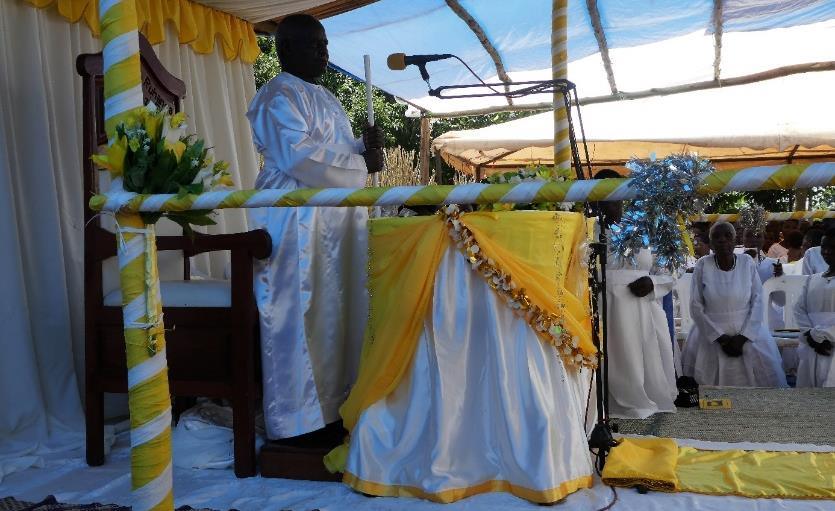
The historical photograph accompanying this essay comes from that study: Dosteo Bisaka at worship in Munteme, Hoima, on 19 September 2016. Ukah interprets the movement’s vestments and ceremonial staff in relation to Catholic forms and their reworking in a distinct religious project. This is his historical interpretation, not a claim that the photograph measures present membership or proves a single cause of religious change. [9]
Even familiar names need a history. Religious-studies researcher Alexander Paul Isiko’s 2019 article distinguishes the Balokole associated with the East African Revival of the 1930s and Anglican institutions from the wider use of ‘born again’ for Pentecostal-charismatic Christians. He discusses how people explain these distinctions in Uganda. His study concerns religious organisations and a proposed regulatory framework, using interviews and documentary material. That focus does not make it a population survey. Its useful contribution here is linguistic and historical: terms that overlap in conversation can refer to different institutional affiliations and religious experiences. [10]
Together, these sources support a more precise way of reading the November projections. The regional model describes possible population trajectories; the census and surveys document particular populations through particular questions; historical ethnography and religious-studies scholarship investigate practices and the meanings of names. None can simply replace the others. For Uganda, the value of bringing them together is that people remain visible as respondents, researchers, interpreters and makers of religious life. The result is a conditional account of population change that leaves room for histories and experiences a numerical category cannot contain. [3][7][10]
- [1]Pew Research Center. The Future of World Religions: Population Growth Projections, 2020–20702026-11-18
- [2]Pew Research Center. Methodology: Future of World Religions2026-11-18
- [3]Pew Research Center. The Future of Religion in Sub-Saharan Africa2026-11-18
- [4]Uganda Bureau of Statistics. National Population and Housing Census 2024: Final Report, Volume 1 (Main)2024-12; reference night 2024-05-09
- [5]Uganda Bureau of Statistics and ICF. Uganda Demographic and Health Survey 20162018-01; fieldwork 2016-06-20 to 2016-12-16
- [6]Afrobarometer / Hatchile Consult. Uganda Round 10 questionnaire (2024)Document revised 2024-04-08; resource page 2024-11-19
- [7]Afrobarometer / Hatchile Consult. Summary of Results: Round 10 Survey in Uganda, 20242025; fieldwork 2024-01-16 to 2024-02-01
- [8]Pew Forum on Religion & Public Life. Tolerance and Tension: Islam and Christianity in Sub-Saharan Africa2010-04; Uganda fieldwork 2009-02-04 to 2009-02-12
- [9]Journal for the Study of Religion / Asonzeh Ukah. Everything is Plastic: The Faith of Unity Movement and the Making of a Post-Catholic Religion in Uganda2018; fieldwork 2016–2017
- [10]Journal of African Studies and Development / Alexander Paul Isiko. State regulation of religion in Uganda: Fears and dilemmas of born-again churches2019-10-31
- [11]Pew Research Center. Appendix A: Sources — Future of World Religions2026-11-18
Did this publication help you understand the topic?
0 voluntary responses. Browser-based participation; responses are not a representative survey.
We welcome suggestions, contributions and recommendations.
Editorial standards ↗