Caring for objects and interpreting their histories are practical questions for the museum professionals gathering in Harare on 20–22 November 2026. Hosted by the National Gallery of Zimbabwe, the CIMAM conference places African institutional knowledge and culturally diverse approaches to museum work within its programme. A small carved wooden headrest offers a concrete way into that discussion. Following its material description, attribution and interpretation reveals several kinds of knowledge a museum can preserve—and the different evidence each requires. The question concerns how an object becomes understandable to people encountering it today. [1]
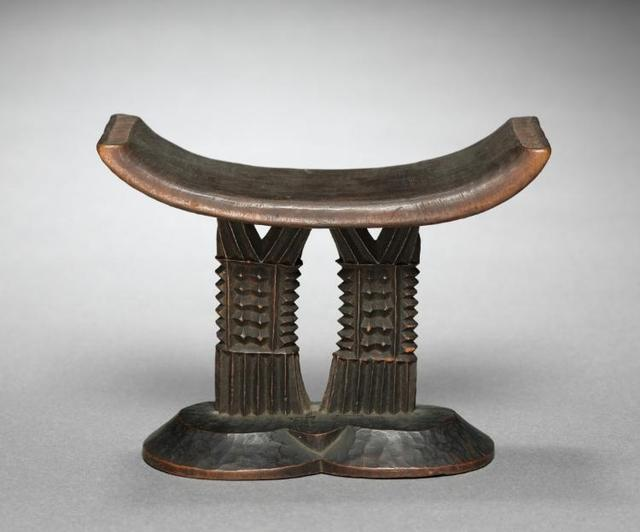
The Cleveland Museum of Art dates headrest 1921.1548 to around 1910, attributing it to a Shona-style blacksmith-carver in Zimbabwe or Mozambique. Its description identifies a curved upper support, carved uprights and a base. Tool marks remain, while areas expected to touch the skin were smoothed. These particulars make skilled work visible through decisions about surfaces. The individual maker and precise place remain unresolved. [2]
Cleveland connects darkening of the upper surface to contact with hair and hairdressing products. It explains headrests as supports under the neck or chin that protected elaborate braids: a carved surface designed for a body and altered through contact. Its account also discusses heirlooms and burial goods as wider contexts. Those associations do not provide a personal biography for this headrest, whose individual owner is unnamed. [2]
The Metropolitan Museum’s account of another headrest,2001.759.4, shows how much more specific a formal description can become. Attributed to a Shona artist and dated to the 19th–20th century, it has two vertical supports, a rectangular upper platform and a lower platform formed from adjoining circular shapes. The museum associates this rectilinear arrangement with northeastern Zimbabwe and adjoining parts of Mozambique. This is a regional attribution based on a pattern of features; its usefulness depends on describing those features closely enough for a reader to understand the comparison. [3]
The same record describes the work as carved from one piece of wood, with a polished-looking surface interpreted as the result of frequent use. Reading the supports, platform and spaces together brings out the carver’s work of balancing a small structure. An attribution such as “Shona artist” can therefore introduce the object, but the detailed description contributes something the broad name alone cannot: an account of a particular solution to making a usable support. Even within the museum’s regional classification, the shape needs explanation rather than being left to stand as a cultural emblem. [3]
Meaning introduces a different evidential problem. For headrest 2001.759.2, the Met describes an eastern Zimbabwean style through carved lozenges, V-shaped supports, circles and other incised motifs. It suggests that some circles may evoke ndoro, shell ornaments associated with prestige, political and religious leadership and spirit mediums. The language of possibility matters. A resemblance between a carved circle and an ornament can support an interpretation, while leaving open how a particular maker or user understood the design. The record itself says that meanings have been debated by scholars. [4]
That record also presents an interpretation connecting incised decoration with female scarification, noting the reported use of nyora for both. It places this alongside aesthetic explanations and acknowledges difficulty in recovering specialised knowledge. These are attributed curatorial interpretations, including a reported linguistic connection, rather than a demonstrated translation of every mark on every headrest. Their coexistence is valuable: readers can encounter the object as a designed thing, a possible bearer of social meanings and a subject of continuing interpretation. Choosing one explanation as a universal key would lose the qualifications already present in the account. [4]
Anitra Nettleton’s account of her research offers a way to understand why such qualifications are productive. In the preface to her 2007 book African Dream Machines, the University of the Witwatersrand art historian describes work with southern African woodcarving. Research in European collections in 1975–76 was followed by further work in 1990–91, using notes, photographs, sketches and available museum registers. The account connects looking at forms to asking how objects entered collections. Each record can contribute information, while access to registers affects which histories can be reconstructed. [5]
Drawing became part of that method. Nettleton explains that restrictions on photography initially prompted some drawings, and that drawing subsequently helped her present information unavailable in a conventional single frontal photograph. The act of representing a shape could also serve its analysis. It nevertheless clarifies an important relationship: knowledge of an object develops through sustained attention, different views and documentary work. A catalogue image is one contribution to that process, whose possibilities depend partly on the information accompanying it. [5]
In 2013, Zimbabwean curator Esther Chipashu posed a related question. Her published conference abstract, drawing on her curatorial work at the Zimbabwe Museum of Human Sciences, proposed examining how colonial collecting had shaped categories for objects from different cultural backgrounds. She argued for attention to the social and genealogical processes through which things were made, and for communities to participate as equal contributors to collecting and exhibitions. This was an argument set out in an abstract for a planned paper; it should be read as an intervention, rather than a report of completed reform. [6]
Headrests were among the objects Chipashu named, alongside cooking pots, musical instruments, mats and weapons. Collecting can retain an object’s material presence while leaving work, relationships and changing uses poorly explained. Her proposal placed the production of knowledge within relationships between museums and communities, extending the task beyond expert classification. It also locates this discussion in a Zimbabwean practitioner’s earlier work. The questions entering the present Harare programme have histories within Zimbabwean museum practice, rather than arriving there for the first time with an international gathering. [6]
Comparison across collections can expose another difficulty: how a cultural attribution was established. In a 2020 catalogue essay, William Joseph Dewey discusses a 20th-century headrest attributed to Bari people of South Sudan. It combines two supporting columns with strips of monitor-lizard skin, forming a container. Similar objects had received different geographical descriptions in earlier collections. Dewey explains how information from the Museum of Mankind’s collections, communicated to him in 1992, informed the Bari attribution. Here the catalogue makes part of the route towards a name visible, rather than presenting the name without a history. [7]
Dewey also leaves a question unresolved. He reports a proposed use of the compartment for valuables or tobacco, while noting limited documentation, and does not explain conclusively why the particular binding material was used. This example concerns a different object and community from the Zimbabwean cases. Its relevance lies in attribution: comparison, older collecting records and a named scholarly communication support a judgement with stated limits. An object’s shape can invite questions about handling and use, but the catalogue’s candour about missing documentation helps readers distinguish an interpretation from a securely recorded practice. [7]
Even a description of function can encompass several relationships. The Met’s headrest 2001.759.1 is attributed to a Tsonga or Shona artist and dated to the late 19th–early 20th century. Its catalogue connects support during sleep and protection of hairstyles with an intimate relationship between a person and an object. It also discusses burial with an owner and communication with ancestors as broader contexts. These associations show why placing the work in a furniture category does not exhaust its possible significance. They remain the museum’s account of practices, rather than testimony from this object’s unidentified owner. [8]
The double attribution is itself informative. It preserves a boundary of present knowledge while recognising regional artistic relationships. The catalogue describes variation in the carved supports and credits Shona and neighbouring Tsonga sculptors with diverse formal solutions. Reading that variation alongside the unresolved attribution gives makers room to appear as people making choices. It avoids requiring one object to illustrate a single, perfectly bounded style. It also discourages applying an interpretation recorded for one setting automatically to an object whose precise maker, place and personal history remain uncertain. [8]
Digital access changes how readers can engage with such records. Cleveland makes images of designated public-domain works and collection metadata available through its open-access initiative under a CC 0 designation. Its published policy permits reuse and explains the difference between open images and restricted material. Thus an object can be studied beyond the gallery through an image and identifiable record. The policy concerns access to museum material; interpreting a maker’s decisions or former owner’s experience requires further evidence. [9]
The museum also describes collection data as material refreshed through its public systems. Retaining an accession number, approximate date and qualified attribution allows a reader to locate the object again, rather than encounter an untraceable image labelled “African art”. Digital circulation can carry the particularity of a work as well as its appearance. In that respect, access becomes more useful when the historical and descriptive information travels with the image and remains open to further examination. [9]
The National Gallery of Zimbabwe’s programme gives this documentary work a present setting. Chipashu is scheduled to contribute as a chronist on 21 November, offering an interpretive account of the day’s discussions. These are planned encounters and roles, not evidence of what participants have already concluded. They place local curatorial work within the gathering, while leaving the substance of the discussions and their subsequent effects to be documented as they occur. [1]
CIMAM’s conference abstract describes repair as situated and sometimes incomplete. Its programme connects museum practice to care, knowledge and relationships, and includes African and diaspora practitioners among those shaping the discussion. The historical records considered here make those broad terms concrete. Care can involve describing how a surface met a body, retaining the uncertainty in a regional attribution, or making the path towards an interpretation intelligible. These are different operations, each contributing to an account in which a carved object retains more of its particularity. [10]
Harare’s current museum conversation can be read alongside this longer work of looking, recording and interpreting. The headrests and published accounts offer no single formula for repair. They do show how makers’ work, histories of use and the methods of researchers and curators can remain visible together, with uncertainty attached to the claims it qualifies. That is a substantive way to approach the conference’s question of care: through the knowledge preserved and the relationships a museum account makes possible. [10]
- [1]National Gallery of Zimbabwe. CIMAM Annual Conference 2026, Harare: programme and host account20–22 November 2026 programme; undated page accessed 2026-11-20
- [2]Cleveland Museum of Art. Headrest, accession 1921.1548Object c.1910; undated catalogue accessed 2026-11-20
- [3]Metropolitan Museum of Art. Headrest, Shona artist, accession 2001.759.4Object 19th–20th century; undated catalogue accessed 2026-11-20
- [4]Metropolitan Museum of Art. Headrest, Shona artist, accession 2001.759.2Object late 19th–mid 20th century; undated catalogue accessed 2026-11-20
- [5]Anitra Nettleton / Wits University Press. African Dream Machines: Style, Identity and Meaning of African Headrests — Preface, pp.vii–viii2007 print publication; online 2019-05-18; preface text accessed 2026-11-20
- [6]Esther Chipashu / ICOM International Committee for Museums of Ethnography. Collecting for the colonial gaze: invoking a paradigm shift into the ways in which ethnographic collections are constituted in Zimbabwean Museums — conference abstract, p.11ICME meeting 10–17 August 2013; presentation scheduled 14 August
- [7]William Joseph Dewey / Palmer Museum of Art and Penn State University Libraries. African Brilliance: Catalogue 59 — Bari headrest, accession 2016.1732020 catalogue; object 20th century; accessed 2026-11-20
- [8]Metropolitan Museum of Art. Headrest, Tsonga or Shona artist, accession 2001.759.1Object late 19th–early 20th century; undated catalogue accessed 2026-11-20
- [9]Cleveland Museum of Art. Open Access: policy and collection documentationUndated; accessed 2026-11-20
- [10]CIMAM. Museums Beyond Limits: Imagining Repair Across Cultures, Ecologies and Knowledges — conference abstract and programme20–22 November 2026 programme; undated page accessed 2026-11-20
Did this publication help you understand the topic?
0 voluntary responses. Browser-based participation; responses are not a representative survey.
We welcome suggestions, contributions and recommendations.
Editorial standards ↗