Dakar’s Musée Théodore Monod d’Art africain dated the start of its exhibition Sport, Mémoire & Société to 4 November 2026. Wrestling is one of four sports it presents through archives, first-person accounts and contemporary art. A contest lasts minutes; learning to wrestle, earning a place on a bill and building a following can take years. Research conducted in Dakar and its suburbs makes those years visible, while older records show how wrestling moved between training grounds, city venues and the screen. Together they explain how athletes and the people around them made a sport that Dakar now puts on display. [1][2][3][4][5]
The museum’s title puts sand next to concrete, two surfaces that point to different ways of knowing a sport. On a training ground, a wrestler learns to read another person’s balance and movement. The stadium draws a line between the contest and the audience. The museum makes a further change: people can stop over a photograph or compare recollections rather than follow a bout to its outcome. Senegalese wrestling is one strand in a show that also includes football, basketball and athletics. Its history offers a particularly clear example of what changes when a practice moves from one setting to another. [1][3][4][7]
One relocation took place in a Dakar cinema. In his study of the city from 1914 to 1960, Djibril Seck traces a ticketed wrestling show in 1927 to the Rialto, where the cinema operator Maurice Jacquin installed a ring. The sale of admission changed who was paying for what: practising wrestling and buying a place to watch it became distinct activities within the same event. This was one episode in a longer history of wrestling in Senegal. It helps explain how the commercial spectacle developed in Dakar, without supplying an origin story for the practice itself. [2]
Seck draws on official papers, newspapers including Paris-Dakar, and oral material to explain a tension that the cinema alone could not show. Colonial administrators saw physical training as useful to their purposes and authorised some paid displays. People gathering around wrestling also used it to express attachments to places and communities and to give public value to forms of manhood under colonial rule. These are Seck’s historical interpretations, supported by evidence of different sorts: a permit documents authorisation, while what a gathering meant to participants takes other evidence to recover. Putting them together explains how an event could serve purposes its organisers did not share. [2]
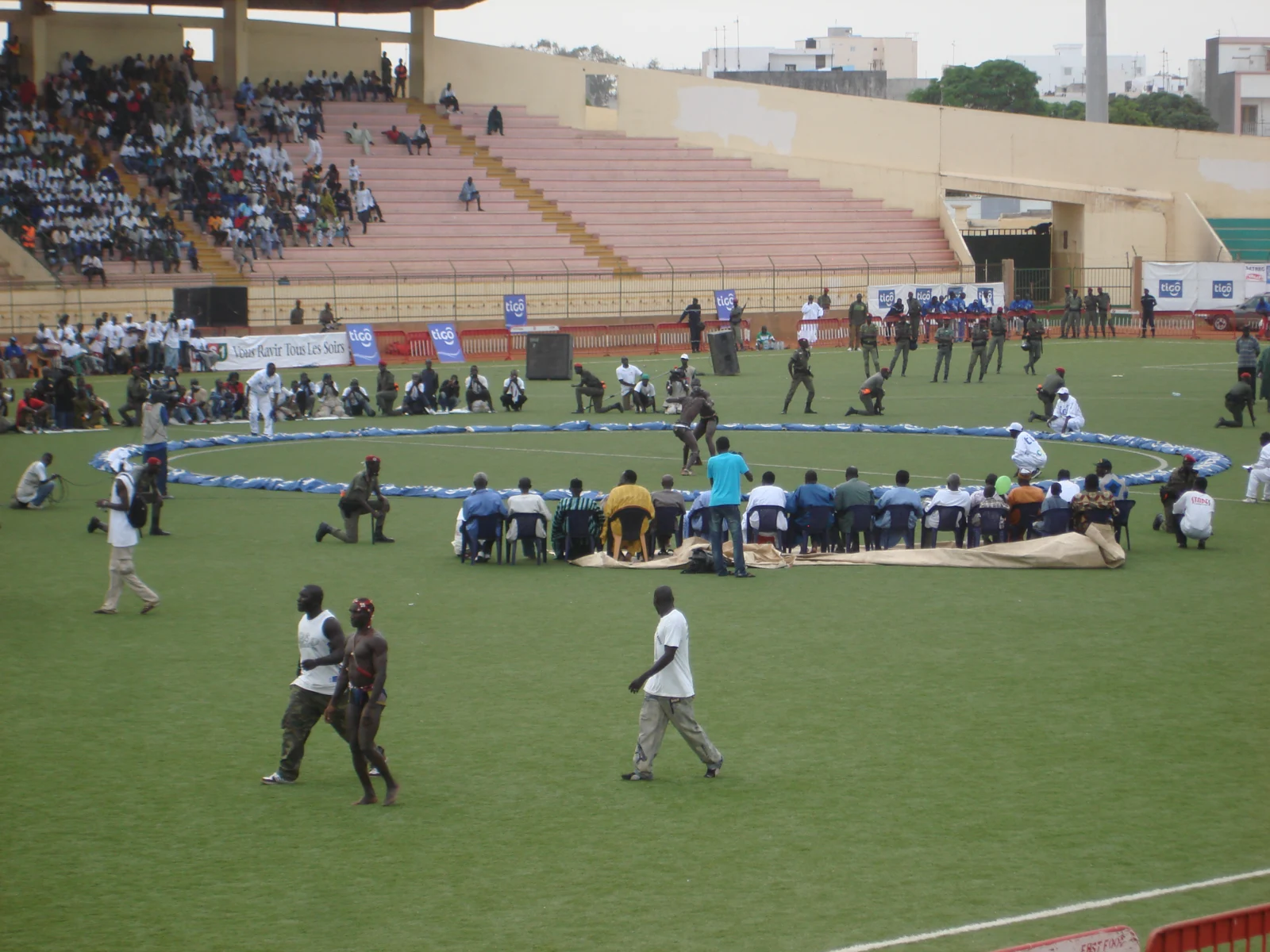
The stadium in KaBa’s photograph, made at Demba Diop in July 2007, shows another arrangement. A boundary marked out on the field encircles the wrestlers. Spectators sit at different distances from the contest; photographers and other people at field level stand or kneel around it. Advertisements run along the barrier behind them. The frame records how much space and work a public bout can involve. It cannot tell us which hold decided the match, what the spectators heard, or what the two athletes earned. Those details require different records. [3][4][7]
The kind of wrestling matters. In the study Cheikh Tidiane Wane and Dominique Chevé published in 2022, the focus is the highly publicised form that allows striking. They distinguish it from contests without striking and describe variations in rules and preparation across communities. The label ‘Senegalese wrestling’ can therefore refer in one context to a particular professional spectacle and in another to a wider family of practices. Treating every image of wrestling as a record of the same rules would erase the very differences that the researchers explain. [3][4]
Wane and Chevé watched wrestlers train at sites including the beaches of Yoff and Parcelles Assainies, observed contests at Dakar stadiums, and interviewed 30 athletes in differing circumstances. Moving between training and competition lets them examine parts of a wrestler’s working life that fall outside the public fight. In one account, a future champion learned by following older neighbourhood wrestlers onto a sandy training ground. He continued selling fish alongside wrestling until bout payments made full-time training possible for him. The order matters: an income outside sport helped sustain his entry into it. One career shows how that could happen; it does not say how often it happens. [4]
Family connections mattered in some accounts, but the practical ways they mattered are more useful than the idea that a gift simply runs in families. One athlete described childhood bouts organised by his father, then years in smaller competitions before his debut in the arena. In this account, inheritance meant access to repeated practice, people to learn from and a place to begin. A training group could offer a related form of belonging. Wane and Chevé describe athletes identifying with particular neighbourhoods and suburbs, an association supporters helped make public. That attachment can shape the meaning of a match for people who never enter the ring. [4]
The careers in the study also make a useful distinction between a large purse and a reliable living. A payment may be attached to one scheduled fight; it says little about the wait for the next one. The researchers describe competitors covering expenses for preparation while bouts were irregular, and show how work outside the arena could coexist with an athletic career. Their interview group gives those arrangements a human scale. It cannot supply a current estimate of the odds of making a living from wrestling, and the circumstances observed for the study should not be treated as a pay survey for Dakar in 2026. [4]
Mamadou Tine’s 2009–10 study at Université Cheikh Anta Diop adds something the stadium photograph cannot preserve: what people said, sang and heard. Tine used interviews and both in-person and recorded observation of contests. He paid attention to announcers, singers, griots, religious specialists and supporters, whose speech, music and actions made the event intelligible to people around it. In that account, spectators could encounter a challenge and learn how it was received through voices around the arena as well as through the movements of the athletes. The people who made a bout memorable did not all compete in it. [3][7]
Film gives that work a different record. Paulin Soumanou Vieyra made the documentary Lamb in 1963, three years after Senegal’s independence. The film’s restoration catalogue describes seaside training, rules and spectators at a Dakar arena; the Bibliothèque nationale de France identifies Senegal’s Ministry of Information in the production record. The two records make it possible to date the film and distinguish the scenes the catalogue describes from the settings other researchers studied decades later. They also put a filmmaker in the history of the sport: how a public elsewhere could learn about Senegalese wrestling depended in part on what Vieyra chose to record and what institutions subsequently preserved. [2][5][6]
The sources make different kinds of comparisons possible. A photograph can show the gap between the athletes and the stands, but has no sound. A film can convey sequences of training and contest, although its running time and editing determine what fits. Interviews can bring into view a long wait for a match or the work that pays for training. The museum’s combination of testimony, archives and contemporary art gives visitors a way to encounter these kinds of material together. Its programme says little about how visitors responded, and neither the 2007 photograph nor the historical film catalogue establishes what was actually displayed in a particular gallery. [1][3][4][5][7]
The Monod exhibition’s sporting memory is easiest to grasp if we follow a bout outwards: to the places where people learn, to the side jobs that can keep training possible, to the voices that carry a match beyond its final hold. Follow it across time and the crowd comes into focus too: buying a seat in a cinema in 1927, gathering around a stadium circle in 2007, or, this November, being invited to spend time with records in a Dakar museum. Each setting lets people notice a different part of what the athletes and their communities have made. [1][2][3][4][7]
- [1]Musée Théodore Monod d’Art africain (IFAN Cheikh Anta Diop). Sport, Mémoire & Société : Entre Sable et Béton, Terres de Champion.ne.sProgramme from 2026-11-04; consulted 2026-11-14
- [2]Liens Nouvelle Série, FASTEF, Université Cheikh Anta Diop. Djibril Seck, Ordre colonial, identité et masculinité. La lutte à Dakar, 1914–19602015-07
- [3]INSEPS, Université Cheikh Anta Diop (IRD archive). Mamadou Tine, L’arène de lutte comme lieu socio-culturel à Dakar : rites-rituels et pratiques de la tradition à la modernité2009–2010 academic year
- [4]Staps, De Boeck Supérieur. Cheikh Tidiane Wane and Dominique Chevé, Bare-knuckle fights, uncertain success: Why are young people getting involved in Senegalese wrestling?2022, no. 136
- [5]PSV-Films. LAMB (nouvelle version restaurée)Undated catalogue page, consulted 2026-11-14; film 1963
- [6]Bibliothèque nationale de France. Lamb / Paulin Soumanou Vieyra, réal. (notice bibliographique)Digital edition deposited 2016; catalogue consulted 2026-11-14
- [7]KaBa, Wikimedia Commons. SenegaleseWrestling2.JPG2007-07 (capture)
Did this publication help you understand the topic?
0 voluntary responses. Browser-based participation; responses are not a representative survey.
We welcome suggestions, contributions and recommendations.
Editorial standards ↗