From 6 to 14 November 2026, Angola’s National Museum of Anthropology marked its fiftieth anniversary in Luanda with a programme devoted to its collections and research. A study published earlier this year offers a close look at what those collections can do: a mortar can start a lesson about impact, and an axe can lead students into questions about metals and wood. The point of taking science into the galleries is also to see the people already using that knowledge in their work. A useful lesson brings the two together and makes clear what a museum object can, and cannot, tell us. [1][2]
Take a wooden mortar and its pestle. In the article Manuel Cazo, Cristina Sá Valentim, Pedro Casaleiro and Sérgio Paulo Jorge Rodrigues published in May 2026, the mortar is an object for preparing food, with a hollow deep enough to contain what is being pounded. In use, the pestle delivers repeated blows; grains break into smaller pieces under the impact. That gives a teacher a way to introduce force and changes in particle size. It also provides a reason to ask why the vessel is shaped to stay upright and keep its contents together while someone works. Neither question requires assuming the museum’s particular specimen was used to process every food the authors mention. [2]
The mortar belongs to a history of work as well as a lesson in mechanics. The study reproduces a historical image of a Kwanyama woman using a mortar. In a classroom, that image and the object would answer different questions. The object lets students examine the design; the image locates the tool in a particular person’s activity. Neither alone explains how the worker judged when the material had been pounded enough, or how she learned the movement. Those are questions for documented accounts of use. A pupil who already knows a comparable tool at home might recognise a movement that somebody encountering it in a display case would miss. [2]
A second example is the kanjavite, an axe the researchers describe from the museum’s collection. They identify a wooden handle and a worked iron blade and, citing the museum’s exhibition catalogue, record its collection in Namibe in 2004 and an association with Helelo makers. The date is a date of collection, rather than a date of manufacture. The two materials direct attention to different parts of the work: a blade needs an edge that can concentrate a blow on a narrow surface; the handle gives the user a grip and distance from that edge. The shape invites an explanation of how the tool works, but the photograph and catalogue entry do not reveal the composition of the metal or exactly how it was heated and worked. [2]
Luanda’s museum opened its first exhibition in November 1976, a year after Angolan independence, according to the researchers’ account. They describe a permanent exhibition organised partly around activities, including farming, fishing, weaving and metalworking. That arrangement allows one tool to be read alongside related work. It also changes what a visitor might expect to find in a museum of anthropology. A visitor can approach ironwork as evidence of design and technical knowledge, just as a visitor to a science museum might approach a machine. The difference is that here the research keeps the maker’s community and the object’s use in view. [2][5]
The learning proposal moves between the display case and the classroom. Cazo and his colleagues suggest giving groups photographs of objects to sort and asking students to identify the kinds of knowledge each object might help them investigate. A single item can belong to more than one group: a tool can raise a question about geometry, another about materials, and another about the distribution of work. Comparing the reasons behind different classifications is part of the exercise. It gives students a chance to put an explanation into words and test it against what they can see or what the museum knows about the item. [2]
This is a plan for education, developed as part of research in progress. The authors describe a qualitative approach and aim to put the museum’s records and collection into dialogue with teaching. Their publication does not establish how much pupils learned from the proposed activities, or how a visit compares with another kind of lesson. A teacher trying such an exercise could ask students to explain an object before and after working with it, and look for changes in how they reason about materials and use. That would be a way of testing the educational idea, rather than taking the museum visit itself as evidence that learning happened. [2]
Making those lessons possible takes work on both sides of the display case. Angola’s 2023 statute assigns the museum’s museography department the job of maintaining object records, including when items are on display, in storage or in transit. It assigns education staff a different task: developing projects for particular audiences. A record may tell an educator what the museum actually knows about an object; the educator can then decide which questions students can answer from that evidence. The statute describes how that work is assigned. It does not show that all objects have equally detailed records or that any particular school has been able to visit. [3]
An older Angolan museum illustrates why the history of a record matters. In a separate study, Cristina Sá Valentim reads reports and other documents from a music collection organised through the Museu do Dundo under Portuguese colonial rule. The museum, established in 1936, belonged to a different undertaking from the independent Angolan museum that opened in Luanda in 1976. The collecting mission hired or relied on people who could carry equipment, interpret and help locate performers. Choosing what to record and how to classify it shaped the account that reached the catalogue; it did not erase the choices made by performers about what to sing. [2][6]
One example is a Cokwe song documented during a 1951–52 collecting campaign. Valentim follows it across the sound catalogue and later written records, where one explanation treated the song as commentary on hardship under Portuguese rule. She shows how the collectors could preserve a performance yet leave one of its meanings out of the accompanying account, then add it in a subsequent record. That is a practical lesson for reading any museum label: being able to trace a document to its source is essential, but even a carefully dated record tells the story from somewhere. In this case the differences between the records, not just the catalogue entry, help restore context to the performance. [6]
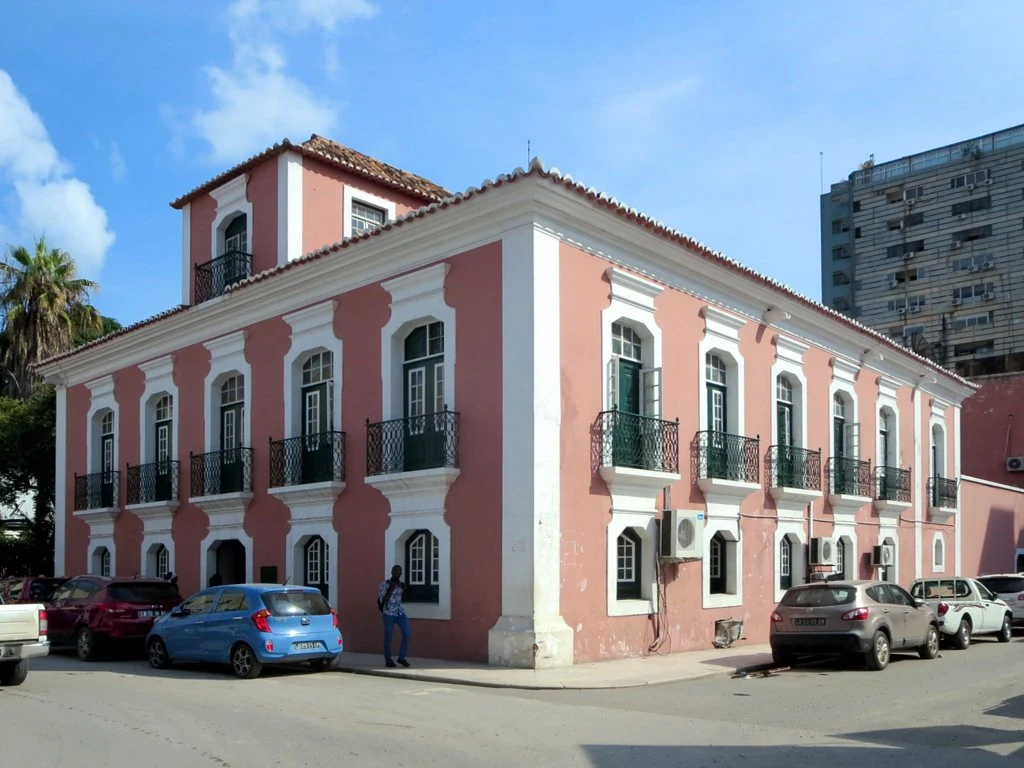
An archival photograph of the museum from April 2015 shows the building on a Luanda street corner. It fixes a place and a date, but it tells us nothing about the making or use of the things inside. Angola’s 2023 report on intangible cultural heritage makes a related distinction in practice. It lists museums that conserve and interpret objects, but also names universities and other groups working to document or pass on knowledge. One example it gives is research at Universidade Lueji A’Konde on sona, geometric drawing associated with Cokwe communities in eastern Angola. A report listing the work is evidence of what Angola documented at the time, not a measure of how widely the practice is taught. [4][5]
That distinction matters even when a museum has a strong record. A photograph of a drawing preserves its appearance. It need not preserve the sequence in which someone made it, the explanation that accompanied it or the occasions on which it was shared. Reading the museum’s educational proposal alongside the heritage report suggests two ways to teach from collections: explain what the object itself can show, then seek records of the practice that produced it. Where those records are thin, the gap belongs in the explanation. A shape or material can be described accurately without attributing a technique, purpose or identity that the source cannot establish. [2][3][4]
The November anniversary marked fifty years of keeping and showing things. The next question raised by the education proposal is what students can learn to do with the evidence: explain how a design works, notice when a date refers to collection rather than manufacture, and ask whose account of the object was preserved. Starting with ordinary tools can make scientific ideas easier to examine in the gallery. Taking the people who made and used the tools seriously also makes the science lesson more exact. [1][2][3][6]
- [1]Ministério da Cultura de Angola. Museu Nacional de Antropologia assinala 50 anos com jornadas culturais e científicas2026-11-10; programme 6–14 November
- [2]História da Ciência e Ensino: Construindo Interfaces, PUC-SP. Sobre o uso de artefactos históricos do Museu Nacional de Antropologia de Angola para educação e divulgação científicas2026-05-15
- [3]Ministério da Cultura e Turismo de Angola, Diário da República (text on LEX.AO). Decreto Executivo n.º 235/23 de 08 de novembro — Estatuto Orgânico do Museu Nacional de Antropologia2023-11-08
- [4]Republic of Angola, submitted to UNESCO. Angola: periodic report on the implementation of the 2003 Convention for the Safeguarding of the Intangible Cultural HeritageSigned 2023-12-10
- [5]David Stanley, Flickr. Museu Nacional de Antropologia2015-04-08 (capture)
- [6]Africana Studia, Centro de Estudos Africanos da Universidade do Porto. Cristina Sá Valentim, À procura da ‘autenticidade indígena’. Tradição, tradução e transformação nas recolhas etnomusicais do Museu do Dundo em Angola2015, no. 24
Did this publication help you understand the topic?
0 voluntary responses. Browser-based participation; responses are not a representative survey.
We welcome suggestions, contributions and recommendations.
Editorial standards ↗